

Wilder Lost Opetaia. Now the Fury–Joshua Undercard Needs a Real Fight.
GOATIFYThe biggest boxing fight of December has suddenly lost its most intriguing supporting act. Jai Opetaia's reported withdrawal from his December 11 heavyweight meeting with Deontay Wilder leaves the Fury–Joshua event in Cardiff searching for a replacement—and leaves the sport debating what kind of opponent would make the result mean something.
Richard Riakporhe has volunteered to step in, pointing to his readiness for twelve rounds. Derek Chisora, beaten by Wilder earlier this year, is another possibility. Neither has been announced as a signed replacement. The immediate task is to separate what is known from what remains an offer, a report or a promotional possibility.
For all the attention that Tyson Fury and Anthony Joshua will command, the co-feature matters. The original matchup carried a genuine sporting experiment. The next one must offer more than a recognizable pair of gloves and a date on a poster.
Opetaia's Exit Erases the Card's Boldest Boxing Experiment

A withdrawal is a familiar problem on a boxing card. This one carries unusual weight because Jai Opetaia was not supposed to be interchangeable undercard inventory. The undefeated Australian cruiserweight was the element that made a heavyweight evening built around familiar names feel genuinely curious. Against Deontay Wilder, Opetaia would have tested an elite southpaw's speed, precision and discipline at a higher weight against a former heavyweight champion who remains dangerous even when his overall performances are uneven.
The proposed contest was announced only earlier this month. On November 17, reports said Opetaia had withdrawn from the December 11 co-feature in Cardiff. An official replacement for Wilder had not been announced when those reports appeared. Accounts differ on the reason: some refer to a possible hand problem, while others explicitly say no cause was supplied. The sensible position is to treat the withdrawal as the reported development and the diagnosis as unconfirmed until Opetaia's team supplies a clear explanation. Speculation is not a medical bulletin.
That distinction matters for the wider story. If a training problem is ultimately confirmed, then a short-notice change was unavoidable. If the exit relates to a different concern, the lessons for matchmakers could be very different. Right now neither promoters nor fans should build an argument on a cause that has not been established across reliable reporting.
Opetaia was bringing an undefeated 31-0 record and 24 knockouts into a heavyweight debut. Wilder came with 45 wins, four defeats and a draw, and 43 knockouts. Those numbers advertised a sharp contrast, but the subtler intrigue was tactical. Could Opetaia control the lead hand, change angles after combinations and keep Wilder from planting for his straight right? Would Wilder's reach and natural heavyweight power force the cruiserweight to spend long stretches working at a cautious distance? Neither question has an answer now.
For Opetaia, the lost exposure is substantial: this was a globally visible supporting spot beneath Tyson Fury versus Anthony Joshua. Yet preserving his position at cruiserweight may also make career sense. A highly discussed possible meeting with David Benavidez next year remains a prospective storyline, not a finalized reward. A detour into a heavyweight danger fight could have transformed that trajectory, positively or negatively. His withdrawal postpones the experiment without resolving any of the strategic debates that made it fascinating.
GOATIFY
GOATIFY Boxing
The planned Wilder–Opetaia clash had knockout power and technical ambition. Explore GOATIFY Boxing designs for fans of the sweet science.


The card's first task is therefore not to pretend the original matchup can be replicated. The organizers need a different, honest selling point: a replacement opponent who can credibly compete, prepare safely and give Wilder a fight that belongs on this platform rather than merely filling a line on a schedule.
Riakporhe Has a Real Heavyweight Case, Not Just a Loud Callout

Richard Riakporhe did more than float an abstract ambition when the Wilder opening appeared. The British heavyweight champion publicly volunteered to face the American at less than four weeks' notice and said he was ready for the full twelve-round distance. That is a strong sales pitch in an industry where late substitutions often produce an eight-round compromise or a familiar opponent arriving mainly to survive.
The detail that separates his offer from pure social-media theatre is his 2026 heavyweight form. Riakporhe moved up after a cruiserweight career that included a defeat to Chris Billam-Smith, then rebuilt his position. In April he stopped Jeamie Tshikeva in the fifth round at Tottenham Hotspur Stadium to win the British heavyweight title. Reports of that contest describe how the long left hand disrupted Tshikeva's approach and set up more powerful right-handed work. Those are real ring observations, not merely promotional adjectives.
There is also an uncomfortable caveat. Domestic title success does not automatically mean Riakporhe is ready for every level of heavyweight competition. His three fights at the weight are useful evidence of an adaptation, not an extensive résumé against the division's elite. Wilder may be further from his championship peak, but the timing and power in his straight right remain the kind of danger that punishes a replacement who cannot impose his own pace.
On paper Riakporhe has a more credible physical basis for the job than a conventional smaller late substitute. His frame and reach allow him to work outside, and his heavy jab would give Wilder decisions to make before opening up. He could attack the body to interrupt Wilder's long-range rhythm, and he is less likely to be forced into an unnatural sprint merely because his opponent is big. The questions are whether he can read Wilder's right-hand setups quickly enough and whether he can sustain twelve-round concentration against a fighter with that level of knockout experience.
The short preparation window changes the answer. Getting ready for a generic heavyweight opponent is not the same as preparing for Wilder's right hand and unusual timing. The medical checks, sparring readiness, contracted weight and approved round limit all matter. No amount of confidence expressed online should substitute for a commission-cleared, genuinely prepared challenger.
Riakporhe has not said an agreement is signed. He said he wants the fight. As of the November 17 reports, his offer remained a proposal and the organizers had not named him as Wilder's opponent. That boundary is critical, especially with another contender already presenting himself. But judged on athletic logic and a fresh domestic championship, Riakporhe deserves consideration on his own merits. There is more substance here than the usual late notice name-drop.
Chisora Gives Wilder a Story. Does He Give Him the Right Fight?
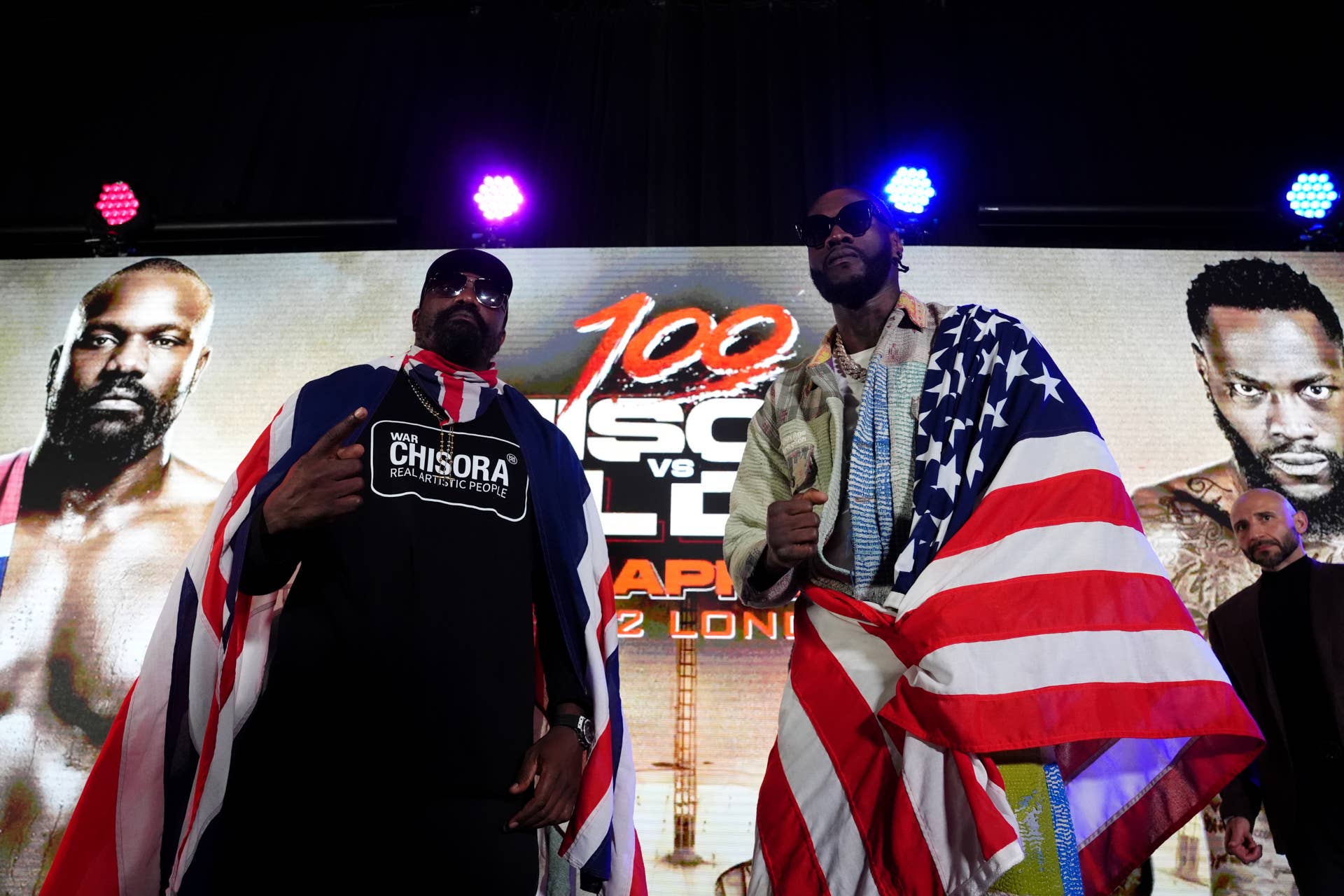
Derek Chisora offers something Riakporhe cannot: the audience knows exactly how he and Wilder look together in the ring. Their April 4 bout at London's O2 Arena was a demanding twelve-round fight that Wilder won by split decision. Chisora repeatedly made the contest ugly and physical, brought pressure, worked the body and refused to disappear when hurt. The scoring was close enough that another meeting would not need an elaborate explanation.
GOATIFY
GOATIFY Boxing
A late replacement must bring more than bravado. Find GOATIFY boxing shirts, hoodies and accessories as the heavyweight matchup takes shape.
That familiarity is precisely what makes the proposed rematch both attractive and limited. Chisora reportedly has been training for an undercard appearance, which may make him more feasible on compressed notice. He understands Wilder's power, distance and rhythm from direct experience. A new opponent must learn those things through footage and imitation in the gym. Chisora has already absorbed the hard lessons in real time.
But the commercial elevator pitch cannot end with familiarity. Wilder already beat him, and another twelve rounds of the same attritional patterns could feel like a rerun rather than an exciting replacement for an ambitious cruiserweight-versus-heavyweight clash. Fans buying into Fury-Joshua in Cardiff will recognize Chisora immediately. Whether they are eager to see him face Wilder again only months later is a different question.
The first fight showed both men's remaining strengths and weaknesses. Chisora can make opponents abandon clean technical work by crowding them and turning exchanges into wrestling-range problems. He is also willing to trade in pockets where other heavyweights become hesitant. Wilder still possesses the power to change the fight abruptly, but can be forced into long inactive stretches and uncomfortable defensive decisions. A rematch would likely revisit that clash of temperaments.
One could argue that the competitive case for a second bout is stronger than for some anonymous replacement opponents. It would carry the unresolved arguments from the April scorecards and give Chisora a direct chance to reverse a loss. On the other hand, there are career-wear considerations with two veteran heavyweights returning for another hard fight on relatively short notice. Preparation, medical clearance and the wishes of the boxers matter more than an easy nostalgia headline.
Riakporhe presents the opposite proposition. He has less name recognition globally but offers a fresh style, a current British championship and a plausible next-step opportunity. He could establish himself against a former world champion rather than revisiting an old result. The price is that no one has observed a full fight between them to know whether the stylistic promise translates into twelve compelling rounds.
There is no obviously perfect solution. If the organizers prioritize a known story that can be sold instantly, Chisora is a logical contender. If they prioritize novelty and a credible British challenger with upward momentum, Riakporhe may be the stronger choice. Both are possibilities at this stage, not confirmed contracts.
Fury–Joshua Can Sell the Main Event. The Undercard Still Has to Earn Its Place

The headline fight remains Tyson Fury against Anthony Joshua on December 11 at Cardiff's Principality Stadium. That name pairing is large enough to dominate publicity without a stacked undercard. Yet there is a difference between selling a historic main event and delivering a complete night that feels worthy of the setting and the global streaming audience.
Wilder-Opetaia helped bridge that gap. It offered a second conversation distinct from Fury and Joshua: could a technically polished undefeated cruiserweight succeed immediately against a historically explosive heavyweight? Even viewers skeptical of the matchmaking had a reason to tune in early. A replacement that exists only because a famous name must stay on the poster would be a weaker advertisement.
GOATIFY
GOATIFY Boxing
From Wilder's power to Chisora's pressure, boxing rewards every kind of courage. Browse GOATIFY Boxing fan gear.
The other announced bouts contribute to the challenge. The reported card includes Martin Bakole against Solomon Adebayo and Da'Mazion Vanhouter against Michael Essomba, but the lineup has also faced contract questions around Bakole. Those disputes should not be treated as evidence that a bout has definitely collapsed; they are reasons not to present a provisional undercard as immovable fact. Promoters have several moving parts to settle in a narrowing window.
That window makes the sequence of confirmations important. First, there needs to be a clear statement on whether Wilder remains definitely scheduled to fight. Second comes the opponent's identity, with signed agreements rather than social-media proposals. Third comes the contest's distance, weight arrangements, licensing and the planned broadcast slot. Finally the full card should be published in a format that viewers can trust, rather than assembled through a chain of rumors.
There is also a ranking question that transcends the business of a single event. What does a win over the chosen replacement actually prove for Wilder? Beating Riakporhe would offer evidence against an active British heavyweight titleholder and potentially rebuild some sporting credibility. Beating Chisora again would settle a rivalry more decisively but might leave the division asking what new territory Wilder had covered. Neither outcome is identical to beating Opetaia, whose cruiserweight success could have created a different kind of legacy argument.
For the challenger, the calculation cuts in the other direction. A hurried opportunity in front of a huge audience can transform a career, but the financial appeal should not drown out preparation and career timing. A legitimate contender deserves enough notice to be fit, medically cleared and tactically ready for a dangerous opponent. That is especially true for a twelve-round contest involving Wilder's one-punch power.
The best late adjustment would be transparent about its limitations and then focus on a compelling sporting reason to watch. Cardiff's fans do not need another invented title or a manufactured grudge. They need a real heavyweight fight with consequences, a properly prepared opponent and a promotional promise that survives the week before the weigh-in. The main event will generate curiosity regardless. The rest of the card can still choose to deserve it.
Opetaia's departure is a blow because it removes the undercard's most unusual test, not because the show has lost its only recognizable name. Wilder remains a major draw. Riakporhe has the current championship form and a public offer. Chisora has a close previous result and a story that viewers already know. None of those ingredients by itself makes a fight official or good.
The organizers' choice should answer two questions: can this challenger be fully ready for the bout, and will the contest produce a meaningful result rather than merely preserve the advertised slot? Until an opponent is contracted and confirmed, the debate is open. Fury–Joshua may be the attraction, but a credible Wilder fight is still an opportunity to improve the whole night.
The next announcement should be judged on details: a signed opponent, a safe preparation window, and a competitive reason to care. Neither a viral callout nor an exciting poster settles those questions. Fans should demand clarity rather than accept an announced possibility as a completed booking. That is the difference between rescuing a slot and genuinely salvaging an excellent heavyweight co-feature.
GOATIFY
GOATIFY Boxing
Discover GOATIFY Boxing tees, hoodies, caps, tanks and stickers for fight-night fans.


















