Pio Esposito's Double Stunned France. Italy Now Lead a Three-Team Race.
GOATIFYFrance had the early goal, the greater share of the ball and enough chances to put the game out of reach. Italy had Francesco Pio Esposito — and, crucially, a way back each time the evening threatened to turn against them. The Inter striker scored twice as the Azzurri beat France 3–1 at San Siro on November 12, 2026, ending a long wait for a home victory over their rivals and handing Zinedine Zidane his first loss in charge of Les Bleus.
This was anything but a straightforward home win. Gianluigi Donnarumma's error gifted Michael Olise an early lead, Bradley Barcola and Rayan Cherki hit the woodwork, and Sebastiano Esposito missed a second-half penalty. Italy nevertheless responded through Pio Esposito and Davide Frattesi before their younger striker converted another spot kick. The result leaves a three-team contest alive in Nations League Group A1 with one match remaining.
France got the first ten minutes. Italy found a route back on the left
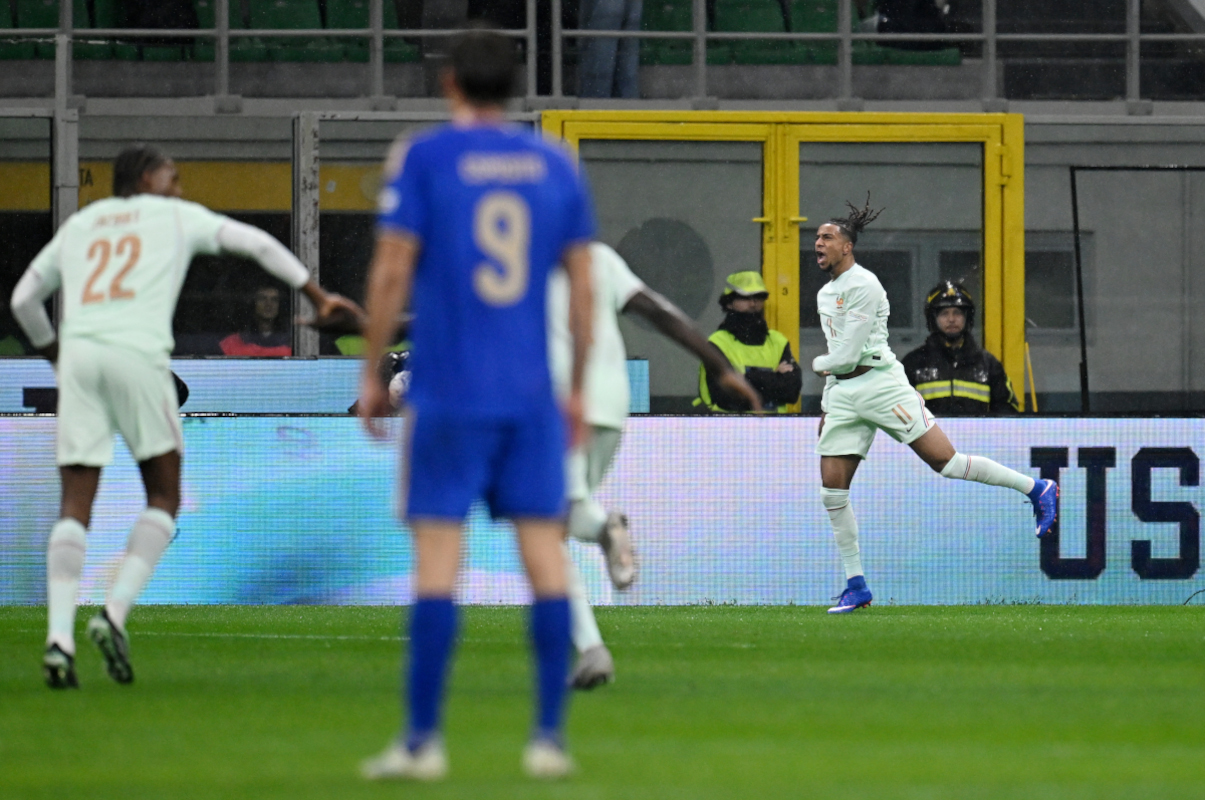
France did not look like a team that would lose by two goals when the match began. Zidane's visitors forced Italy to defend their box almost immediately, with Adrien Rabiot making a late arrival for a header that Donnarumma kept out with his boot. Lucas Da Cunha then went close from a half-volley. The movement was sharp, the passing aggressive and the Italians had little time to settle.
The tenth-minute breakthrough was as costly as it was avoidable. Donnarumma tried to build from the back but passed the ball into danger. Olise accepted the invitation, went past a defender and finished. For a goalkeeper used to imposing himself in high-pressure games, this was the kind of mistake that changes the emotional temperature of a packed stadium. France's lead was deserved on the balance of the opening phase, but Italy had effectively supplied the final pass.
That error also creates a distorted picture if viewed on its own. Donnarumma's evening included important saves after the giveaway, and France's chances were not limited to the mistake. He reacted to a Barcola effort, repelled a later Rabiot drive and eventually pushed Cherki's shot onto the post. Goalkeepers can simultaneously be responsible for a damaging moment and be essential to keeping the match alive.
France's personnel made the pace more notable. Kylian Mbappé and Ousmane Dembélé were absent, and Zidane was without several other recognizable options. Even so, the visitors generated danger from a combination of close-range pressure, attacking combinations and shots around the area. The two teams arrived with significant group stakes; France played like one intent on controlling the qualification picture rather than protecting a draw.
Italy's response arrived in the 26th minute and was built from the opposite end of the pitch. Frattesi helped carry a transition forward, Nicolo Cambiaghi reached the left byline, and his delivery was cut back into the space between the French defenders and goalkeeper. Pio Esposito applied a deft close-range touch with the outside of his foot. It looked simple at the finish, but the timing of the run made the move work.
GOATIFY
GOATIFY Soccer
Italy's response to the early France goal came through a perfectly timed run and a delivery from the left. Explore GOATIFY's Soccer collection while following the moments that turned this rivalry on its head.

Kylian Mbappe – World Cup Winner Crewneck Sweatshirt
A football fan design for everyday wear.
Shop Now ↗
Michael Olise – Nonchalant Football Pullover Hoodie
A football fan design for everyday wear.
Shop Now ↗

Kylian Mbappe France Euro 2024 Ninja Turtle Sticker
Add football personality to your favourite gear.
Shop Now ↗
Glazers Out Manchester United Fan Protest Mug
Add football personality to your coffee break.
Shop Now ↗
Kylian Mbappe France Euro 2024 Ninja Turtle Tank
A football fan design for everyday wear.
Shop Now ↗That equaliser mattered beyond the numbers on the scoreboard. Italy had barely found an attacking rhythm after conceding, yet the chance offered evidence that the French back line could be forced to turn and recover when the hosts reached the wide areas. Cambiaghi did not need a spectacular cross: a controlled pull-back was enough to put the striker in position to score.
For Pio Esposito, playing at a club stadium he knows from Inter made the occasion even more vivid. This was not an isolated cameo goal from a late substitute. He led the line from the start, scored Italy's first and would later be trusted with an even higher-pressure finish. His ability to separate himself for a close-range chance was every bit as valuable as his nerve after the break.
The first Italian goal changed the contest's feel but did not immediately establish home dominance. Sebastiano Esposito forced Mike Maignan into a save and Cherki attempted a shot from range, yet Barcola had the outstanding first-half opportunity to restore France's advantage. The winger curled a right-footed attempt toward the far side of the goal; the ball clipped the base of the post and stayed out.
Scalvini also had to intervene to stop Barcola from finishing a dangerous delivery across the area before the interval. France were repeatedly finding moments in which a small change of angle could have produced another goal. It is why treating the result as a routine dismantling of Zidane's team would miss what was happening on the field.
The opening half was therefore a useful summary of the entire match: France carried a higher volume of possession, Italy looked vulnerable during stretches of pressure, and one clean wide combination was enough for the hosts to change the score. Italy's subsequent win came not from removing all of France's threats, but from responding more decisively to its own.
At half-time there was nothing settled. Olise's strike had exposed Italy's uncertainty, Pio's equaliser had restored belief, and the width of a goalpost had separated France from going back in front. The decisive chapter would be written after the interval, when both Esposito brothers were suddenly placed at the centre of the match's biggest moments.
A missed penalty, then Frattesi: three minutes flipped the match
The restart brought no reduction in the game's intensity. Donnarumma had another awkward moment near his own goal line as he dealt with a ball close to going out of play, then had to summon a much better intervention when Cherki drove a shot toward the corner. The goalkeeper got a hand on it and the ball struck the post. With Barcola having hit the woodwork before the break, France now had two strong visual reminders of how narrow their margins were.
Italy answered with a chance of their own. Pio Esposito helped move the ball toward Cambiaghi, who lunged to reach it in front of Maignan; the French goalkeeper managed to block the effort. The exchange captured an increasingly open game. Neither side could assume the next goal would come from a patient spell of possession, because the next transition could produce a shot almost immediately.
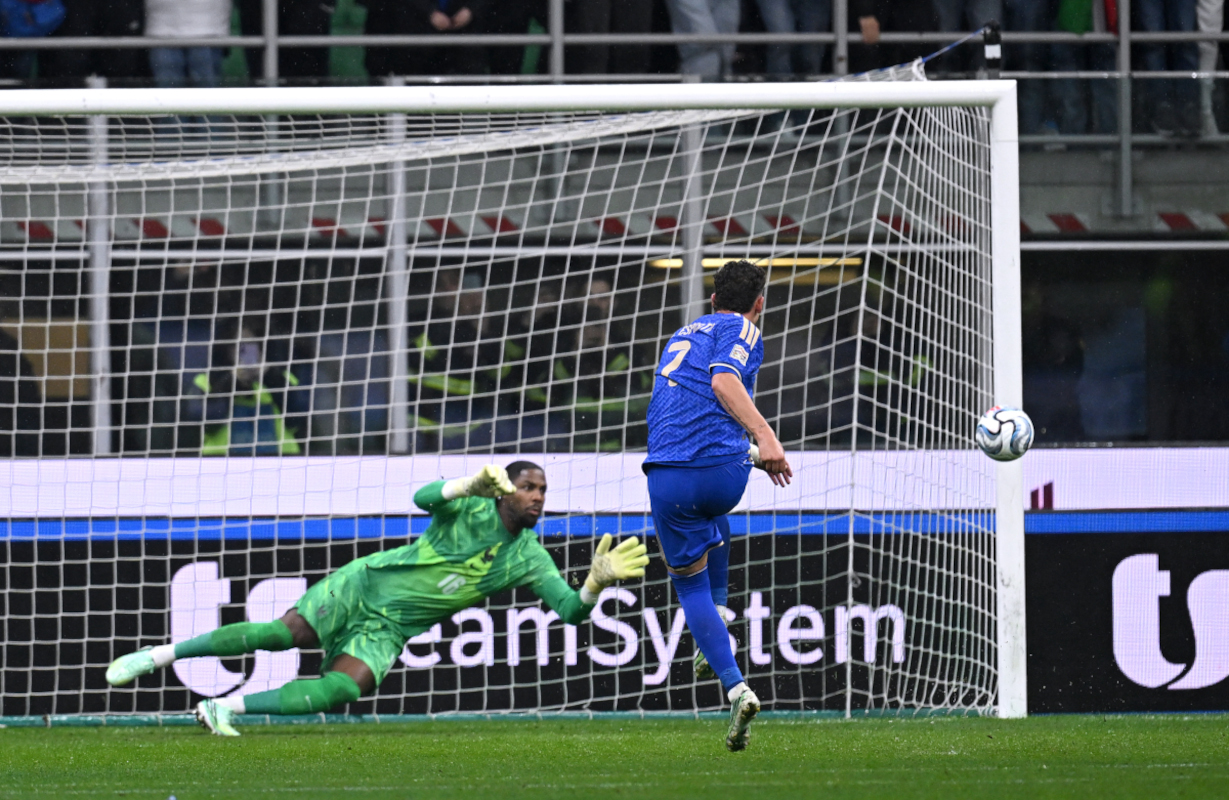
One of those breaks became the first major penalty incident. Cambiaghi surged forward and was brought down by Malo Gusto inside the area. Italy had earned a chance to turn a level match into a lead, and with the younger Esposito already on the score sheet the moment seemed made for the family story to grow.
GOATIFY
GOATIFY Soccer
From a missed penalty to Frattesi's immediate response, international football can change in three minutes. Browse GOATIFY soccer shirts, hoodies and stickers inspired by the game's biggest nights.

Kylian Mbappe – GOAT Soccer Crewneck Football Sweatshirt
A football fan design for everyday wear.
Shop Now ↗

Jude Bellingham – Future World Cup Champion Hoodie
A football fan design for everyday wear.
Shop Now ↗
Anal Arsenal Parody Football Decal London Fans Sticker
Add football personality to your favourite gear.
Shop Now ↗
Kylian Mbappe Purple Ninja Turtle Donatello Mug
Add football personality to your coffee break.
Shop Now ↗
Kylian Mbappe Ninja Turtles Real Madrid Soccer Hat
A football fan design for everyday wear.
Shop Now ↗Instead it was Sebastiano, the older brother, who prepared to take the penalty. His attempt flew wide in the 60th minute. There is no need to invent a dramatic goalkeeper save or a disputed refereeing call to explain its impact. Italy had an uncontested opportunity from the spot and failed to make the shot count. For a few moments, all the momentum of having won the foul threatened to evaporate.
Penalty misses can occupy disproportionate space in accounts of a game. At 1–1 against a team that had struck the woodwork twice, the miss carried obvious weight. The danger for Italy was that France might seize on the relief and turn one of its many attacking entries into a second goal. It was also a test of how Italy reacted as a team rather than of Sebastiano alone.
Three minutes later the response arrived. Nicolo Barella recovered possession, giving the Azzurri another opportunity to attack down the flank. Federico Dimarco had only recently come off the bench, but he provided the decisive left-sided ball into the box. Frattesi arrived centrally and met the cut-back first time, beating Maignan from close range for a 2–1 lead in the 63rd minute.
The timing made this goal especially important. Rather than spending a prolonged spell dwelling on the penalty miss, Italy returned to its most effective route to goal: reaching the side of the area and finding a runner arriving inside it. Pio's first-half equaliser and Frattesi's winner followed different sequences, but both were completed by a player attacking a well-delivered ball in front of goal.
Dimarco's involvement also illustrated the value of an intervention from the bench. His contribution was not an abstract tactical adjustment that could only be appreciated after the match. He supplied the ball for the finish almost immediately, turning possession regained by a teammate into a goal. Against a France side still threatening at the other end, that kind of efficient first contribution has disproportionate importance.
Frattesi, meanwhile, gave Italy an attacking presence from midfield rather than asking the forwards to shoulder the entire scoring burden. His arrival at the correct spot was the sort of run that defenders struggle to track when attention is concentrated on the ball and its delivery. It also rewarded the earlier work of the midfield in helping to launch Italy's first equaliser.
The missed penalty and the winning goal should not be treated as unrelated footnotes. Together they show how quickly the emotional balance changed. An apparent chance wasted in the 60th minute became a two-goal turnaround in the scoreboard narrative by the 63rd: the deficit had disappeared, the second goal had arrived, and France now had to chase.
For France, the immediate problem was straightforward. Creating opportunities and forcing goalkeeping interventions had not been enough. Italy had converted two moving-ball chances with close-range finishes, and France had not restored its initial advantage. Zidane still had time and attacking talent to respond, but the group leader position was slipping away.
GOATIFY
GOATIFY Soccer
Pio Esposito's brace leaves Italy, France and Belgium fighting for one group's final advantage. See GOATIFY Soccer designs for fans following the drama through to the last round.


Kylian Mbappe – El Dictator Football Decal Sticker
Add football personality to your favourite gear.
Shop Now ↗


The game remained open; it had not yet become a comfortable victory for the hosts. A single French response could have made the final minutes tense. Yet Italy were about to be offered another penalty, and this time the responsibility would fall to the brother who had already provided the team's first goal.
Pio Esposito finished it — but Group A1 remains a three-team fight
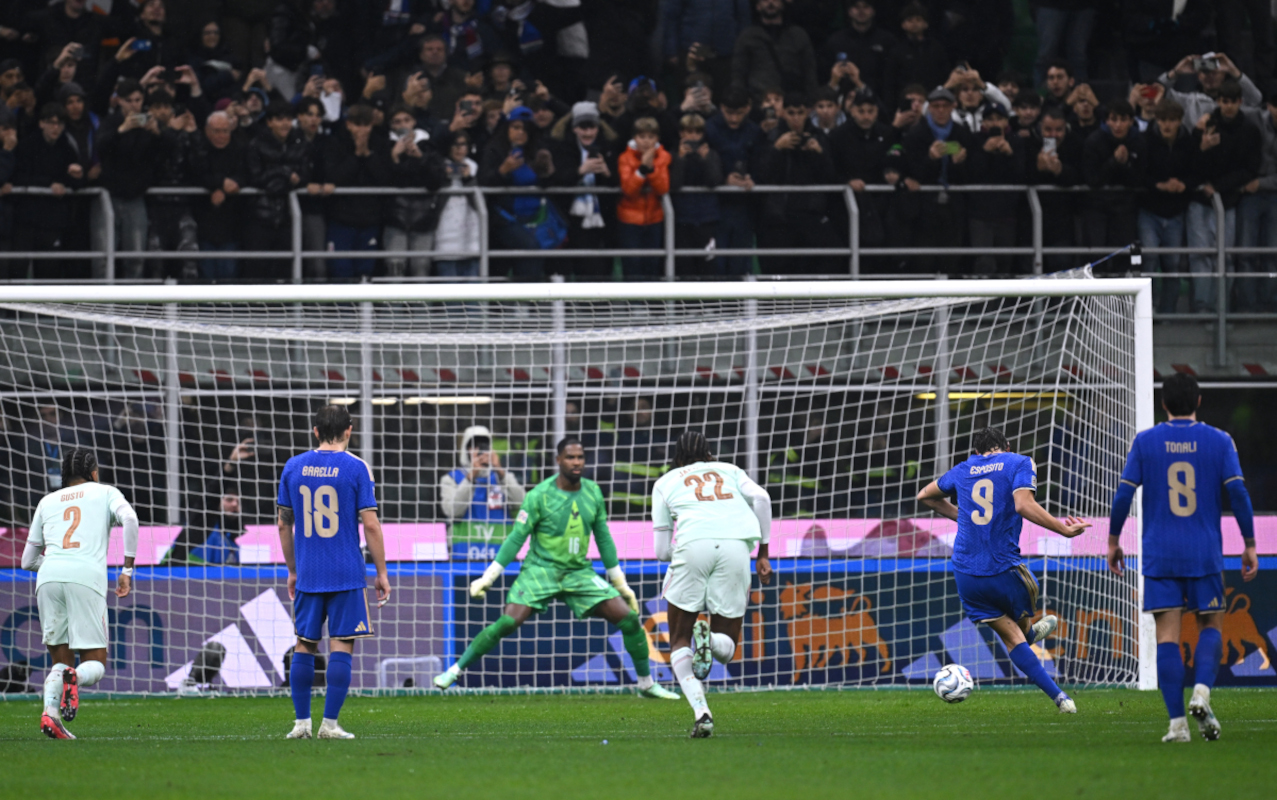
The opportunity to seal the match came from a French mistake rather than a long passing sequence. Antonio Vergara capitalised on Adrien Truffert's error, drove into danger and was fouled by Dayot Upamecano. The referee awarded Italy its second penalty of the night. With Sebastiano having missed the first, choosing the taker now carried an additional layer of tension.
Pio Esposito stepped forward and sent a low, firm shot into the corner in the 75th minute. He had restored parity in the first half; now he had converted the chance to put the result almost beyond France. A 3–1 score did not erase the chances Zidane's players had created, but it gave the home side the cushion that those chances had so far failed to produce.
The brothers' contrasting experiences could become the most memorable storyline from San Siro. Both started in Italy's attack. Both stood over a penalty within a quarter of an hour. Sebastiano's went wide; Pio's found the net. Yet the temptation to reduce the entire night to one brother succeeding where the other failed would be unfair to the work that created the opportunities, or to Sebastiano's involvement in Italy's attacking play before his substitution.
For the younger forward, the decisive spot kick also carried personal resonance after an earlier World Cup play-off penalty miss against Bosnia. That context mattered because penalty taking is rarely only a technical question once a player has been associated with a painful miss. This time, under pressure and with his brother's recent failure fresh in everyone's mind, he was precise.
It was a performance that highlighted more than finishing skill. Esposito was involved when Italy needed a focal point for quick attacks; he reacted to the pull-back for the first goal and then accepted responsibility from 12 yards. For a striker being measured by his ability to decide major international games, the combination is more persuasive than an isolated highlight reel.
France's late efforts included an Olise free kick that went over the bar. Dimarco also attempted an ambitious effort from near midfield that flew well off target. Those moments did not change the result, but they underscored the match's increasingly stretched shape after Italy had built a two-goal lead. The contest never resembled a slow, controlled possession exercise.
The implications are larger than a memorable home win. Italy entered the final phase of the group knowing that it needed points against direct competitors, and beating France did more than improve its goal tally. According to the post-match standings, Italy and France are level on ten points in Group A1, with Belgium a point behind on nine. Italy's head-to-head position places the Azzurri above France after this result.
Belgium's 2–1 win away to Turkey means the third challenger is not a theoretical possibility. Kevin De Bruyne and Charles De Ketelaere scored in Belgium's comeback, keeping them just a point behind the two leaders. A group that seemed capable of becoming an Italy-France duel is instead going into its last day with three live contenders.
GOATIFY
GOATIFY Soccer
Shop GOATIFY soccer and football shirts, hoodies and stickers.

Manchester United Ratcliffe Out, Glazers Out Sweatshirt
A football fan design for everyday wear.
Shop Now ↗
Bottlers FC Tottenham Hotspur Parody , Spursy Hoodie
A football fan design for everyday wear.
Shop Now ↗
Ousmane Dembélé – GOAT Comeback Decal Gift Sticker
Add football personality to your favourite gear.
Shop Now ↗


GLINEOS OUT Manchester United Fans Protest Mug
Add football personality to your coffee break.
Shop Now ↗The final fixtures make that clear. Belgium are scheduled to host Italy on Sunday, while France welcome Turkey. Italy therefore have a direct game against the third-place side, not an easy chance to simply protect a lead against a detached opponent. France's match may look more forgiving from the table, but Zidane will have to restore confidence after his first defeat as national-team head coach.
Goal difference, head-to-head results and the eventual outcome of those fixtures will all shape the final group calculation. It would be premature to declare Italy the automatic quarter-final winner or France eliminated on the basis of one result. What Thursday established is that Italy have moved into the strongest immediate position while leaving their fate to be settled on the pitch.
The historical note gives the achievement still more weight. Italy had not recorded a home victory over France since a friendly in May 1962, a gap stretching across generations of international football. Breaking that wait in a competitive game, and doing it from 1–0 behind, gives Mancini's team a result with a psychological value that a routine win against lower-ranked opposition could not have supplied.
Still, there is a sober lesson beneath the celebration. France produced 18 shots to Italy's 11, and each side registered five on target according to the match figures. Italy scored three times while France hit the woodwork twice. Effective finishing can win an important evening without proving that every tactical issue is solved, especially when the next opponent is itself fighting for the group.
Zidane's side can point to their spells of pressure, the chances created by Barcola and Cherki, and the absences of several senior figures. Those are legitimate explanations for why the result may not fully represent the gap between the squads. They are not substitutes for points, though, and first defeat or not, France have been punished for failing to turn promising positions into a second goal.
Italy leave San Siro with the headline star in Pio Esposito, the decisive supporting cast in Cambiaghi, Barella, Dimarco and Frattesi, and a major match won despite an early goalkeeping error and a missed penalty. The bigger test arrives next: whether the resilience demonstrated against France can carry into a closing-round contest in Belgium when every action may decide the group.
Italy's comeback gives Roberto Mancini's side the advantage in a group where the final matchday still matters enormously. The 3–1 score is clear; the path to it was not. France made Donnarumma work, twice struck the woodwork and threatened to control the contest before Italy converted the chances that arrived in the biggest moments.
Pio Esposito's two finishes will deservedly dominate the headlines, but Cambiaghi's delivery, Frattesi's movement and Dimarco's immediate impact provided the route back. Sebastiano's missed penalty could have tilted the evening the other way; instead, Italy responded within three minutes and finished stronger on the scoreboard. Now Belgium and France await the last group games, where Thursday's emotional high must become another performance.
GOATIFY
GOATIFY Soccer
Shop GOATIFY soccer and football shirts, hoodies and stickers.


Kylian Mbappe Orange Ninja Turtle Michelangelo Sweatshirt
A football fan design for everyday wear.
Shop Now ↗
Kylian Mbappe Blue Ninja Turtle Leonardo Sticker
Add football personality to your favourite gear.
Shop Now ↗
Ralf Rangnick "United Need Open Heart Surgery" Tee
A football fan design for everyday wear.
Shop Now ↗
Kylian Mbappe Ninja Turtles football/ soccer Mug
Add football personality to your coffee break.
Shop Now ↗