

Andreeva Dropped 11 Games. Pegula Saved Match Point. Now They Finally Meet.
GOATIFYThe WTA Finals have produced a particularly cruel semifinal contrast. Mirra Andreeva has barely allowed her opponents to get started. Jessica Pegula, meanwhile, needed to survive a match point just to remain in the tournament. On Saturday, November 14, the two will play each other for the first time on the WTA Tour, with a place in the Indian Wells championship match at stake.
Andreeva won all three group matches without losing a set and surrendered only 11 games across 47 played. Pegula absorbed an opening defeat, steadied herself and came through a long three-set duel against Linda Noskova in which her season was one point from ending. The form guide might point toward the teenager, but the knockout format offers no reward for winning previous matches by comfortable margins.
The other semifinal carries its own compelling reversal. Noskova topped her group despite losing a dramatic final round-robin match to Pegula. Elina Svitolina lost her opener and then beat Karolina Muchova and Aryna Sabalenka in three sets to qualify. The Czech brings a winning head-to-head record; the Ukrainian brings the experience of having already won this tournament.
Andreeva has made the entire draw play at her speed
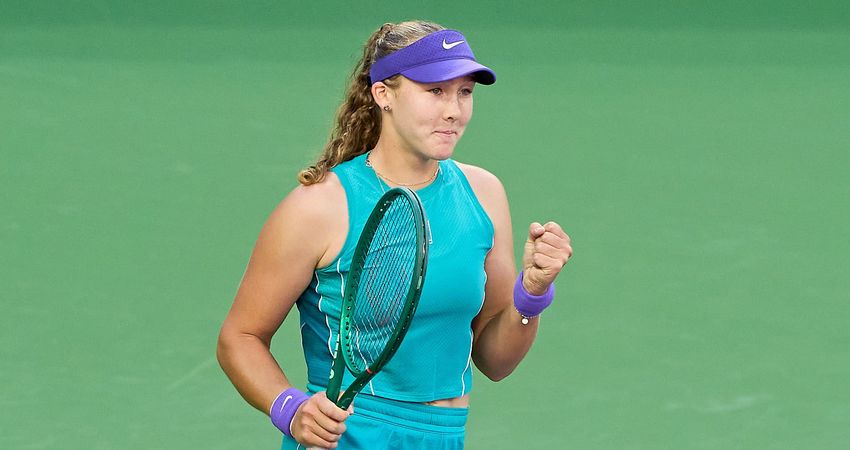
At 19, Andreeva has turned her first singles appearance at the year-end championships into a study in control. She beat Svitolina 6-4, 6-0 in her opener, then defeated second seed Sabalenka by the same score. When alternate Diana Shnaider replaced an ill Muchova in the final group round, Andreeva completed the sweep 6-2, 6-1. Across those three matches, her opponents won 11 games combined. Those results are not a projection about what she might become; they are the actual route she has taken to this semifinal.
The numbers need context. A 36-to-11 game advantage is a startling measure of separation against a season-ending field, yet it does not mean the contests were frictionless. Sabalenka led Andreeva 4-1 in their opening set before the match reversed so dramatically that the teenager captured 11 games in succession. From that deficit, she won the last 45 of 55 points, according to the tournament's match report. A player capable of escaping a bad spell is more dangerous than one whose reputation rests only on attractive scorelines.
The sequence against Sabalenka is especially instructive for Pegula. At 4-1 down, Andreeva did not wait passively for the match to change. She raised her serving intensity, won important return points and moved the baseline exchanges onto her terms. Her opponent's exceptional power could not prevent the momentum from shifting. The tactical implication is not that Andreeva will automatically repeat that burst; it is that even a strong opening against her may not be enough without continued precision.
The Russian also brought relevant Indian Wells experience into this week. She won the desert's major spring tournament in 2025, defeating Sabalenka in the final, and is now demonstrating that she can adapt to the different pressures of November. She has already secured a Roland Garros singles title in 2026. The larger pattern is a player accumulating evidence against elite opponents, rather than relying on a reputation built around age or potential.
Her rally construction explains why matches can get away from opponents so quickly. Andreeva can redirect pace without needing to attack every ball, defend a wide corner and then use an angle to force the next movement. When her depth holds, rivals have to strike progressively riskier shots to end rallies. That is a tactical interpretation of her results rather than a substitute for match statistics, but it helps explain why seemingly balanced games can turn into long runs of consecutive games won.
GOATIFY
GOATIFY Tennis
Explore GOATIFY tennis fan styles while Mirra Andreeva's dominant group-stage run challenges the remaining semifinalists.


Tennis GOAT Golden Racket & Ball Crewneck Sweatshirt
A tennis fan design for everyday wear.
Shop Now ↗

Against Pegula, control of the middle of the court will be decisive. If Andreeva can keep returns deep and send Pegula repeatedly into uncomfortable recovery positions, she can recreate the accumulation of pressure that marked the group stage. If her first delivery falls short, however, Pegula's ability to take a return early could make the first strike much more contested than it was against Shnaider. Andreeva's remarkable efficiency is a strength; it is not immunity from a different style of opposition.
There is also a psychological wrinkle in a first meeting. Each player has watched the other for years, yet they have not built a history of actually solving each other's patterns under match pressure. Andreeva said they had practiced together only twice. A familiar scouting report can describe backhand direction or preferred return positions, but it cannot fully reproduce how a first official meeting feels when a set reaches 5-5 or the crowd senses a change in momentum.
The group stage established who arrived with the cleanest record. The semifinal asks a harder question: how will Andreeva respond if she is denied the front-running position that has made her week look so straightforward? Pegula's objective should be to create that uncertainty early, rather than trying to win a sustained hitting contest on Andreeva's preferred terms.
Pegula survived match point and brings a different kind of pressure
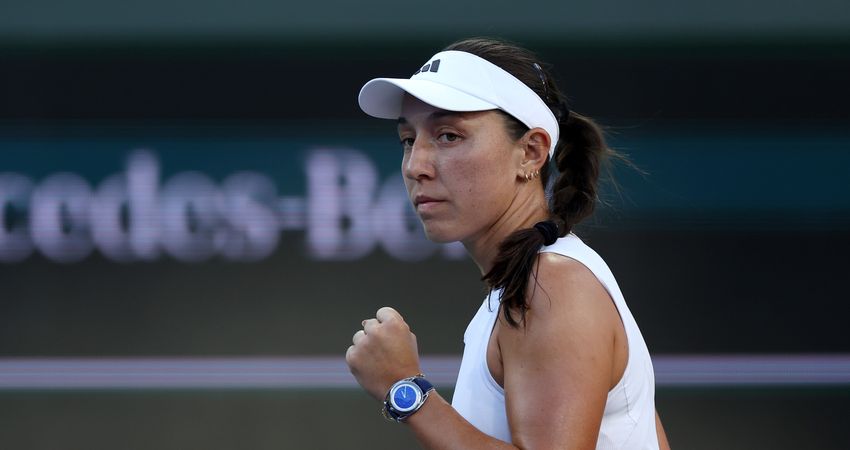
Pegula's route is almost the photographic negative of Andreeva's. She lost to Coco Gauff in three sets in her opening match, then recovered with a straight-sets victory against Marta Kostyuk. That left a tense finale against group leader Noskova. The American needed to win and to negotiate the round-robin tiebreakers; defeat would have brought her season to a close. She was pushed to the edge before producing the tournament's most striking escape.
Noskova had already made her presence felt by taking the second set, which guaranteed the Czech first place in Group 1, but she did not treat the match as exhibition tennis. She went 2-0 ahead in the decider and later served for a 5-4 lead. Pegula double-faulted to offer a match point while serving at 4-5. One more unsuccessful point would have changed the entire semifinal draw. Instead, Pegula survived the danger, held for 5-5, broke for 6-5 and finished the contest 7-6(2), 4-6, 7-5.
The escape took two hours and 45 minutes and required more than defensive grit. Pegula struck a career-high 16 aces, surpassing her previous best of 14, coincidentally also set against Noskova earlier in 2026. The serving tally matters because her game is sometimes described too narrowly as returning, timing and steadiness. This version of Pegula can win a short point with the first delivery and protect herself from the exhausting rallies Andreeva prefers to dictate.
The serve was not uniformly reliable, however. Pegula's first-serve percentage dropped from 61 percent in the opening set to 50 percent in the second, allowing Noskova more opportunities to attack the second ball. The lesson for the semifinal is precise: one big service performance cannot be assumed to repeat automatically. If the American must constantly defend vulnerable second serves against Andreeva, 16 aces from the previous round will offer no protection.
Pegula advanced as Group 1 runner-up with a 2-1 record, finishing ahead of Gauff in the tiebreak. She is appearing in a WTA Finals semifinal for the third time, following appearances in 2023 and 2025. Her experience does not give her a mechanical advantage against a 19-year-old, but it does supply a catalogue of high-pressure matches in which she has had to reset, alter a pattern and commit to the next point without obsessing over the score.
GOATIFY
GOATIFY Tennis
Browse GOATIFY tennis designs as Jessica Pegula prepares for a first-ever tour meeting with Mirra Andreeva.


Tennis GOAT Golden Racket & Ball Decal Sticker
Add tennis personality to your favourite gear.
Shop Now ↗The contrast between their weeks creates a fascinating energy question. Andreeva's matches have been short and clinical, while Pegula has spent far more time under pressure. More court time can leave heavy legs, especially in the second semifinal weekend of a long season, but it can also sharpen a player's sense of which risks must be taken to survive. The story is not simply fresh legs against tired legs. It is efficiency against tested resilience.
Pegula must use her early contact point as a weapon. Returning from near the baseline, she can deprive Andreeva of the time needed to construct the sharp angles that have undone group rivals. A controlled deep return through the middle, rather than chasing low-percentage corners, might sometimes be the better choice: it reduces the space Andreeva can exploit on the next ball. Once a neutral rally begins, Pegula's flat, accurate exchanges could keep the teenager from opening the court at will.
The danger is predictable play. Andreeva is unusually comfortable tracking balls across the baseline, so a steady stream of identical drives risks becoming the rhythm she wants. Pegula should vary return positions selectively, introduce higher trajectories when pulled wide and be willing to redirect down the line after establishing depth crosscourt. Those are prospective tactical choices, not claims about instructions from her coaching team. The question is whether she can execute them while protecting her second serve.
Most strikingly, the two have never met in a competitive WTA Tour singles match despite both occupying the top tier of the rankings. That makes any categorical prediction less convincing. Andreeva's overwhelming group statistics deserve respect; Pegula's latest comeback shows she can escape a match already tilting away. Whoever wins the first several return games will tell us more about this matchup than their results against entirely different opponents.
Noskova's first-strike power faces Svitolina's recovery game
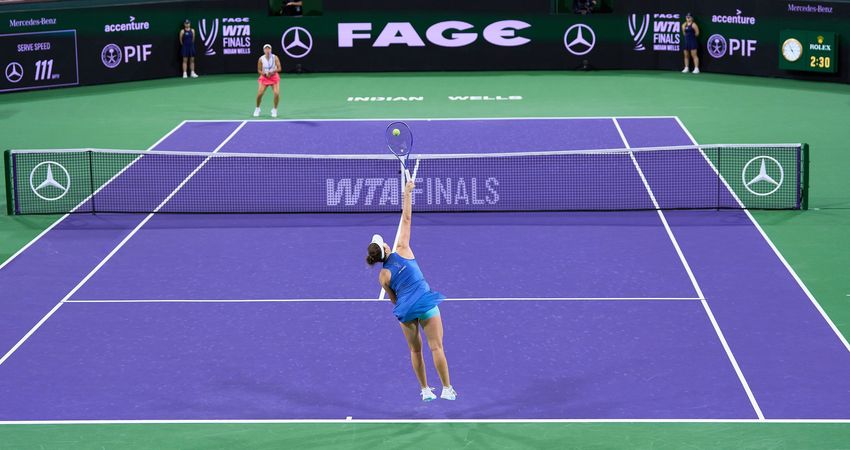
The second semifinal brings a different set of calculations. Linda Noskova won Group 1 by beating Kostyuk and Gauff in straight sets, then lost an extraordinary three-set contest against Pegula. Elina Svitolina followed the opposite sequence in Group 2: an emphatic defeat by Andreeva, then victories over Muchova and Sabalenka to emerge as runner-up. On Saturday they meet with neither player able to lean solely on the order in which those results arrived.
Noskova's group finish was already secure after she took the second set against Pegula. She nevertheless continued to take risks and came within a point of a third victory. In that defeat she struck 46 winners, compared with 35 for Pegula, according to the tournament's group review. The statistic underlines both the threat and the danger: Noskova can dominate with first-strike power, but high output does not remove the possibility of errors or late momentum swings.
Her serve is a central part of that equation. When Noskova lands the first ball and hits her next shot cleanly, she can shorten a point before Svitolina's movement and counterpunching have an opportunity to take over. The flip side emerged against Pegula, when the Czech committed 15 double faults. That is an unusually expensive way to surrender initiative, and one a disciplined returner like Svitolina will try to expose if the same pattern appears.
Svitolina's presence in the last four is a reminder that the competition rewards adaptation. She was comprehensively beaten by Andreeva at the start of the event and could easily have carried the disappointment into her next appearance. Instead, she came through the pressure of a three-set encounter with Muchova and then upset Sabalenka 6-3, 3-6, 6-1. She won the deciding set against the second seed by an overwhelming margin, precisely the kind of statement needed after a difficult group opener.
GOATIFY
GOATIFY Tennis
Shop GOATIFY tennis shirts and accessories while Noskova and Svitolina prepare for their WTA Finals semifinal rematch.


The Ukrainian is the sole remaining singles semifinalist who has previously won the WTA Finals, having taken the title in 2018. She reached another championship match in 2019. That historical experience should not be mistaken for an assurance of victory; it is relevant because she knows how the demands change after the round-robin portion. The decision to attack the right ball, rather than to attack every ball, often matters more than a player's reputation in a knockout match.
Noskova holds a 3-1 lead in their competitive head-to-head, including a significant meeting just two months ago. At the Billie Jean King Cup final in Shenzhen, she defeated Svitolina 6-3, 7-6(5) to help secure the trophy for Czechia. Svitolina did win their Stuttgart quarterfinal in April, which shows the series is not one-directional. Still, the hard-court record offers a stronger starting case for the Czech than a generic argument about a younger player being the favorite.
The court will reward the player who controls rally length without giving away cheap points. Noskova would prefer to move forward behind a strong serve or first groundstroke and keep the exchange short. Svitolina is more likely to build pressure by extending the rally, varying depth and returning enough balls to ask the Czech to make one more difficult shot. Both can attack; the difference is in how frequently they need to do so to feel comfortable.
Recovery also matters. Svitolina has played two hard three-set matches after her loss to Andreeva and has spoken about the physical challenge of being ready again. Noskova survived an extended match of her own, one in which she was a point from an undefeated group finish. Neither can assume that a comfortable first set will translate into an easy afternoon. Small drops in footwork or serve percentage may be unusually consequential against opponents who can exploit the first short ball.
The wider significance is that the four semifinalists represent four different paths through the same event. One stormed through without dropping a set; one climbed off match point; one won her group despite a final loss; one recovered from an opening collapse. The second match should not be treated as an afterthought to Andreeva-Pegula. Noskova's strike power against Svitolina's problem-solving may be just as compelling a test of which strengths survive when the safety net is removed.
Saturday's first singles semifinal is scheduled for 12 p.m. Pacific time at Indian Wells, with Andreeva facing Pegula. Svitolina and Noskova follow. The winners meet in Sunday's championship match. Those are the confirmed fixtures as of the morning of November 14; there is no semifinal result to report yet.
Andreeva is the form player, and her 36-11 game differential is difficult to ignore. But Pegula's ability to stay present under a match point and generate a career-high serving performance gives her a credible route to an upset. Noskova can impose superior first-strike pace in the second semifinal, while Svitolina's recovery against Sabalenka demonstrates that she can find another level late in a long match.
Four players, four very different weeks, and only two tickets to the final. The most useful prediction is not that the group winners are certain to advance. It is that the opening exchanges will reveal whether Saturday belongs to efficient front-runners or players who have already learned how to fight their way out of trouble.
GOATIFY
GOATIFY Tennis
Shop GOATIFY tennis products from the Tennis-filtered collection scope.
Tennis GOAT Golden Racket & Ball Crewneck Sweatshirt
A tennis fan design for everyday wear.
Shop Now ↗


















