

Lebrón and Augsburger Survived Dubai. Now the Draw Is Their Chance.
GOATIFYJuan Lebrón and Leo Augsburger reached Dubai as an obvious title threat. They nearly left before their first match was finished. The second seeds dropped the opening set to Manuel Castaño and Pol Hernández, trailed by a break in the next, and had to find a completely different level to advance 4–6, 6–3, 6–3. On a normal week, surviving would be the story. At the November 12 round of 16, the more interesting question is what that escape has made possible.
Neither Arturo Coello and Agustín Tapia nor Alejandro Galán and Federico Chingotto are in the Dubai P1 men's field. Their absence has reshaped the list of realistic winners. Lebrón and Augsburger enter Thursday as the highest-seeded remaining team, but they have only just shown how vulnerable they can be to a pair willing to wrestle control of the middle of the court. Victor Ruiz and Facundo López now have a chance to test whether the comeback was a warning or a reset.
The draw at the Hamdan Sports Complex is also full of less predictable stories: a qualifier pair that eliminated a leading seed, experienced Argentinians trying to turn momentum into a deep run, and women's favorites returning with a different race on their minds. Dubai is not simply a tournament suddenly missing its dominant men. It is a test of which teams understand how to win when the familiar route to the final disappears.
Lebrón turned a collapsing opener into a test of control

The scoreline against Castaño and Hernández is worth reading as three distinct matches within one. In the first, the challengers disrupted the higher seeds' preferred patterns and took the set 6–4. In the second, they went a break ahead and brought an upset within touching distance. Then Lebrón began to change the shape of points, and his partnership's attacking power finally had a platform. The next two sets went to the favorites 6–3, 6–3, but the recovery should not hide the seriousness of the initial problem.
Lebrón's best work is not simply a question of hitting harder. He can remove pace from a rally, open an angle that did not exist two shots earlier, and use a disguised change of direction to make an opponent defend one extra ball. Against younger opponents who had already established an aggressive rhythm, that capacity to interrupt the rally mattered. Once Lebrón took greater control of the ball, Augsburger could play the sort of decisive overhead and finishing exchanges that make the pairing so dangerous. The shift was tactical as much as emotional.
That distinction matters because power alone will not win three or four consecutive matches in a high-level draw. Augsburger's explosive left-side game creates spectacular winners, but an opponent can try to attack before he is fully involved, drag the pair into uncomfortable defensive rotations, or make Lebrón hit from less profitable positions. A partnership becomes a genuine title favorite when it has several ways to win, not just one overwhelming one. Wednesday supplied evidence of another gear, though it also showed why they may need it again.
GOATIFY
GOATIFY Padel
The first round exposed both Lebrón and Augsburger's vulnerability and their ability to adapt. Explore GOATIFY padel designs as Dubai's round of 16 takes shape.


The next examination comes against Víctor Ruiz and Facundo López, a pairing with its own comeback in the bank. They recovered from a set down against Javi Barahona and Ignacio Piotto to reach Thursday's fourth scheduled center-court match. That is a useful reminder that their entry into the round of 16 was earned rather than handed to them by a draw adjustment. They know what it feels like to start poorly and rebuild an encounter, and they will have seen the early openings Castaño and Hernández found against the second seeds.
There is a particularly interesting Argentine connection. López and Augsburger both come from Misiones, but the match should be decided less by familiarity than by execution. Ruiz and López cannot afford to give Lebrón easy opportunities to dictate the pace from neutral positions. Their best chance is to keep the first exchange uncomfortable, challenge the second seeds' movement through the center, and resist being rushed into a low-percentage winner when Augsburger moves forward. If they can force lengthy, uneven rallies, Wednesday's nervy start becomes relevant. If Lebrón controls height and direction early, the nominal favorites can make this look very different.
The seed line says one thing, the preceding match says another. Lebrón and Augsburger should be expected to advance on talent and established tour experience. But the most important question in Dubai is not whether they can produce one brilliant comeback. It is whether the adjustments arrived early enough to become their starting standard. An open bracket removes some formidable obstacles; it does not remove the need to earn every service game and every net position.
Without the top two pairs, the men's bracket has more than one claimant

The withdrawal of the top two men's pairings changes probability more than it changes the basic skills required to win a P1. Coello and Tapia have dominated the season, while Galán and Chingotto have often been the pair most capable of forcing them into difficult matches. When both combinations are absent, the rest of the draw is no longer structured around the possibility of meeting one of them late in the week. Every surviving team can look at its half and see a more plausible route to a trophy.
That does not mean Lebrón and Augsburger can treat the title as theirs. Franco Stupaczuk and Jon Sanz are another highly seeded option, and Coki Nieto and Mike Yanguas have the balance to trouble opponents who prefer short, explosive points. Juan Tello and Maxi Arce arrive with the experience of a Kuwait Major final behind them. Each partnership represents a different way of winning: sustained pressure, court coverage, direct power or the ability to change the tempo without losing shape.
Tello and Arce's Thursday test is particularly instructive. They face Edu Alonso and Aimar Goñi after both teams came through their openers in straight sets. Alonso and Goñi beat Teo Zapata and Adrián Naranjo 6–3, 6–4; Tello and Arce also advanced in two sets. Goñi has added confidence after representing Spain at the recent world team championship in Doha. Tello's aggressive shot-making can create pressure, but the pair will need more than a highlight reel if opponents keep making the next ball. Their performance is an early indicator of whether the second tier of contenders can take advantage of the opening at the top.
GOATIFY
GOATIFY Padel
The absence of the usual leaders puts other men's teams in contention. Browse the GOATIFY Padel collection while the challengers try to seize their chance.
Stupaczuk and Sanz reached the last 16 after Arnau Ayats and Emilio Sánchez Chamero retired from their first-round meeting. That has preserved energy, but it also means they must find a competitive rhythm quickly against Sanyo Gutiérrez and Maxi Sánchez Blasco. Extra rest can help during a long tournament, yet a late first serious examination is not always a gift. The third seeds still need to establish their patterns under pressure before the draw becomes more demanding.
Another thread runs through the qualifiers Manuel Aragón and Albert Roglán. They were overwhelmed 6–0 by fourth seeds Paquito Navarro and Martín Di Nenno before producing one of the event's sharpest turnarounds, winning the next two sets 6–4 and 6–2. Thursday brings Flavio Abbate and Franco Dal Bianco, themselves winners of a three-set match against Álex Ruiz and Javi García. That meeting is compelling partly because neither pair can simply rely on the advantages normally attached to a top seed. The ticket to the quarterfinals will be earned through composure, not ranking protection.
Tino Libaak and Gonza Alfonso also have a chance to advance against lucky losers Marcos González and Diego García, whose position in the draw followed the withdrawal of Coello and Tapia. An unexpected opportunity can release players from the pressure of expectations, particularly when a rival has spent months building toward a specific target. But once a round-of-16 match begins, the story of how a team reached it becomes irrelevant. The only meaningful question is how quickly it can establish a reliable pattern on court.
The strategic mistake would be to assume all of these possibilities favor the highest seed equally. A tournament without its usual front-runners can become more volatile, not less. Players who might normally conserve ambition for a quarterfinal now have a different ceiling, and that changes risk-taking. Lebrón and Augsburger have perhaps the most convincing combination of top-end talent and opportunity, but a field with more teams believing they can win is seldom a relaxed field. Their reward for surviving Wednesday is a wider door, not a clear corridor.
The women's bracket offers a different kind of title pressure
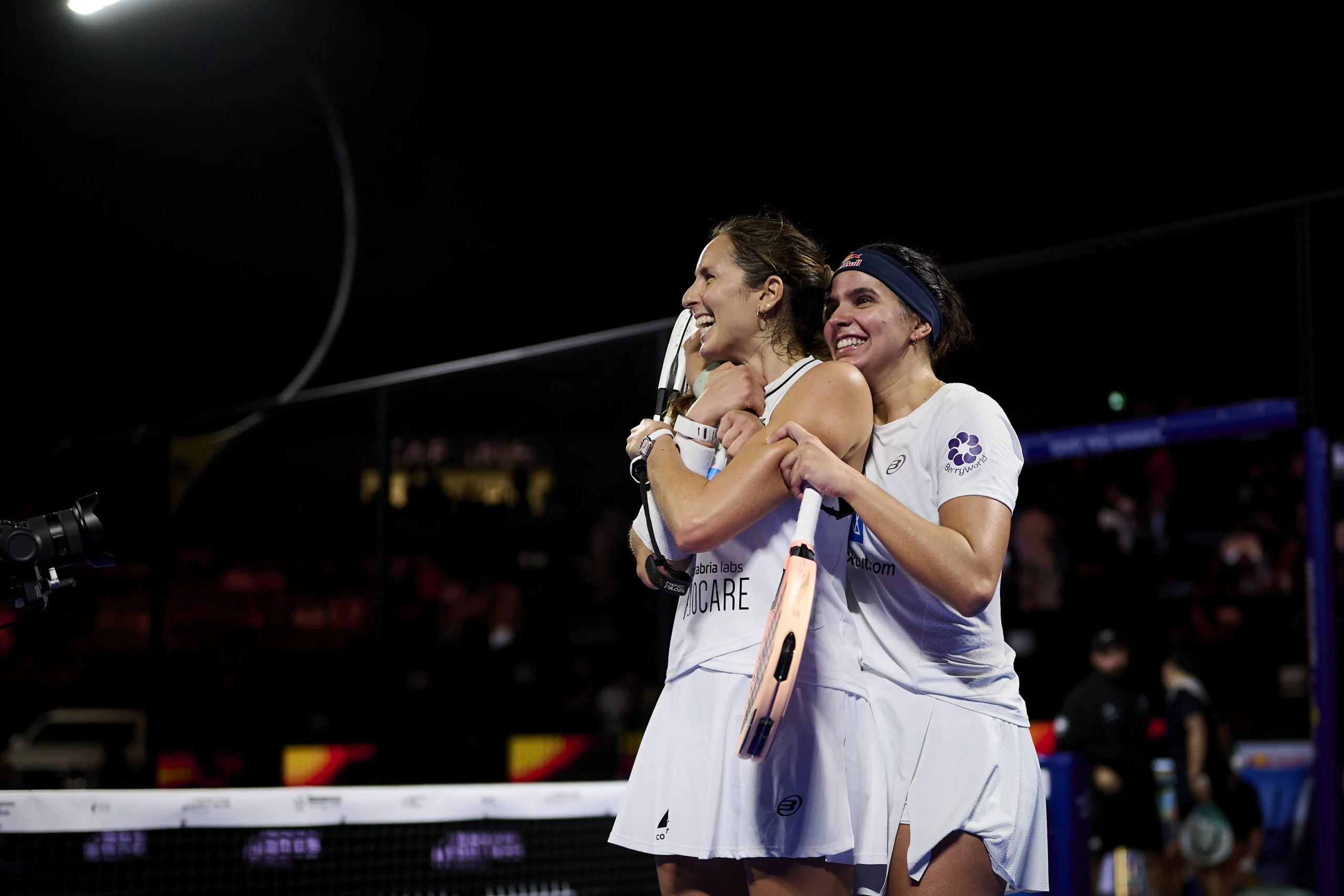
The Dubai program underlines how different the two draws are. While the men's bracket has lost its two most influential teams, the women's competition welcomes many of its biggest names into Thursday's round of 16. Gemma Triay and Delfi Brea open the center-court order against Marta Talaván and Sofía Saiz. Ariana Sánchez and Andrea Ustero follow against Letizia Manquillo and Lucía Sainz, before Paula Josemaría and Bea González meet Martina Fassio and Verónica Virseda. That sequence provides a concentrated look at the combinations setting the standard late in 2026.
Triay and Brea arrive with recent proof that a bad opening set need not become a lost final. At the October 31 Kuwait Major they fell behind against Sánchez and Ustero, then took the next two sets 6–1, 6–1 to secure another major title. It was their seventh trophy of the season and Triay's 59th career title, moving her clear in the professional women's all-time count. The numbers are a reminder that their apparent comfort in the Dubai draw comes from repeated success under serious pressure, not a generous schedule.
GOATIFY
GOATIFY Padel
Triay and Brea bring a record-setting 2026 season into Dubai. Shop GOATIFY's padel collection as the women's title race continues.
Yet a strong record creates pressure of its own. When a top-ranked team is expected to reach the final, every early match becomes a test of efficiency, rhythm and energy management. Triay and Brea know that a single flat start can invite an opponent into a contest that should have been shorter. Their opponents on Thursday are not the same caliber as a major finalist, but they can still exploit loose service games or a hesitant approach to the net. The safest route through a busy week is to play with the urgency of a final long before reaching one.
Sánchez and Ustero provide a contrasting example of a pairing with both established craft and the speed of a newer attacking presence. Their Kuwait final defeat did not erase how difficult they are to put away in extended rallies. Josemaría and González also bring the capacity to alter a match with aggressive changes of direction. These are not interchangeable rival teams: each tests a different balance of defense, initiative and patience, and each can expose the weaknesses of whoever emerges from the opposite half.
The point is not that the women will necessarily produce fewer surprises than the men. The sport's best pairs can be pushed by opponents with enough quality to take advantage of a slow start. The difference is that the leading contenders have entered Dubai with their roles intact, rather than learning that the established top of the draw has vanished. Managing expectations and converting superiority are their immediate problems. Finding a completely new route to a title is the men's problem.
Thursday's matches are therefore a useful snapshot of the tour. On one side, the second-seeded men must prove that a dramatic escape has made them better rather than simply spared them elimination. On the other, the leading women must show that a proven formula still works against challengers eager to disrupt it. Both stories fit the same venue and the same tournament week, but they ask competitors for different kinds of discipline. That variety is why the Dubai P1 can matter even before the biggest trophies are decided.
The round-of-16 scoreboard will eventually provide the simple answers: who advanced, who went home, and which half of the draw opened next. The more revealing answers concern how those results are achieved. Lebrón and Augsburger have shown they can recover from a position that looked increasingly hopeless. Now they need to show that the recovery was a sustainable adjustment rather than a one-night rescue.
Ruiz and López offer the first check, while Tello and Arce, Stupaczuk and Sanz, Nieto and Yanguas, and the qualifier stories complicate any neat prediction. Dubai's unusual men's draw has created a rare chance for a title that will not require beating either of the sport's two dominant combinations. What it has not created is an easy title. For Lebrón and Augsburger, that distinction defines the week.
GOATIFY
GOATIFY Padel
Shop GOATIFY padel products from the Padel-filtered collection scope.


















