

Lebrón and Augsburger Were Down 4–1. Dubai Became Their Second Title.
GOATIFYFor a moment, Dubai looked ready to deliver another shock. Juan Lebrón and Leo Augsburger were the highest-ranked men's pair left in the Premier Padel P1 draw, yet Tino Libaak and Gonzalo Alfonso pushed them into a 4–1 deficit in the opening set. The supposed favorites had the trophy in sight on paper and were losing control of the match on court. Two hours and 22 minutes later, Lebrón and Augsburger were champions, winning 7–6(5), 5–7, 6–3 on Sunday, November 15.
The score tells a story of momentum reclaimed twice. They rescued the first set, lost the second when the Argentine challengers struck late, then took the decisive break early in the third. It was the partnership's second Premier Padel title of 2026, following Brussels in April, and a reminder that being designated favorite is not the same thing as playing like one for three sets.
Dubai's other champions made a louder statement in fewer sets. Claudia Fernández and Martina Calvo beat Paula Josemaría and Bea González 7–5, 6–1 for their third title together since August. The women's final had a tense opening act, then a striking reversal of control. Together the results offered two different lessons about winning a title: surviving a final that keeps escaping, and turning a narrow advantage into a decisive finish.
With the Mexico Major and Barcelona Finals next on the calendar, Dubai was not simply a stopgap after the withdrawals of the men's top two pairings. It showed which contenders could actually use an opened draw, and which rising partnerships might carry momentum into the final weeks of the 2026 season.
A 4–1 Hole, Then a Tiebreak: How the Favorites Recovered the First Set

At 4–1 in the opener, the title was not slipping away permanently, but the match was already exposing the difference between a seed number and control of the court. Libaak and Alfonso reached the final as the No. 10 seeds. They were not there simply because other names had vanished from the draw. They had earned their chance and started by making the No. 2 seeds play from behind. The Argentinian duo's attacking exchanges and changes of pace made the opening games uncomfortable for a partnership expected to command the middle of the court.
Getting back from that deficit required more than one spectacular winner. A pair that trails by a break in professional padel has to win return games, and doing so means constructing repeated pressure against opponents who can finish points quickly at the net. The recovery to a tiebreak suggested Lebrón and Augsburger had steadied both their positioning and their decision-making. They won the breaker 7–5. That is a narrow margin, but from 4–1 down it represented a major transfer of pressure: the challengers had led the set, yet the favorites were the ones who found the final two important points.
Dubai also showed why a rescued opener is not an automatic route to a trophy. The second set stayed tense until the 11th game, when Libaak and Alfonso made the break that sent them on to a 7–5 set win. A team protecting a title opportunity needs the ability to absorb that reversal without reverting to desperate shots. Lebrón and Augsburger's response was immediate. They broke in the second game of the deciding set, got the early 2–0 cushion and defended it to win 6–3.
GOATIFY
GOATIFY Padel
The Dubai comeback demanded patience under pressure. Discover GOATIFY's Padel collection for court and match-day style.


The pattern matters more than merely calling the match a comeback. There were two resets: first when the favorites had to stop an early run, and again when the challengers leveled the match. Neither reset required the same response. In the opener, the task was to chase and retrieve. In the third, it was to build a lead and avoid giving away the advantage through impatience. They handled both over a 142-minute final, against opponents who had beaten them in their previous two meetings.
The comparison with Brussels in April is revealing but not identical. There, Lebrón and Augsburger lost the first set to Arturo Coello and Agustín Tapia before reversing the final. Dubai's decisive crisis arrived sooner, at 4–1 down in the first set, and the opponents were different. The common thread is a partnership finding a way to protect its aggressive identity without assuming every point must be won with a low-percentage finish. One six-month gap between titles can feel enormous for players this ambitious. The ability to survive an ugly scoreboard before finding their best level is a skill that travels better than a single hot run of overheads.
Libaak and Alfonso Didn't Lose Their Threat Just Because Dubai Had Favorites
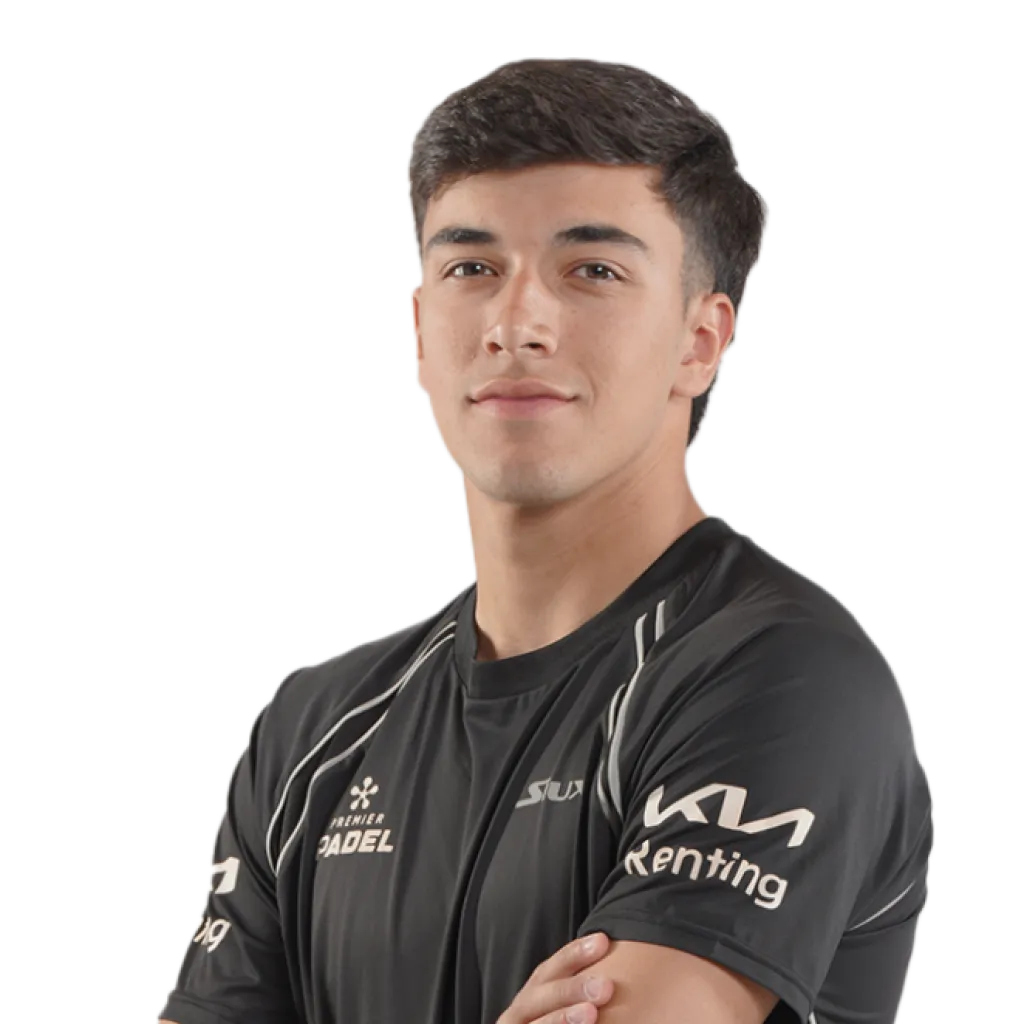
The most useful way to judge the Dubai men's final is to take the runners-up seriously. Libaak and Alfonso arrived with two victories over Lebrón and Augsburger in their earlier 2026 meetings. One was a three-set win in Kuwait late in October. Those results gave them something more valuable than an underdog label: practical evidence that their matchup could disrupt the favorite pair. The 4–1 opening lead in Dubai therefore should not have been dismissed as a fluke or an inexplicable slow start.
Libaak was playing his first Premier Padel final, according to the International Padel Federation's tournament report. That milestone is easily overlooked when the headline belongs to the champions. The 21-year-old Argentine had already shown that he could compete with higher-ranked opposition; reaching Sunday's title match was another step. Gonzalo Alfonso, meanwhile, brought more final-round experience from his earlier tour partnership with Tolito Aguirre. Their different paths were part of the appeal of the pairing: youth capable of accelerating rallies alongside a partner who could help manage their shape and tempo.
They also did not receive a free pass to the last match. Their route included a three-set quarterfinal against Lucas Bergamini and Jairo Bautista, and a 6–1, 6–4 semifinal win over Javi Garrido and Juani De Pascual. Those results gave Dubai its unlikely finalists. In the title match, they were capable of taking the first break, absorbing the loss of the opening set and recovering the second. That sequence is a reminder that a final can be competitive without its eventual winner being in trouble on every point.
GOATIFY
GOATIFY Padel
Libaak and Alfonso made the favorite pair fight to the end. Browse GOATIFY Padel gear for fans of the game's emerging rivalries.
Consider how close the men's scoreboard was underneath the set result. A match database recorded 111 total points for Lebrón/Augsburger and 104 for Libaak/Alfonso, a seven-point difference across a three-set contest. The winners took 70 of 105 points on serve to their opponents' 69 of 110, while the deciding set provided the clearest separation: 31 points to 24. Those numbers are one way of checking the eye test; the champions made the more telling gains late, but the losing pair were consistently close enough to demand them.
The absence of Coello and Tapia and of Galán and Chingotto changed the bracket. With both leading men's pairs withdrawn, Lebrón and Augsburger were the obvious remaining favorites. That is a real qualification when judging the strength of the title run. It is not a reason to devalue the result completely. The top seeds who still entered had to navigate the draw, survive challengers with nothing to protect and then beat a pair that understood how to trouble them. The opening set and the second-set loss illustrate exactly how little the original rankings guaranteed once the ball was in play.
For Libaak and Alfonso, the frustration should coexist with progress. There is a difference between reaching a first final in a rearranged draw and nearly taking it from an established pair with two previous wins against you. Their next test is whether the same sharpness survives when the top-ranked duos return and opponents prepare more specifically for their combinations. Even without a Dubai trophy, they have given those teams a serious reason to pay attention.
Fernández and Calvo Turned a Close Final Into a 6–1 Statement

If the men's final was a test of recovery, the women's championship was about a partnership recognizing the moment to accelerate. Claudia Fernández and Martina Calvo faced Paula Josemaría and Bea González, a pair with far more established experience together at the top of the tour. The favorites across the draw had fluctuated throughout 2026, and a 7–5 first set is rarely a sign that a match is over. Yet Fernández and Calvo converted that narrow opener into the kind of second set that can change how the rest of the field views them.
The initial break went to Josemaría and González. It did not last. Fernández and Calvo fought through the exchanges and ultimately took the first set 7–5, including a crucial late break that stopped the contest moving into a tiebreak. The momentum then became remarkably one-sided. They moved 5–0 ahead in the second before closing out a 6–1 set and a title in one hour and 57 minutes. It was not a wire-to-wire rout; it was a competitive opener followed by a decisive stretch in which one partnership repeatedly solved the other's service games.
That distinction is important because descriptions of a comfortable straight-sets victory can erase the hard work done to establish it. At 5–5 in the first set, either pair still had a plausible route to controlling the final. Once Fernández and Calvo gained that first-set advantage, they played with freedom while their opponents were increasingly forced to chase. The second-set score is extraordinary precisely because the first had been so narrow. It indicates how dramatically pressure can change the tactical balance of a match without any change of opponents or venue.
GOATIFY
GOATIFY Padel
Fernández and Calvo's third title of 2026 highlights padel's rising talent. Explore the GOATIFY Padel collection before the Mexico Major.
Their Dubai triumph was their third title together since August, following wins in London and Düsseldorf. The partnership has not needed a full multi-year history to build a clear identity at the top of the women's game. Fernández, already a champion in Dubai with González the previous year, was now lifting the same trophy alongside a different partner. Calvo, still in the early stages of an elite career, added another major achievement to a season that has made her one of the circuit's most consequential young players. Both had also been part of Spain's World Cup success in Doha the week before. Sustaining that form across consecutive events was no small physical or mental demand.
The contrast between the two winning pairs is one of Dubai's most interesting details. Lebrón and Augsburger reached their second 2026 title only after losing control twice in the final; Fernández and Calvo saw a small edge and turned it into an avalanche. Neither pattern proves that one team is better prepared for the rest of the calendar. They show different tools: resisting shifts of momentum and making a hard-won shift irreversible. Both could matter when the fields grow stronger at the last Major.
That Major is scheduled for Acapulco, Mexico, from November 23 to 29, with 2,000 ranking points at stake. The Barcelona Finals are scheduled for December 10–13. It would be premature to assign titles or ranking movements from the Dubai result alone, especially when the full top end of the men's field did not compete. But what can be said now is useful: Fernández and Calvo arrive with a third shared title, Lebrón and Augsburger with renewed evidence of their resolve, and Libaak and Alfonso with a first final that was far closer than the seeding sheet suggested.
The significant part of Lebrón and Augsburger's Dubai win is not that the highest remaining seeds lifted the trophy. It is that they did so after absorbing the exact kind of pressure that had troubled them against Libaak and Alfonso before: an Argentine pair capable of dictating pace, an early deficit, and a match that reset after the second set. The 7–6, 5–7, 6–3 scoreline records another title, but the recovery explains why it mattered.
Libaak and Alfonso leave without the trophy, not without credibility. Their first Premier Padel final together forced the favorites to earn every important change in momentum. Fernández and Calvo, meanwhile, gave the women's draw a different sort of conclusion, accelerating from a tight 7–5 set to a 6–1 finish that made their third shared title look increasingly convincing.
The last Major of 2026 in Acapulco, scheduled for November 23–29, is worth 2,000 ranking points; the Barcelona Finals follow December 10–13. Those are new tests, not results Dubai can predict. But the tournament has sharpened the questions: can Lebrón and Augsburger repeat this recovery against the full elite field, can Libaak and Alfonso convert deep runs into a title, and how far can Fernández and Calvo take a partnership that keeps finding another level?
GOATIFY
GOATIFY Padel
Shop GOATIFY padel products from the Padel-filtered collection scope.


















