

The 10 Worst New York Jets Draft Decisions, Ranked by the Damage
GOATIFYEvery team has a draft regret. The New York Jets have built something closer to a museum wing, complete with exhibits from multiple decades and a few very expensive attempts to fix the previous exhibit. But the worst decision is not automatically the player with the shortest career. The price of the pick, the alternatives genuinely available, the team's roster problem and the way the player was developed all matter.
This is a ranking of draft decisions, not a list of people to ridicule. Injuries can derail a good evaluation; a productive player can still represent a poor use of scarce capital when a better fit was sitting on the board. We weigh the cost at the time and the opportunity lost afterward, while resisting the fantasy that every future Hall of Famer was an obvious selection on draft night. The Jets franchise, previously the New York Titans before adopting its current name in 1963, supplies enough history without borrowing another team's mistakes.
Our top ten runs from 2012's failed pass-rush experiment to the quarterback decision that restarted a rebuild instead of ending one. Some players had meaningful NFL careers elsewhere. That difference between a bad Jet pick and a bad football player is central to the story.
No. 10–8: When first-round projection outran the plan

These three cases look different on the surface. One was a physically imposing defender asked to change his job. One was a talented lineman whose health kept rewriting the depth chart. One was a second-round quarterback who never made a regular-season appearance. Together they illustrate how fast a draft valuation collapses when a club confuses a tempting trait with a complete role.
No. 10 — Quinton Coples, No. 16 overall in 2012
Coples was not an instant zero. The North Carolina defensive lineman flashed enough as a rookie to record 5.5 sacks, and his early New York seasons showed the disruption that had attracted evaluators. The problem was sustainability and fit. After being moved from defensive line toward outside linebacker, he never became the dependable, scheme-transcending edge force a mid-first-round choice is supposed to buy. By 2015 the Jets had released him, and the hoped-for cornerstone had become an awkward roster fit.
The painful comparison is Chandler Jones, whom New England selected five spots later at No. 21. Jones developed into a dominant NFL pass-rusher. That comparison is fair because he occupied a broadly similar pass-rush market and was available on the same board; it is not fair to pretend his entire career could have been forecast perfectly. New York had identified a premium need, spent premium capital and still watched a divisional rival take the more durable answer. That is a draft miss even if Coples contributed some useful plays.
No. 9 — Mekhi Becton, No. 11 overall in 2020
At Louisville, Becton looked like a moving wall with unusual feet. His rookie work gave the Jets real evidence that the gamble could succeed. Injuries, however, took away huge stretches of his New York tenure, and expectations hardened faster than his availability. Eventually he rebuilt his career in a different role with Philadelphia, including on its Super Bowl-winning line. His later success is an argument against reducing him to a punchline, but it also highlights how the Jets struggled to turn a remarkable prospect into a stable long-term starter.
Tristan Wirfs went at No. 13, two selections later, and developed into one of the NFL's outstanding tackles. Both were legitimate offensive-line prospects at the time; choosing Becton wasn't some bizarre reach. It became a costly judgment because the original club needed reliability at a foundational position, and its preferred upside scenario never lasted long enough to anchor an offense.
GOATIFY
GOATIFY NFL
From promising prospects to missed fits, the Jets' draft history sparks plenty of debate. Browse GOATIFY's NFL shirts and fan designs.


No. 8 — Christian Hackenberg, No. 51 overall in 2016
A second-round quarterback need not become a superstar to justify the gamble. He does, however, need to justify a place on the field. Hackenberg never appeared in a regular-season NFL game, which is a remarkable outcome for a selection that early. The Jets knew his Penn State tape involved accuracy concerns yet believed their coaches could reconstruct the promising early-career version. It never happened.
Dak Prescott lasted until No. 135, and Jacoby Brissett was selected later too. Neither was a universally obvious alternative on the second-round clock. The indictment is simpler: New York spent a valuable pick on a developmental project without managing to develop him into a usable backup. At least with a late-round flyer, the tuition is cheaper.
No. 7–5: The quarterback reset and the price of moving up

The next trio shows why opportunity cost belongs in the headline. Spending one high pick is dangerous enough; paying additional picks to get there doubles the exposure. A bad trade-up decision can damage two drafts at once, leaving the roster less equipped to rescue the player it just acquired.
No. 7 — Sam Darnold, No. 3 overall in 2018
Darnold belongs on this list with a major qualification: he has since proved that he can play high-level professional football. His revival outside New York, capped by helping Seattle win a Super Bowl, weakens any lazy argument that the Jets simply selected a talentless quarterback. What failed was the entire Jets version of the investment.
To move from No. 6 to No. 3, New York sent Indianapolis three second-round selections along with its own first-round position. A rebuilding offense needed those surrounding players. Darnold spent three years managing unstable coaching, protection and supporting-cast questions before leaving for Carolina. Josh Allen went seventh to Buffalo and Lamar Jackson 32nd to Baltimore. Neither was certain to flourish in every environment, but the Jets had a path to either quarterback without paying to move into Darnold's slot. Even more damning, Darnold's later success shows development and circumstance were material parts of the outcome.
This is not a retroactive claim that Darnold was doomed on draft night. It is a criticism of a franchise that paid extra for the right answer, then failed to give its answer a consistent problem to solve.
No. 6 — Johnny “Lam” Jones, No. 2 overall in 1980
The Jets acquired the second selection by sending San Francisco two first-round choices, Nos. 13 and 20. They chose the Texas sprinter and receiver Johnny “Lam” Jones, betting that breathtaking speed would transform the passing game. He finished his NFL career with 2,322 receiving yards and 13 touchdowns, production that did not begin to match the price of the move.
One pick later Cincinnati selected Anthony Muñoz, who became one of football's defining offensive tackles. That is the sharpest counterfactual, although it needs a footnote: Muñoz had serious pre-draft knee questions, and teams had to evaluate medical information in real time. It is therefore unfair to act as if his durability was guaranteed. Still, trading two first-rounders for a receiver whose signature skill never translated into sustained offensive influence is exactly the kind of downside the Jets should have priced in.
No. 5 — Dewayne Robertson, No. 4 overall in 2003
Robertson did not vanish after three games. He started regularly, occupied the middle of the Jets defense for several seasons and contributed. The draft decision looks far worse when the receipt is attached. New York traded the No. 13 and No. 22 selections plus a fourth-rounder to Chicago to jump to No. 4 for the Kentucky defensive tackle. That is a substantial bet on one player becoming a difference-maker rather than merely a functional starter.
He never supplied the disruptive ceiling the price implied. Terrell Suggs, Kevin Williams and other high-impact defenders were available later in the first round. It does not follow that the Jets could have drafted all of them, or even that their original slots guaranteed the ideal option. It does show the key asymmetry: the club surrendered two first-round bites at the apple to buy one projection that turned into merely adequate value. In a league where depth is constantly tested, that is a very expensive way to become ordinary.
GOATIFY
GOATIFY NFL
Draft-day trades can reshape an entire team's future. Explore GOATIFY's American football fan apparel and accessories.
No. 4–3: The alternatives Jets fans could see on draft night
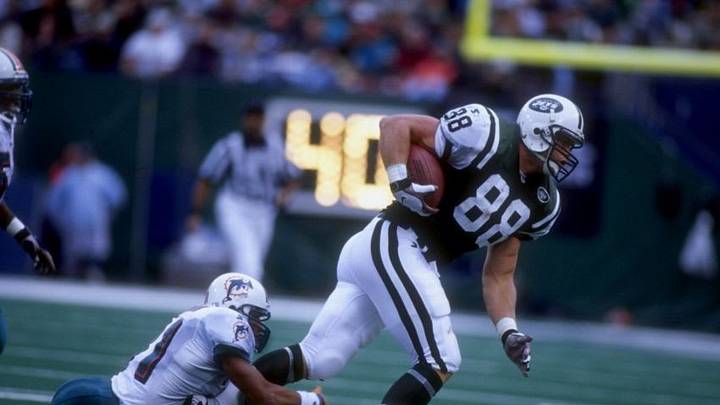
There is a special category of draft pain in which the crowd's instinct turns out to be a better highlight reel than the front office's confidence. But even here, player careers need to be judged accurately: Kyle Brady lasted many NFL seasons and became a respected blocker; Blair Thomas had real early running ability. The mistake is the return relative to the rare opportunity New York held.
No. 4 — Kyle Brady over Warren Sapp, No. 9 in 1995
The Jets selected Penn State tight end Kyle Brady at No. 9. In one of the draft's most replayed scenes, fans wanted defensive tackle Warren Sapp instead and made their preference abundantly clear. Sapp went 12th to Tampa Bay and grew into a Hall of Fame defensive centerpiece. It is tempting to stop there, print the crowd chant and call the case closed.
That would undersell Brady and overstate what New York knew. Brady was a capable blocker with a lengthy NFL career, particularly in Jacksonville. The scouting decision was not to draft a man with no professional ability. It was to use a top-ten pick on a comparatively narrow tight-end profile while a rare interior disruptor remained available. Sapp's eventual résumé makes the contrast spectacular, but even the narrower draft-night question—where is the positional scarcity, and what does this team most need?—was uncomfortable.
The lesson is not that angry fans are secretly a reliable scouting department. It is that the Jets took a player whose realistic excellent outcome was less transformational than the defender they bypassed. Brady was not a bad professional. The allocation of a premium selection was the questionable part.
No. 3 — Blair Thomas, No. 2 overall in 1990
Thomas was not drafted out of nowhere. The Penn State running back had been a college star, and his speed and balance made him a plausible offensive centerpiece. The Jets selected him second overall and saw flashes. But the backfield committee limited his early opportunities, injuries complicated the path and his tenure never produced a sustained run of elite lead-back seasons. Over four years in New York he rushed for 2,009 yards and five touchdowns.
Seattle took future Hall of Fame defensive tackle Cortez Kennedy with the next pick. Dallas selected Emmitt Smith at No. 17. Smith would become the NFL's career rushing leader, but he was not sitting at No. 3 with a giant sign proclaiming that future. Kennedy is the closer draft-board comparison: a blue-chip defensive player available immediately after Thomas. Either contrast makes it harder to defend spending No. 2 on a running back without a clear plan to maximize his touches.
Thomas should not carry all the responsibility for those deployment choices. The Jets chose the player, then used him in a structure that made it difficult to earn back the price. It is a recurring Jets theme: buying the centerpiece, then realizing the room has not been built around it.
No. 2–1: The high picks that never delivered their promised reset
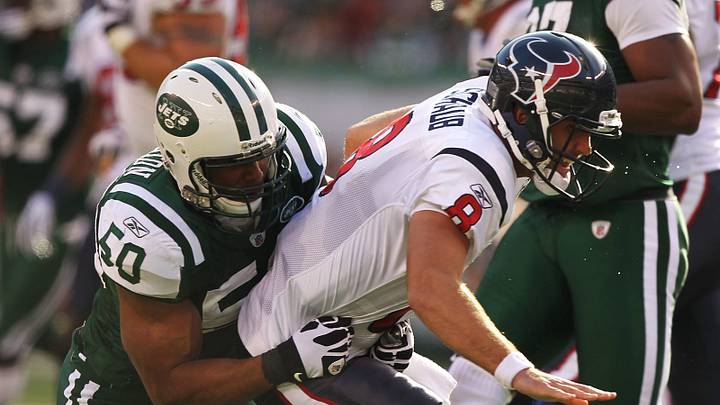
At the top of this list the debate becomes particularly ugly. Vernon Gholston supplied one of the starkest production failures by a high defensive draft pick; Zach Wilson absorbed the value of the most precious kind of selection, a franchise-quarterback reset. One case is the absence of a pass rush. The other is the return of an entire organizational plan to the starting line.
No. 2 — Vernon Gholston, No. 6 overall in 2008
The Ohio State pass-rusher arrived with the kind of combination a scouting room can fall in love with: strength, size, testing numbers and elite college production. New York selected him sixth to become a pressure-generating pillar. In three Jets seasons he did not record a single regular-season sack. For a defender picked that high largely to chase quarterbacks, the statistic is brutal.
GOATIFY
GOATIFY NFL
For fans who still remember Brady-versus-Sapp and Blair Thomas, GOATIFY's NFL-inspired designs celebrate the game's unforgettable debates.
The comparison pool was strong and genuinely available. Linebacker Jerod Mayo went at No. 10 and tackle Ryan Clady at No. 12. Both became major contributors for their teams. A player taken sixth need not outperform every later All-Pro to be worth the choice, but he must develop at least one bankable NFL-level skill. Gholston could not turn his physical promise into production through multiple defensive staffs.
There is also value in acknowledging what the team admitted. Former general manager Mike Tannenbaum publicly accepted responsibility for the selection. That should be the standard way to discuss this failure. A draft grade belongs partly to the evaluator and the organization, not solely to a young defender asked to fulfill a top-ten projection. Gholston is No. 2 because the cost was enormous and the return was virtually invisible in the statistic he was paid to supply.
No. 1 — Zach Wilson, No. 2 overall in 2021
The Jets entered 2021 needing a fresh quarterback direction after moving on from Sam Darnold. BYU's Zach Wilson offered arm talent, creativity and off-platform throws that appeared to promise a modern solution. New York used the second pick in the entire draft to make that bet. Across 34 appearances for the Jets, he threw 23 touchdowns against 25 interceptions, completed roughly 57 percent of his passes and finished with a 12–21 record as a starter. The club eventually traded him for a late-round draft-pick upgrade.
That résumé explains the ranking but not all of the failure. New York's protection, play-calling, expectations and repeated resets did Wilson few favors. Injuries and coordinator turnover were not imaginary. Yet the quarterback decision was supposed to bring stability to a franchise desperate for it; instead the franchise ended up with another rebuild and another question at football's most important position.
Ja'Marr Chase went fifth, Penei Sewell seventh, Patrick Surtain II ninth and Micah Parsons 12th. All were available when New York was on the clock, and each demonstrates the enormous blue-chip talent the Jets could have used elsewhere. That is a comparison of opportunity, not a dishonest claim that a club seeking a quarterback should have known the exact order of those careers. The larger alternative was strategic: build the foundation first, retain flexibility and avoid spending No. 2 on a prospect who would need unusually good development conditions.
Gholston wins the worst single stat line. Wilson takes No. 1 because a top-two quarterback selection is not merely a roster move. It sets the timeline, shapes the coaching staff, dictates spending and influences the next several drafts. For the Jets, the reset lasted just long enough to require another reset.
The recurring failure is not that the Jets once misread a 40-yard dash or bet on the wrong quarterback. It is that so many of these selections required a combination of huge draft capital, immediate organizational certainty and a development plan that never arrived. Gholston's empty sack column is the cleanest statistical indictment; Zach Wilson's No. 2 price tag and the quarterback-sized hole left behind make his decision the most damaging in our ranking.
Hindsight is the easiest scouting department in football. It never misses on Warren Sapp, Anthony Muñoz, Josh Allen or Tristan Wirfs. A real front office does not enjoy that privilege. Still, it can value flexibility, question medical and projection risk, resist forcing positional need and build a system that gives the pick an actual chance. The Jets' best draft lessons are therefore about process, not punchlines. The next selection will never be guaranteed; avoiding the same old traps is at least within the franchise's control.
GOATIFY
GOATIFY NFL
Shop GOATIFY NFL and American football shirts, hoodies and stickers.


















