

Turin Champions Fear Doubles Cuts. Their 2027 Stakes Just Rose.
GOATIFYWinning the ATP Finals ought to be the uncomplicated end of a season. For Théo Arribagé and Albano Olivetti, it has instead made the next one more demanding. The French pair lifted the doubles trophy in Turin on November 22 after a 3–6, 7–6(2), [10–6] comeback against Marcelo Arévalo and Mate Pavić. Within hours, their conversation had shifted from a seventh title together this season to Grand Slams, a possible place in France's Davis Cup team and deep concern about the future shape of the doubles tour.
That last issue changes the meaning of the celebration. Olivetti warned after the final that proposals to reduce doubles draws in 2028 could make 2027 unusually consequential for players outside the highest rankings. The details have not been officially settled in the reporting available on November 23, so his concerns should not be presented as rules already adopted. But they explain why a team at the peak of its first full season is looking over its shoulder.
There are two separate questions behind the same trophy: can Arribagé and Olivetti turn a magnificent run of tour victories into a breakthrough at a major, and can doubles specialists across the sport count on retaining the opportunities that allow such breakthroughs to happen? Their Turin performance supplies a compelling answer about competitive ability. It cannot resolve the structural argument by itself.
Olivetti's 2028 warning is serious — but it is not a published rule
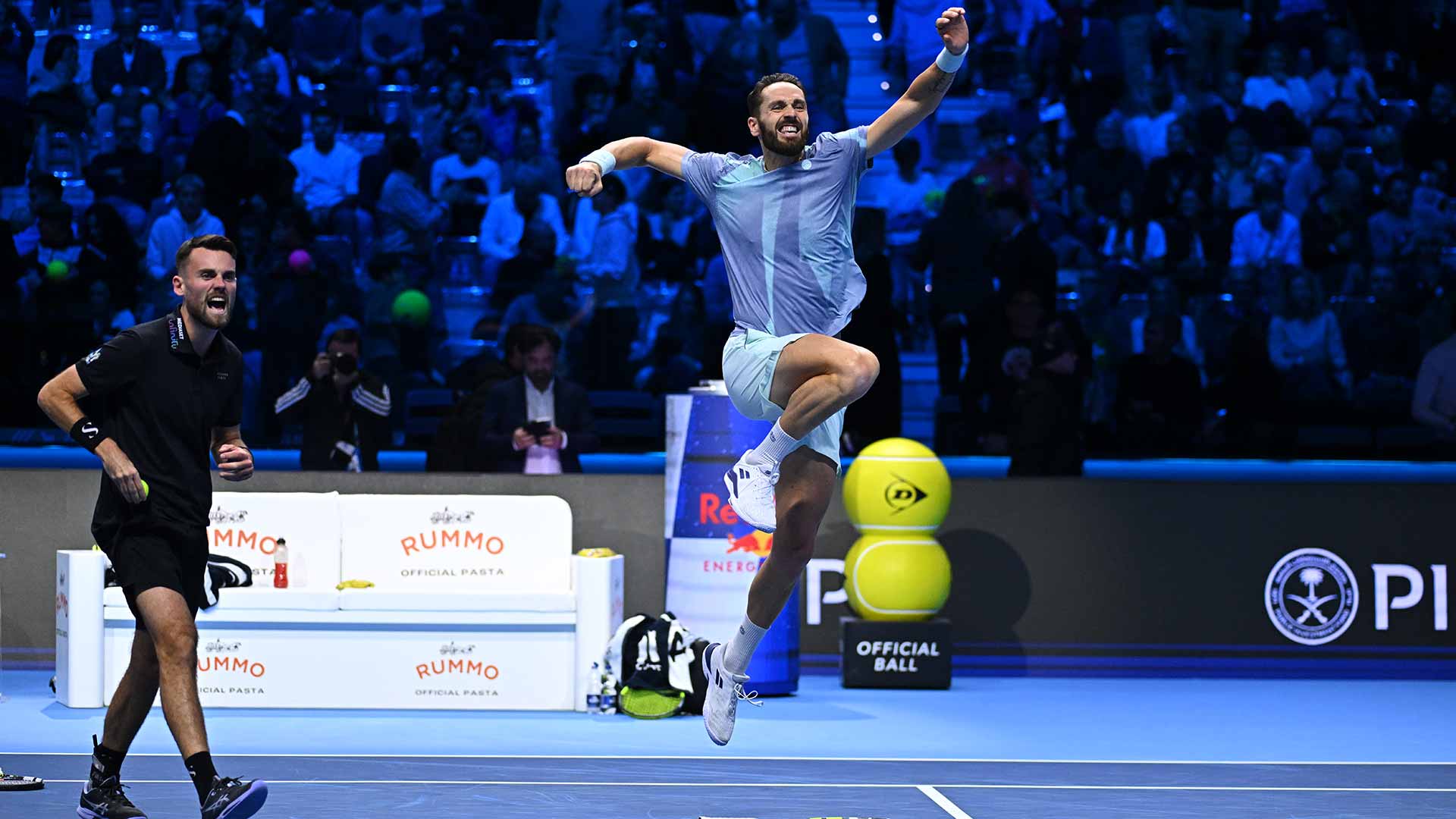
The most striking part of Olivetti's post-final remarks was not the size of his ambitions. It was the idea that the basic arithmetic of making a living in doubles might soon change. Speaking after Sunday's title, the 34-year-old said the direction of reforms under discussion worried him, and described 2027 as an important positioning year ahead of possible smaller draws in 2028. He suggested that a place around the top 30 could become a valuable safeguard while players ranked 40th or 50th might find access harder.
Those are the player's assessment and concerns, not a verified final ATP entry formula. Reporting from Turin said an announcement anticipated during the event had been postponed. No responsible forecast can turn that delay into certainty over precisely how many teams would enter which events or which ranking threshold would control access. A player quoting a number during a debate is not the same thing as a governing body publishing a completed regulation. The distinction matters especially to athletes making career decisions now.
Why would a reduced draw feel existential to a specialist? Fewer available slots can potentially do more than cut a single tournament appearance. Entry determines access to points, prize money, matches against high-ranked opponents and the results needed to maintain a ranking. An athlete who suffers an injury or a poor run may then find that a lower position makes it harder to enter events that would offer the chance to recover. The precise effect depends on the final format, qualification routes and ranking rules, none of which should be assumed in advance.
Olivetti also criticized the idea that doubles players themselves should carry the blame for limited visibility. His complaint was fundamentally about promotion. Singles receives much of the attention, but tennis's doubles format offers a different spectacle: reflex exchanges at the net, coordinated positioning, quick decisions about poaching and very small margins when big servers meet. Selling that spectacle requires scheduling, broadcasting and storytelling as well as athletic performances. A title match that turned on a single uninterrupted burst of points is an unusually strong example of the format's appeal.
GOATIFY
GOATIFY Tennis
Explore GOATIFY tennis designs while considering how doubles opportunities could change.


Tennis GOAT Golden Racket & Ball Decal Sticker
Add tennis personality to your favourite gear.
Shop Now ↗


The winning pair has an unusual vantage point. They are not fringe players requesting a shortcut after a poor campaign. The Frenchmen have won seven titles in 2026 and just defeated multiple established teams at a championship restricted to the season's best combinations. Their form means they speak from a position of competitive credibility; their pathway means they also remember what the lower tiers feel like. Olivetti and Arribagé were competing on the Challenger circuit a year earlier and were outside the doubles top 50 as they built their partnership.
There is a fair counterargument to the players' anxiety. A tour could seek shorter events, more intense fields or better presentation and still value doubles. Any proposed redesign has trade-offs involving court inventory, television windows, draw size and player development. Yet a smaller headline field can concentrate opportunity near the top. Without seeing the final proposals, judging every change as harmful would be premature; dismissing the possibility of access problems would be just as careless.
The title itself cannot freeze a ranking for life. Olivetti is projected to reach an individual career-high doubles ranking of No. 12 and Arribagé No. 13 after Turin, according to the tournament's report. Those positions are a formidable achievement, but the broader debate is about how forgiving the pathway will be for the next team that starts the season outside that circle. In that sense the champions' warning is not only self-interested. It asks whether a future Arribagé-Olivetti partnership could make the climb they just completed.
Seven titles prove the partnership. A Grand Slam still tests something different
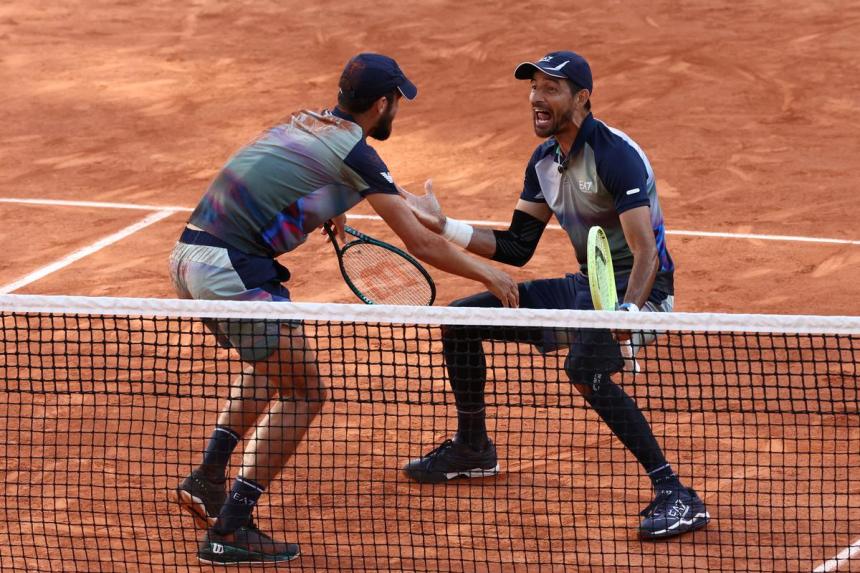
There is a reason Arribagé's ambition for 2027 is a major title rather than an eighth ordinary tour trophy. The pair have already mastered much of the week-to-week rhythm that converts strong partnerships into serial winners. Their 2026 titles came in Auckland, Montpellier, Dallas, Halle, Mallorca, Basel and now Turin. That is a remarkable spread across conditions and tournament levels, from outdoor hard courts through grass and indoor hard courts. Their season has substance well beyond a single hot week.
A major is the conspicuous gap. Reporting from Sunday's press conference notes that they did not advance beyond the second round at any of the four Grand Slam tournaments this season. That record is not inconsistent with their seven titles; it is evidence that success across shorter tour events does not automatically translate to the largest draws. It would be simplistic to blame nerves alone. Opponents and conditions vary, the scheduling demands accumulate, and tight doubles sets often hinge on a handful of return points.
The contrast with Arévalo and Pavić helps place that gap in perspective. The team the Frenchmen defeated in Turin had beaten them in group play a week earlier and entered the final with far more history at the highest level. The Salvadoran-Croatian partnership won the 2024 Roland-Garros doubles crown, and an ATP Finals report says they accumulated nine tour titles together across three seasons, including four Masters 1000 trophies. Their major experience represents a type of credibility the new champions are now trying to acquire.
The final itself should be read carefully rather than romanticized into dominance. Arévalo and Pavić took the opening set 6–3. They fired more aces, held every one of their service games and converted the match's lone break opportunity. Arribagé and Olivetti had no break of serve and went 0-for-3 on their own opportunities. The tournament stats still credit the winners with 42 of 48 first-serve points won, an 88 percent rate that helped prevent further damage. On the conventional scoreboard, the losers controlled much of the contest.
GOATIFY
GOATIFY Tennis
Browse GOATIFY tennis apparel as the French champions plan their Grand Slam breakthrough.


Tennis GOAT Golden Racket & Ball Crewneck Sweatshirt
A tennis fan design for everyday wear.
Shop Now ↗

Where the title changed hands was the pressure sequence. From 1–2 in the second-set tiebreak, the French pair won ten points in a row, six to finish that tiebreak and four to open the deciding match tiebreak. The final score of 3–6, 7–6(2), [10–6] includes a race to ten in place of a full third set. That scoring distinction is important: it is what made such a sudden reversal possible, and it means the dramatic finish cannot be described as a conventional three-set comeback.
The previous day supplied a matching argument for their resilience. Arribagé and Olivetti saved three consecutive match points against Kevin Krawietz and Tim Pütz before winning their semifinal 12–10 in the deciding match tiebreak. Getting through those situations is not purely a matter of fortune. Strong serving gives a team space to survive, but it also takes clear partner communication and the willingness to keep attacking rather than waiting for the opponent to make an error.
There is still a danger in assuming that spectacular tiebreak survival will keep happening on demand. The same format that rewards a burst of six or ten points can just as quickly punish a loose volley or a mistimed second serve. To win a Grand Slam, the pair must produce that blend of first-serve quality, aggressive returning and composure against a wider range of opponents, often after a longer accumulated tournament workload. This is less about inventing a new playing identity than making the existing one reliable across more days.
Their positive case is straightforward. They began playing together in late 2025, built confidence quickly and overcame difficult starts in several events. The ATP reports that the team had six titles before Turin; the seventh is now the biggest. A partnership that repeatedly solves match-specific problems has a credible route to a Grand Slam final. But the honest benchmark remains the second-round ceiling, not the beautiful silver trophy they held in Turin.
Monfils made contact. France has not made a Davis Cup selection
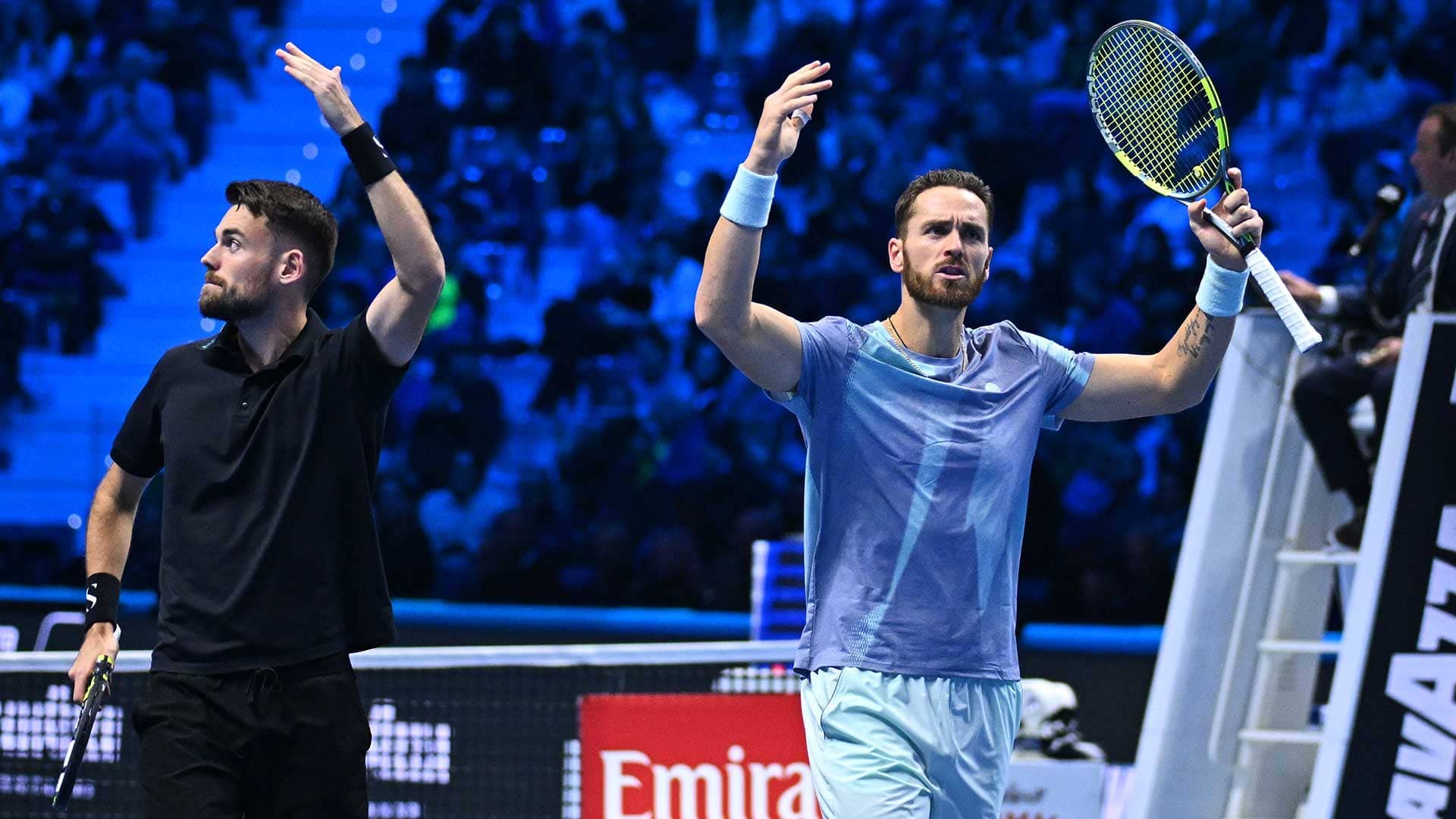
The most immediate new possibility for the French champions is not a ranking calculation. It is representing France. Arribagé told reporters he wants a Davis Cup place, and reports from earlier in the tournament describe a phone call from the new French captain, Gaël Monfils. Monfils expressed interest in potentially using the partnership. That is a meaningful sign of attention, not an official announcement that the two will play a particular tie.
A national-team doubles place demands a different sort of fit. Captains weigh form, reliability under pressure, the singles options in a nominated squad and how pairings complement one another. A successful established team offers ready-made communication and clear roles. After Turin, Arribagé and Olivetti can point not only to wins but to a recognizable structure: aggressive service patterns, decisive net positioning and a capacity to respond together when a match moves against them.
For France, the appeal is especially clear at the margins. A Davis Cup tie can depend on one doubles rubber. With limited room for experimentation, a team that already knows who covers the middle, who attacks which return lane and how to manage a deciding tiebreak has a practical advantage over two singles specialists paired at short notice. That does not make established doubles specialists automatically the best choice every time. It does give the captain a strong option that he did not need to manufacture during a training camp.
GOATIFY
GOATIFY Tennis
Discover tennis-inspired styles while the Davis Cup future of France's doubles pair develops.


It is tempting to connect Monfils's contact with the Turin title and describe a selection as settled. That would be a leap beyond the evidence. The initial call came while the pair were still playing the year-end event; the victory has subsequently made their case stronger. It remains up to the captain and the relevant team-selection process to determine when and how they might be used. Their objective is definite. Their next Davis Cup appearance is not.
Arribagé also mentioned the 2028 Los Angeles Olympics as a further ambition. That longer horizon makes the present tour debate feel connected to national representation. Rankings, available competitions and a player's ability to stay active all shape the route toward a future Olympic conversation. Yet Olympic qualification rules, French nomination decisions and tournament entries should not be reverse-engineered from a post-final quote. They are separate processes with separate conditions.
The partnership itself has moved quickly enough to encourage both men. They began together in the autumn of 2025 and suffered an unpromising first outing at a Valencia Challenger. They then won in Almaty, found greater stability and became the most prolific title-winning doubles team on the tour in 2026. Their story illustrates the value of pairing complementary instincts and staying with the experiment after an initial loss. It also illustrates why fewer opportunities to test partnerships could have consequences below the headline level.
The age gap creates a natural question about how long the peak can continue. Arribagé is 26 and Olivetti 34, according to ATP reporting. One partner may have substantially more seasons ahead, while the other has spent years refining a specialty that rewards anticipation and partnership chemistry. Those differences are not evidence of an imminent split. They make the task of planning a season around majors, national-team ties and ranking protection more intricate than simply booking the next event.
The real opportunity now is to translate a successful finish into a deliberate calendar. Grand Slams provide the headline competitive target. A possible French call-up would supply a different stage for their strengths. Maintaining entry and momentum throughout the regular tour gives both goals a foundation. For a team that has already proved it can fight through match points and beat established champions, the next challenge is not proving its ceiling exists. It is building a repeatable route back toward it.
Turin answered one question emphatically: Arribagé and Olivetti belong among the strongest teams in doubles. They won the season finale in their first appearance after a week that demanded both technical precision and extraordinary nerve. But victory did not settle their three ambitions for 2027. A Grand Slam remains unclaimed, a Davis Cup place is possible rather than guaranteed, and the proposed direction of doubles reform has yet to become a fully published, testable rulebook.
That combination makes the next season interesting for reasons bigger than whether they lift another trophy. If they push deep into a major while maintaining their rankings, they will strengthen the case that their 2026 breakthrough was sustainable. If the sport changes its entry structure, their story will also become a useful measure of whether the pathway remains open to the partnerships trying to follow them.
GOATIFY
GOATIFY Tennis
Shop GOATIFY tennis products from the Tennis-filtered collection scope.





















