

The 10 College Programs That Produced the Best NFL Talent Since 2000
GOATIFYEvery April, the college football world turns the NFL draft into a scoreboard. One university produces a dozen selections; another claims four first-rounders; fans declare the winner before any of those rookies has played a meaningful professional snap. But the programs that produce the most draft picks are not always the ones that produce the best NFL players. The distinction is huge when one school gives the league an elite tackle for eleven seasons and another delivers several prospects who barely establish themselves.
Our top ten considers players selected in the 2000 through 2025 NFL drafts, with established NFL results assessed through the completed 2025 season. That cutoff deliberately excludes 2026 rookies and prevents a hot month in an unfinished season from rewriting decades of professional evidence. This is an editorial ranking, not a made-up statistical model: we weigh elite peak seasons, sustained starting value, Pro Bowl and All-Pro-level work, positional difficulty, and the breadth of actual NFL contributors. Draft volume is a useful check, not the final verdict.
Transfers count once, for the school where the player finished his college career and entered the draft. That puts Joe Burrow with LSU, Jalen Hurts with Oklahoma and Caleb Williams with USC, despite earlier college stops. We do not give a school a second credit for developing a player at some earlier point. The result is a ranking of professional outcomes attached to a clear, consistent college identity — and there is room for genuine debate.
#10–#8: Clemson, Michigan and Wisconsin — stars are not the whole story

10. Clemson: A smaller volume, a genuinely elite ceiling
Clemson's case is not that it wins every draft-night headcount. It is that some of its best products have become exactly the players franchises build around. DeAndre Hopkins established a long run as a premier receiving target; Dexter Lawrence became one of the league's defining interior defensive linemen; Tee Higgins developed into a high-level second receiving threat who can change coverage choices. Trevor Lawrence adds the premium-position upside, although the existence of a highly drafted quarterback does not automatically turn into decade-long greatness. That distinction matters in this exercise.
Clemson takes tenth because its peak names are impressive but its twenty-six-draft breadth is less overwhelming than the schools above it. It produces credible NFL starters on both sides, yet the absolute quantity of long-lived impact players is not the same as Alabama's or Ohio State's. We are ranking actual NFL value, not the recruiting-service stars those athletes once carried.
9. Michigan: A quarterback outlier and a defensible modern pipeline
Tom Brady is the greatest single trump card any school could lay down for a class within our window: a 2000 draft pick whose professional résumé changes an entire conversation. But giving Michigan first place because of one extraordinary quarterback would make the remaining twenty-five drafts meaningless. Jake Long's lengthy tackle career, Rashan Gary's edge production, and Aidan Hutchinson's impact offer a better picture of sustained talent across different roles. The line of scrimmage is the program's clearest recurring export.
Michigan ranks above Clemson for the quality of its upper-end careers and an enduring stream of useful NFL linemen, but it does not get automatic extra credit for national titles earned by athletes who never became established pros. A college defense can dominate for a season without every contributor translating into a professional difference-maker.
GOATIFY
GOATIFY NFL
Shop GOATIFY NFL fan gear for the stars who make every position count.


8. Wisconsin: The players who make everyone else's highlights possible
Wisconsin might be the most easily underestimated entry. Joe Thomas became a Hall of Fame left tackle and a decade-long benchmark for consistency. J.J. Watt won three NFL Defensive Player of the Year awards; his younger brother T.J. Watt became a premier edge rusher. Jonathan Taylor supplied another high-end rushing career, while the Badgers have repeatedly supplied offensive linemen built for long professional workloads. Those achievements come at positions where durability, technique and snap-by-snap reliability often matter more than draft glamour.
For a role-aware ranking, Joe Thomas protecting an offense for years is not less valuable simply because he caught no touchdowns. Nor should J.J. Watt's disruptive seasons be flattened into an undifferentiated list of defensive starters. Wisconsin's output is less glamorous on draft broadcasts, but enough genuinely excellent careers place the Badgers eighth. Their case also demonstrates why a transfer is credited to the school where he completed his college career: J.J. Watt started at Central Michigan, but became the Wisconsin player the NFL drafted.
#7–#5: Oklahoma, USC and Miami — quarterbacks, linemen and game-changers
7. Oklahoma: Professional quarterbacks with more than headline value
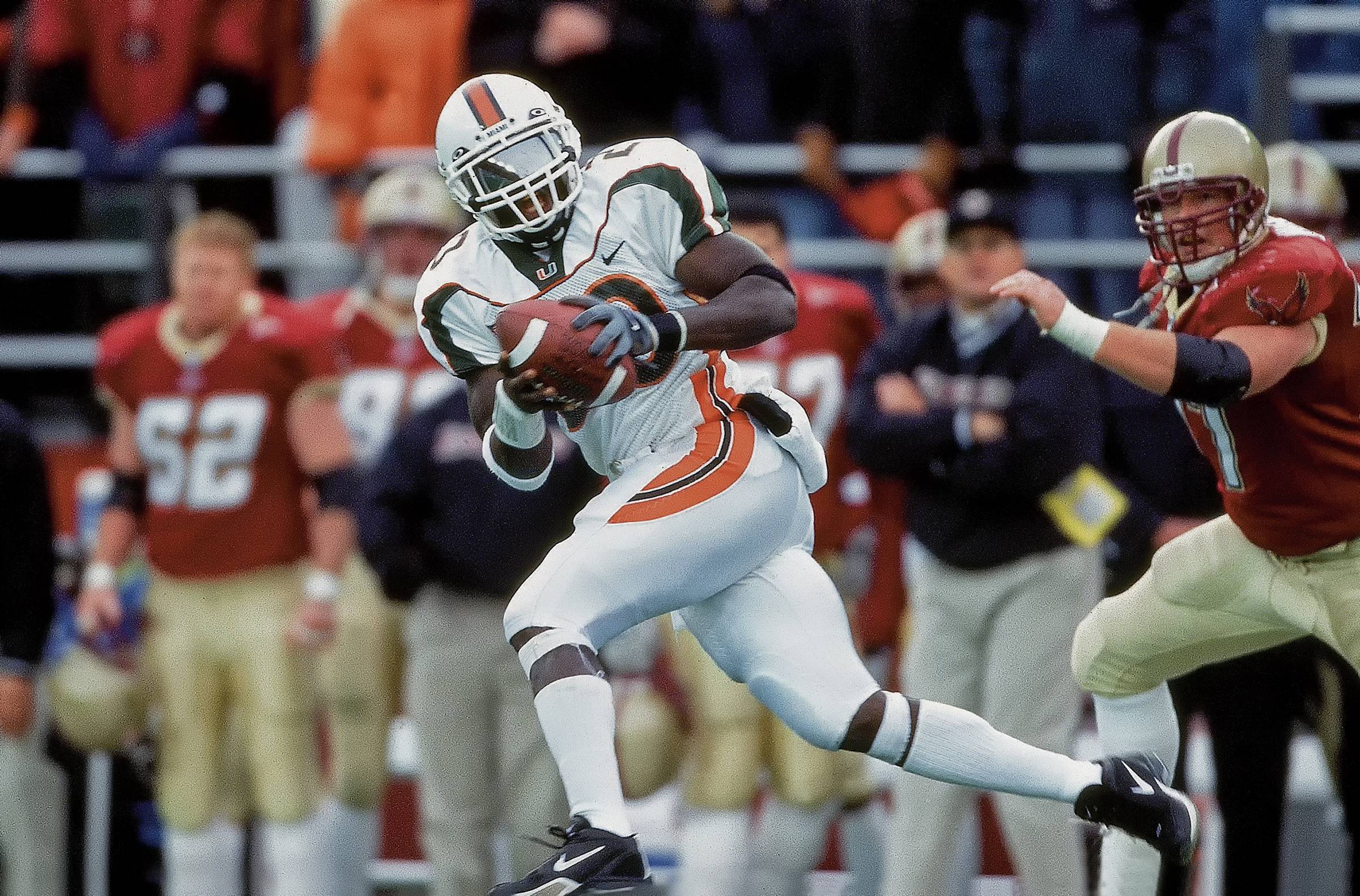
Oklahoma's modern case starts at quarterback, where Baker Mayfield, Kyler Murray and Jalen Hurts represent very different routes into professional relevance. Hurts illustrates our transfer rule particularly clearly: he spent meaningful college years at Alabama but finished his college career in Norman, so his NFL outcome counts once, for Oklahoma. The same final-college principle applies to Mayfield, who began at Texas Tech. Without that rule, transfer-era lists inflate totals by awarding one professional career to two universities.
Yet Oklahoma is not a quarterback-only assembly line. Adrian Peterson delivered an elite rushing prime; Trent Williams developed into one of football's best offensive tackles; CeeDee Lamb became a centerpiece receiver. Those players add all-position substance to the star-quarterback headlines. We value Williams' long-term tackle play every bit as seriously as a quarterback's television exposure. Oklahoma sits seventh because its outstanding peaks come with enough breadth to survive evaluation beyond the position that receives most of the attention.
6. USC: An older wave of legends and a renewed receiving pipeline
USC's strongest evidence within this window includes Troy Polamalu, whose instinctive safety play changed games, and Tyron Smith, who made elite tackle protection look routine. Carson Palmer provided a long quarterback career, while Leonard Williams supplied durable defensive-line production. Amon-Ra St. Brown then demonstrated that an athlete's draft slot need not reflect his eventual professional ceiling. This is a program whose alumni occupy genuinely different roles in the league's best offenses and defenses.
There are important limits. A college Heisman trophy is evidence of college excellence, not a substitute for NFL achievement. Similarly, a player selected first overall belongs in the conversation only to the extent that his professional work eventually justifies it. USC's cultural visibility and long draft tradition help explain its reach, but the ranking rests on NFL careers generated by the defined draft window — not on athletes from its celebrated twentieth-century teams.
5. Miami: One of the greatest early-2000s NFL cohorts ever assembled
Ed Reed and Andre Johnson make Miami's top-end case almost impossible to dismiss. Reed was a transformational NFL safety; Johnson accumulated elite receiving seasons without needing an annual title contender around him. Frank Gore offered extraordinary durability at running back, Vince Wilfork anchored the interior of NFL defenses, Calais Campbell became a long-lasting defensive force, and Devin Hester turned the return game into an offensive weapon in its own right.
GOATIFY
GOATIFY NFL
Celebrate game-changing quarterbacks, safeties and receivers with NFL fan favorites.
Miami is fifth rather than higher because the intensity of its 2000s peak was not matched by equal superstar output in every subsequent draft class. That should not diminish what the Hurricanes produced. A legitimate ranking must recognize special-teams value, long careers at defensive tackle, and difficult roles in the secondary, not just quarterbacks and receivers. It must also refuse to pull older Miami legends such as Ray Lewis into this particular window: Lewis was drafted in 1996. Miami has enough relevant talent without borrowing from an earlier era.
#4–#3: Georgia and LSU — the modern two-way factories

4. Georgia: From Matthew Stafford to a defense-first NFL conveyor belt
Georgia's case links eras rather than relying on one brilliant recruiting cycle. Matthew Stafford became a long-term starting quarterback and Super Bowl winner. Roquan Smith developed into a high-end linebacker; Nick Chubb became a model of powerful, decisive rushing before injury altered his trajectory. More recent classes have supplied Jalen Carter's interior disruption, Jordan Davis' rare physical profile, and Brock Bowers' immediate threat as a pass-catching tight end. The variety is critical: a team cannot build a complete roster out of glamorous first-round edge rushers alone.
The Bulldogs' 2022 class is an especially useful scale check: fifteen players were drafted in that single year, a seven-round record, followed by thirteen Georgia players in the 2025 draft. Volume alone would be a weak criterion, because a seventh-round selection is a prediction, not proof of an NFL career. But Georgia's defensive front has repeatedly converted college dominance into genuine professional starter quality, while its offensive alumni offer more than complementary pieces.
There is an upside to setting a completed-season cutoff. Players from the 2024 and 2025 drafts can be included as evidence of the pipeline without pretending they have already earned long-career distinctions. Bowers' early impact matters, but a decade of established offensive-line excellence must still outweigh a single exhilarating rookie stretch. Georgia ranks fourth because its depth and recent pace are exceptional; it remains behind LSU in our weighting of fully established star careers.
3. LSU: Receivers, defensive backs and a franchise quarterback
LSU has an extraordinary collection of players who became primary professional playmakers. Joe Burrow turned a transfer from Ohio State into an LSU Heisman season and later became the central figure in Cincinnati's modern offense. Justin Jefferson and Ja'Marr Chase transformed receiving expectations, while Patrick Peterson and Tyrann Mathieu gave the secondary a generation of elite recognition. Danielle Hunter and Derek Stingley Jr. add distinct defensive profiles, one around pass rush and one around coverage.
LSU's famous 2019 college offense is an important origin story, but we do not award NFL points for what happened in a college championship game. Burrow, Jefferson and Chase each need to be judged by what they subsequently did against professional opposition. They pass that test on different paths and timelines. Burrow is credited to LSU under the final-college rule, not split between LSU and Ohio State. The same logic keeps the overall ranking auditable when modern rosters have multiple transfers.
LSU edges Georgia here through the concentration of established, league-altering skill-position stars combined with premier defensive backs. Reasonable readers can reverse those two schools if they place greater weight on the volume of defensive-line starters and the speed of Georgia's recent draft output. That is a defensible disagreement about criteria, not a contradiction in the underlying draft data.
GOATIFY
GOATIFY NFL
Discover GOATIFY NFL picks inspired by football's biggest names.
#2–#1: Ohio State and Alabama — where elite volume meets elite outcomes
2. Ohio State: Maybe the most complete modern depth chart
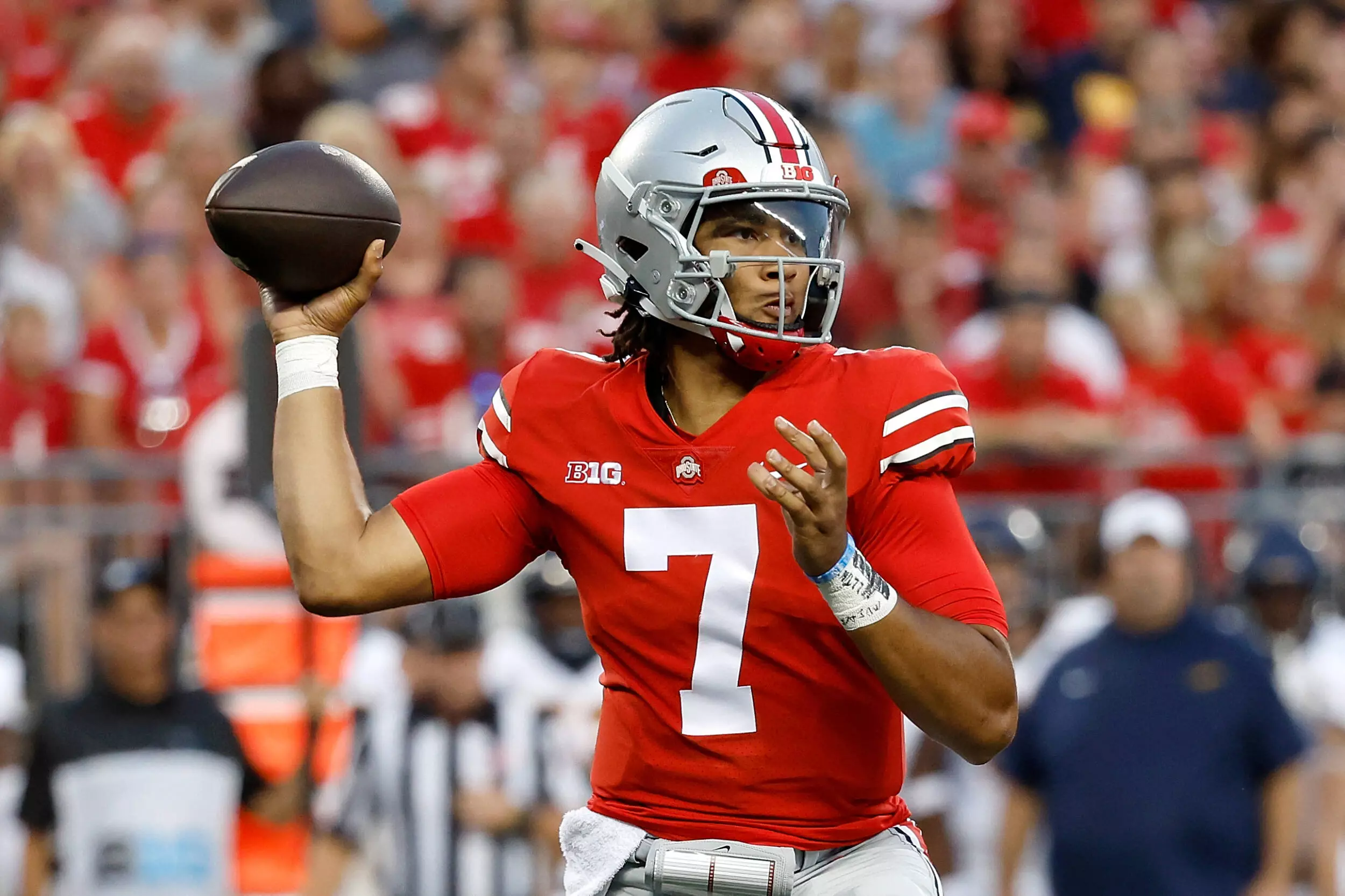
If the task were to fill out a professional roster using alumni across positions, Ohio State would make an exceptionally persuasive first pick. C.J. Stroud supplies high-level quarterback value; Nick and Joey Bosa have been premium edge defenders; Cameron Heyward built a career on interior power and consistency; Marshon Lattimore became an accomplished corner. On offense, Ezekiel Elliott's peak carried enormous volume, Terry McLaurin grew into a trusted receiver, and Garrett Wilson and other recent wideouts have kept the passing-game pipeline productive.
Ohio State's strength is its lack of a glaring position-group gap. The 2025 NFL draft underlined that scale when fourteen Buckeyes were selected, more than any other university that year. Yet the result should be interpreted carefully. Fourteen selections are fourteen chances to succeed, not fourteen proven professionals. That distinction prevents the ranking from turning into an annual draft-count chart with a famous school logo pasted at the top.
The Buckeyes arguably deserve number one on breadth alone. Our judgment is narrower: after recognizing the excellence of Ohio State's defensive front and receiver development, Alabama retains a slight edge in the volume of multi-year, elite-level outcomes across both sides of the ball during the window. The gap is small enough that a different weighting of quarterback and trench value could change the result.
1. Alabama: The strongest blend of volume, premium talent and proven careers
Alabama's NFL production during the modern Saban-era span has become a roster-building language of its own. Derrick Henry produced a historically imposing rushing peak. Julio Jones became a premier downfield and intermediate target; Amari Cooper and DeVonta Smith added high-end receiving careers from different draft eras. Patrick Surtain II and Minkah Fitzpatrick provided top-tier secondary talent, while Quinnen Williams, Jonathan Allen and others supplied the kind of defensive-line quality every team pays a premium to acquire.
That is why Alabama leads this subjective top ten. The program paired regular draft volume with numerous players who subsequently justified their investment across multiple seasons. A standout college quarterback alone does not carry the ranking; neither does the size of a recruiting class. Alabama's advantage is that its best alumni can affect a game from wide receiver, corner, safety, defensive tackle and running back, and its production persisted across more than a single golden year.
Transfers are treated consistently even where it costs Alabama a marquee name: Jalen Hurts' NFL career belongs to Oklahoma in this ranking because Oklahoma was his final college stop. We also do not count every NFL reserve as equivalent to a repeat All-Pro. A good draft record matters, but turning picks into genuine stars is what puts Alabama on top. Ohio State's strength means this is a debate worth having, not an unchallengeable mathematical verdict.
Alabama takes the top spot because sustained high-end NFL outcomes across offense and defense outweigh any one school's draft-night headline. Ohio State is a close second and could plausibly lead if positional breadth and recent draft depth received more weight. LSU and Georgia show how explosive modern pipelines can be, while Miami, USC and Wisconsin prove that a single magnificent era or a position group's longevity can still have an enormous professional footprint.
There is no sensible way to turn a Hall of Fame left tackle, a quarterback who carried a franchise, an elite safety and a perennial receiving star into one undisputed number. That is why this list states its window and transfer rules rather than presenting subjective judgments as a database verdict. The important question is not who collected the most draft-day applause. It is whose alumni actually changed the NFL after the applause stopped.
GOATIFY
GOATIFY NFL
Shop GOATIFY NFL and American football shirts, hoodies and stickers.





















