Neighbours Had Five Assists. Hellebuyck Lasted Nine Minutes.
GOATIFYNine goals, six conceded, one franchise record and a starting goaltender removed before the first period was halfway over. The St. Louis Blues' 9–6 victory against the New Jersey Devils on November 21, 2026, was an unforgettable scoreline and an awkward advertisement for defensive hockey. St. Louis left Enterprise Center with its third consecutive win. New Jersey left knowing the four goals that chased Connor Hellebuyck were only part of a much bigger breakdown.
Jake Neighbours supplied the cleverest work on the winning side. His five assists tied a Blues single-game record, and three of them arrived before six minutes had elapsed. That early burst was quick enough to surpass Brett Hull's club mark for the fastest three points from the opening faceoff. Neighbours did not need to score to control the story: he kept connecting rushes, finishing plays with passes and making different teammates the beneficiaries.
But the scoreboard conceals an important distinction. Nine goals from 23 St. Louis shots is the kind of efficiency nobody should project forward as normal. At the other end, Jordan Binnington had to make 37 saves while the Blues repeatedly allowed a three-goal advantage to become uncomfortable. A team can be spectacular and sloppy in the same game, and these Blues managed both at full volume.
For New Jersey, Hellebuyck's disastrous nine-minute appearance will attract the obvious attention. Coach Sheldon Keefe's reaction pointed elsewhere: the quality of chances and team defending. That is where this wild result becomes useful rather than merely entertaining. It shows how quickly a game can escape a contender, how a playmaking winger can elevate a line, and why St. Louis still has work to do before celebrating an offensive revival as a completed turnaround.
Five Assists, Three Before Six Minutes: Neighbours Rewrote the Start

Jake Neighbours collected a point without scoring a goal, and then kept doing it until the Blues record book needed updating. His five assists equalled the franchise's single-game high, an achievement previously reached by six St. Louis players. Torey Krug had been the last, in February 2024. Neighbours now sits in that company because five separate goals involved the same increasingly important passing link, not because he accumulated empty touches after the game had been decided.
The extraordinary part came before most spectators had settled into the first period. Brandon Carlo scored at 1:51, Jimmy Snuggerud added a power-play strike at 2:13, and Robert Thomas finished a rush at 5:53. Neighbours earned an assist on each of those goals. His three points in 5:53 beat the franchise mark Brett Hull set in 1996, when Hull did it in 6:57. Only Guy Lafleur and Pavol Demitra had recorded three points from the start of an NHL game faster, according to the league's recap. That is a much more specific achievement than simply saying the winger had a big night.
The pass to Thomas illustrated why the stat line mattered. Moving down the right side, Neighbours changed his body position and delivered the puck across to the far post, where Thomas could finish on his backhand. The beauty of that action is not raw velocity. It is the defender being forced to choose between challenging the carrier and protecting the receiver, while the puck travels into a better shooting lane. The play gave St. Louis a three-goal cushion before the six-minute mark, and it identified Neighbours as a creator in his own right.
His fifth helper came as the Blues continued to manufacture offense with different units and different types of chances. On Logan Mailloux's second-period goal, for example, Neighbours found a trailing teammate in space, converting a moving attack into a shooting opportunity. The defenseman scored, but the winger's recognition made the finish possible. There is a pattern to those assists: rather than repeatedly forcing the same pass, Neighbours found the player whose route or timing created separation.
GOATIFY
GOATIFY Hockey
Neighbours tied a club record with five assists. Explore GOATIFY hockey styles for big-game fans.


Neighbours had nine points across his previous three games, including eight assists and one goal, after a season that had not always delivered smooth production. His recent move into a more prominent offensive assignment is relevant context. So is the distinction between influence and finishing luck. Five assists are not a guarantee of a permanent five-point pace. They are evidence that the Blues can involve more than one shooter when their forwards support the puck and move together.
The wider lineup matters too. Thomas was already coming into this game with two consecutive three-point outings; his third straight made the line's momentum harder to dismiss as a one-game anomaly. Even so, the right evaluation is not to declare every top-line combination solved. It is to notice that the Blues are creating chances through passing decisions that let multiple skaters be dangerous. On Saturday, the clearest embodiment of that approach wore number 63.
Hellebuyck Was Gone at 9:03. New Jersey's Defense Started It
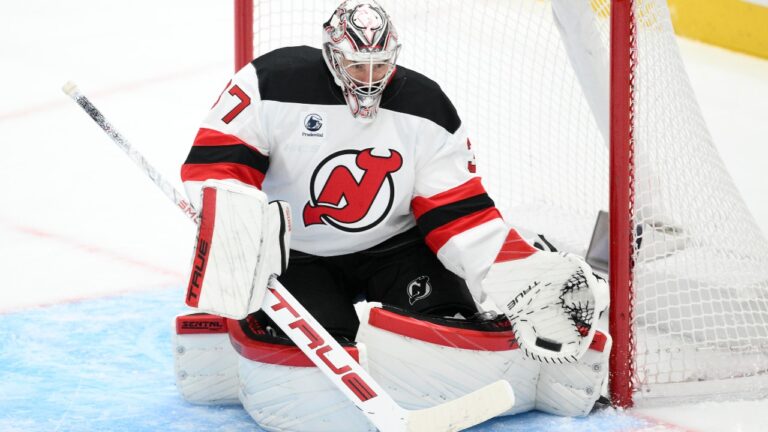
Connor Hellebuyck's night lasted 9 minutes and 3 seconds. He stopped the first two shots he faced and allowed goals on the next four, a startling sequence for a goalie who arrived in New Jersey with an elite reputation. The Devils replaced him with Jake Allen after Philip Broberg pushed the Blues' lead to 4–1. At that moment, removing the starter was understandable. What was less understandable was how often St. Louis had been given room to execute.
Brandon Carlo opened the scoring only 1:51 after puck drop with a wrist shot through traffic from the right point. It was the defenseman's first goal since October 14, 2024, when he played for Boston. New Jersey challenged for interference involving Jimmy Snuggerud in front of the crease. The goal survived review, and the unsuccessful challenge produced a delay-of-game penalty. Just 22 seconds later, Snuggerud scored on the power play to double the advantage. That two-goal burst combined opportunism with an immediate punishment for a failed review.
The third goal offered a different warning. Neighbours found Robert Thomas arriving across the goalmouth at 5:53, creating a finish in a dangerous area rather than settling for another perimeter attempt. Jesper Boqvist cut the deficit to 3–1 at 8:15, but Broberg restored the three-goal gap 48 seconds later. Four goals allowed on six shots is an awful statistical line for any starter; it also means the opponent converted four of the first six attempts that actually reached the net. That is not something to isolate from the defense giving away those attempts.
Sheldon Keefe's postgame comments made that point emphatically. The New Jersey coach held the full team, and himself, responsible for a defensive performance that gave the Blues repeated high-quality looks. Goalie performance and defensive structure can fail together, but those problems need different corrections. A goaltender can adjust depth, tracking and rebound control. He cannot restore a teammate's missed assignment or close a dangerous passing lane from the crease.
The Devils actually showed enough attack to get themselves back into the game. Timo Meier and Luke Hughes scored late in the first, transforming a 4–1 disaster into a 4–3 intermission. Connor Brown then made it 5–4 early in the second. Those rallies reveal why the defeat was not simply a story of one overwhelmed goalkeeper. New Jersey still had scoring resources. Its problem was that every recovery seemed to require creating the next crisis: after Brown pulled the team within one, St. Louis answered with two goals before the halfway point of the second period.
Allen's four goals conceded on 16 shots will not rescue the team-level numbers, and the Devils' problems cannot be tidied away by swapping the name in the crease. The most useful video review would start with the possessions before the shots: entries conceded too easily, failed clears, uncovered receivers and the support or absence of support around the slot. Otherwise Hellebuyck's nine minutes become a distraction from the more serious question of why New Jersey needed its goaltenders to survive those opportunities in the first place.
GOATIFY
GOATIFY Hockey
A nine-minute goalie change made NHL headlines. Browse GOATIFY hockey fan apparel.
Thomas, Broberg and Mailloux Turned Passing Into Nine Goals

Five assists put Neighbours at the center of the celebration, but the Blues' nine goals were not a one-line show. Robert Thomas, Philip Broberg and Logan Mailloux each finished with a goal and two assists. Brandon Carlo contributed a goal and an assist. Jonatan Berggren scored twice, while Jimmy Snuggerud, Pavel Buchnevich and Mason McTavish each provided another finish. A player can have a historic passing night only if several teammates convert the opportunities, and St. Louis had scorers operating from virtually every part of its lineup.
Carlo's point shot started the rout; Snuggerud's one-timer on the advantage showed the value of cashing in on an opponent's unnecessary penalty. Thomas scored from the far post after Neighbours' cross-ice setup. Broberg came through the middle to make it 4–1 and finish Hellebuyck's night. Those are different routes to the net: traffic, special-teams execution, a backdoor finish and a defender joining a dangerous area. It matters because opponents cannot counter all of them by marking one shooter.
The middle period provided a useful stress test, if not an aesthetically pleasing one. New Jersey had closed to 4–3 before the first intermission. Buchnevich extended the lead to 5–3 on a second-period odd-man rush, cutting toward the crease before slipping the puck over the line. Connor Brown then responded immediately for 5–4 after New Jersey forced a turnover in the Blues' end. The game was suddenly vulnerable to the next mistake. St. Louis responded not by freezing the puck in its own zone but by returning to the offensive pressure that had created its lead.
Logan Mailloux scored the 6–4 goal after Neighbours fed him on a rush. Mason McTavish added a power-play marker at 8:59 to restore a three-goal gap, making it 7–4. Those two goals prevented the Devils' second comeback from turning into a tie. They also underscore a central truth about high-scoring wins: the scoreboard can hide moments when the eventual winner was one poor shift away from a genuinely different result.
The shooting numbers show how unusual the finishing was. St. Louis scored nine times on 23 shots, a conversion rate of roughly 39%. One of those nine was an empty-net goal, so that raw percentage is not a clean measure of goaltender efficiency; it is still a reminder that the Blues did not need prolonged shot volume to manufacture a huge score. Quality of chances, power-play timing, a goalie change and the Devils' defensive breakdown all influenced that output.
The best news for St. Louis is that the opportunities were shared among forwards and defensemen. The caveat is that a team cannot plan on turning roughly four out of every ten shots into goals. When the finishing normalizes, movement without the puck, quick decisions through the middle and a consistent willingness to support rushes must remain. Thomas' run of three consecutive three-point games and Neighbours' sudden passing surge give the coaching staff something tangible to build on. Neither excuses the need to tighten the other end of the rink.
Berggren Scored Twice. Six Conceded Still Leaves a Warning
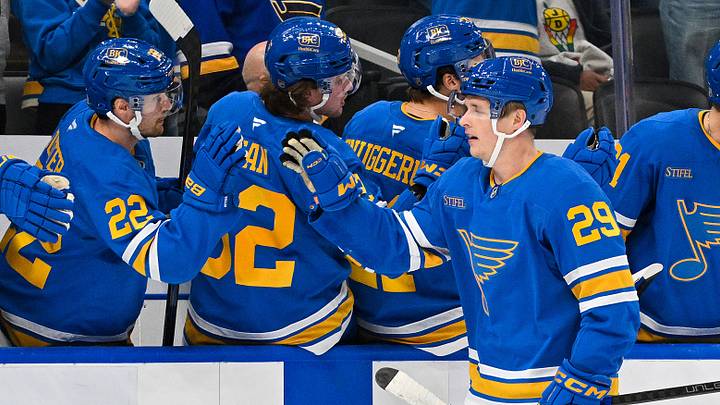
The first minute of the third period looked like the moment the Blues could finally relax. Jonatan Berggren broke away and scored at 1:07, extending the margin to 8–4. Instead, New Jersey found two more goals: Evan Rodrigues redirected a point shot at 3:52, and Declan Chisholm struck with 3:19 remaining. At 8–6, a game that once felt like a first-period knockout was still asking St. Louis to play a competent closing sequence. Berggren's empty-net finish at 17:43 finally turned it into a 9–6 final.
GOATIFY
GOATIFY Hockey
Nine goals came from across the Blues lineup. See GOATIFY designs for hockey supporters.
Berggren's two goals deserve attention because they came from a different part of the offensive story than Neighbours' five helpers. A rush breakaway and an empty-net conversion are not the same tactical challenge. One requires timing and execution with the goalie set; the other usually reflects pressure from a trailing opponent pushing bodies forward. Both count on the scoreboard, but only the first tells us much about what the Blues might reproduce in a tighter game.
Jordan Binnington was busy at the opposite end, making 37 saves despite his teammates providing nine goals. It is an unusual sort of winning workload. A goalie should not have to see that much traffic when the team in front of him is consistently ahead by multiple goals. St. Louis allowed the Devils to creep from 4–1 to 4–3, from 5–3 to 5–4 and eventually from 8–4 to 8–6. Each recovery put unnecessary stress on a game that the Blues had been in position to control.
Coach Jim Montgomery's concerns about defensive intensity and slot protection were not academic. The Devils repeatedly found a way back through St. Louis' mistakes and penalties. The Blues were able to outscore those errors on Saturday; many opponents will not allow them nine opportunities to do so. In a lower-scoring matchup, giving up two or three avoidable goals can decide everything. This is why the story should not end with a celebratory screenshot of the final score.
There is useful context for the attacking optimism. The Blues had just scored eight against Anaheim in another loose contest, then beaten Pittsburgh 5–2. Their three-game run therefore featured 22 goals. That is a remarkable burst, and Neighbours' nine points across those games suggest St. Louis is getting timely production from more than its most famous scorers. But two home games with eight-plus goals in a row are rare enough that this streak should be viewed as momentum rather than as a new baseline.
New Jersey has its own lesson to take forward. The club entered Saturday with a strong record, and Hellebuyck's arrival from Winnipeg had been a major statement of ambition. One terrible outing does not erase his work in earlier starts. Nor should the Devils dismiss the collective defending because they scored six. Keefe needs less open ice in front of his goaltenders and better recovery after turnovers. St. Louis needs the same discipline at moments when possession flips.
An extraordinary night can reveal more than a month of ordinary games, but it can also seduce teams into reading the wrong thing. Neighbours' pass timing, Thomas' finishing and contributions from the blue line looked repeatable as ideas. A 39% raw shooting conversion and six goals conceded did not. The next Blues performance will be more informative if they need only three or four goals to win. Their challenge is to keep the passing sharp while making the game less frantic when they already have the lead.
Jake Neighbours deserves the headline. Five assists, three points in less than six minutes and a place beside some of the Blues' most productive single-game playmakers represent a remarkable evening. Robert Thomas, Philip Broberg, Logan Mailloux, Brandon Carlo and Jonatan Berggren all made sure those passes and chances turned into genuine scoreboard separation.
But the lasting question is not whether St. Louis can score nine every Saturday. It cannot responsibly plan to do so. The better question is whether the new attacking connections survive ordinary shooting percentages and whether the defending improves enough that three-goal leads stay three-goal leads. New Jersey faces the opposite problem: an early goaltending change cannot become an excuse for exposing the crease to repeated high-danger situations.
The Blues won 9–6, moved to 12–9–2 and created a night their supporters will remember. Neighbours' record belongs in the history book. The defensive lessons belong in the next practice.
GOATIFY
GOATIFY Hockey
Shop GOATIFY NHL and hockey shirts, hoodies and stickers.