

Piastri Takes a 10-Place Vegas Hit. McLaren Has a Bigger Problem.
GOATIFYOscar Piastri will arrive at the 2026 Las Vegas Grand Prix knowing that one of his most important results is already written into the weekend: McLaren expects its Australian driver to serve a ten-place grid penalty after fitting a fifth Mercedes internal-combustion engine. The change follows a reliability issue, rather than a bid to sacrifice grid position for a speculative power increase. Before practice has begun, Piastri's path to a strong result has become significantly more complicated.
That distinction matters because McLaren is making two power-unit decisions at once. Both of its drivers are scheduled to run a revised Mercedes turbocharger developed through Formula 1's ADUO catch-up mechanism. Piastri's new combustion engine is an additional, separate change, and that is what triggers his penalty. At Mercedes itself, champion Kimi Antonelli is scheduled to try the updated turbo while George Russell protects his starting position by retaining the existing specification.
The biggest issue is not simply where Piastri starts. With three races left, McLaren is chasing Red Bull for third in the constructors' standings, Lando Norris has found form, and Piastri is desperate to end a difficult season positively. Vegas offers long straights and potential overtaking, but turning a costly reliability decision into points will demand much more than a brave first lap.
The ten-place hit is a reliability bill, not a performance gamble

The headline number is ten. Piastri has already used four internal-combustion engines in 2026, reaching the relevant seasonal allocation. His team says another unit is required after a reliability problem. Taking a fifth for the first time produces a ten-place grid demotion at Las Vegas. This is not the same thing as being handed a time penalty during the race, and it is not yet an actual classified starting position. The penalty is applied to a qualifying result and interacts with whatever else happens in the grid-setting process.
Imagine a straightforward qualifying session with no other penalties or unusual grid rules affecting the arithmetic. A driver qualifying fifth would be pushed a long way into the midfield; a driver qualifying on pole would still be forced deep into the order. Those examples illustrate the size of the handicap rather than predict where Piastri will line up. Qualifying must happen first, other competitors may have their own penalties, and officials will establish the actual grid. The central reality is unchanged: ten positions are an expensive currency at a street race.
McLaren has described a reliability issue but has not publicly established the full failure mechanism, the condition of every alternative engine in its pool or the detailed risk calculation behind the change. It would be wrong to invent a cracked component, assign blame to an engineer, or conclude that Piastri's driving caused the problem. What the team has stated is sufficient to understand the trade: accept a predictable starting-grid disadvantage now rather than rely on an engine it does not want to use through the remaining stretch.
That is an especially important distinction this late in the season. A fresh unit can offer the practical benefit of an engine the team believes is fit for duty, but a fresh engine is not automatically a faster engine under race conditions. The performance question depends on specification, operating parameters, reliability and the surrounding car. The team has not released a measured lap-time advantage that would justify calling Piastri's change a pure speed play. The first-order story is protecting the ability to finish races.
There is also a difference between engine-allocation penalties and the new turbo specification. Formula 1 power units contain distinct regulated elements. A story that bundles all power-unit changes into one vague 'new engine' risks leading fans to the false conclusion that Norris, Antonelli and Piastri all face the same punishment. They do not. McLaren's announced ten-place sanction attaches to Piastri's additional internal-combustion engine, not simply to the fact that an ADUO-updated turbo exists.
GOATIFY
GOATIFY Formula 1
Shop GOATIFY Formula 1 shirts, hoodies and racing stickers.


The practical test will be whether the replacement gives Piastri an uninterrupted race weekend. The penalty will already have been paid when the lights go out, but the reliability benefit is only meaningful if the car completes the distance and generates points. There is no need to convert that conditional possibility into a certainty before practice, qualifying or the race. For now, McLaren has traded a known grid cost against an unquantified risk it considered unacceptable.
Las Vegas offers passing lanes, but no free recovery drive

It is tempting to soften a ten-place penalty by pointing to Las Vegas. The Strip Circuit has long full-throttle sections, enormous braking zones and significant opportunities to slipstream and attack. McLaren has expressed confidence that overtaking is possible here. That is a defensible reason to choose this race to take a necessary penalty rather than defer the headache to a venue where passing can be still more awkward. It is not proof that an efficient recovery will happen.
Starting in traffic changes the entire shape of an afternoon. The front-running car can choose its preferred pace more often, manage its tyres in clean air and respond directly to the nearest rival. A driver emerging from the midfield may spend multiple laps in the wake of cars that are quick in a straight line but slower across a full lap. Passing one opponent is not the same as instantly inheriting the clean air of the next one. The time cost accumulates even when every individual overtake looks impressive on television.
The Las Vegas night setting adds its own demands. Forecasts ahead of the race indicate cool and broadly dry conditions, with temperatures well below those of many conventional F1 weekends. Generating tyre temperature, maintaining grip through corners and getting a consistent braking platform can all become important. The teams will have to learn what the track offers during the actual sessions; treating a midweek forecast as an official race result would be absurd. Surface evolution and a crowded timing window can change the picture quickly.
The 2026 cars also require a different approach from their predecessors. Energy deployment, active aerodynamics and the balance between braking, battery recovery and acceleration are bigger parts of the driving equation. A car may be fast enough to close in one sector yet unable to complete the pass exactly where the driver wants. On a track with long straights, those details are not an excuse for poor overtaking; they are the mechanics that decide whether a recovery attempt becomes efficient or costly.
Qualifying still matters enormously. If Piastri can produce a front-running lap, the penalty puts him in a more useful starting region than a mediocre qualifying performance would. The ten-place drop does not erase the advantage of being quick before it is applied. But a low grid slot raises the risk of being caught in another driver's incident, delayed through the first corners or forced into a strategy that sacrifices ideal tyre life to escape a queue. No team controls those outside variables.
The clearest strategic objective is therefore not 'pass ten cars' as a stand-alone achievement. It is finish as high as possible, limit the time lost in the pack, make the tyre and energy choices work together and avoid introducing more risk than the potential gain is worth. Safety-car timing and pit-stop windows could help or hurt, but predicting an intervention before the race would confuse an option with an event. A clean recovery is possible. It still has to be earned lap after lap.
GOATIFY
GOATIFY Formula 1
Shop GOATIFY Formula 1 shirts, hoodies and racing stickers.


The new turbo is a separate technical test—and Russell shows why
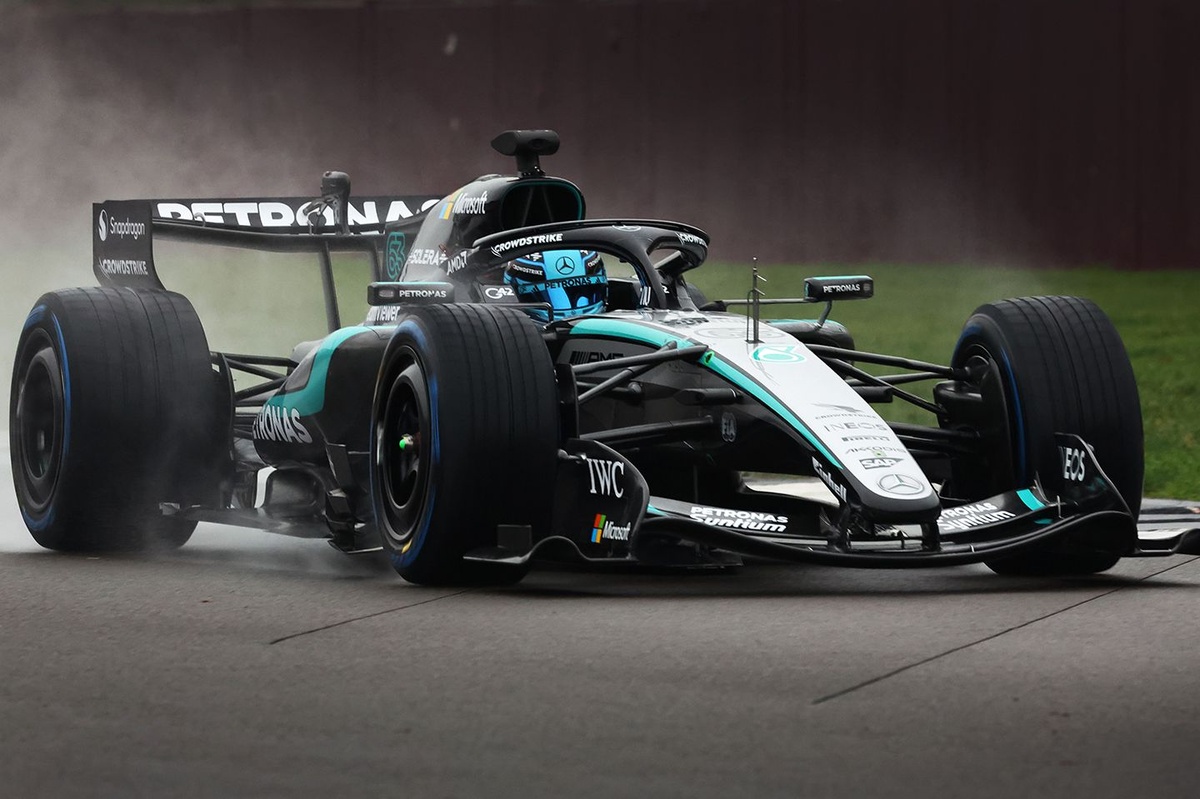
McLaren's other announcement risks being lost behind the grid-penalty headline. Both of its cars are expected to use an updated Mercedes turbocharger, part of the manufacturer development allowed under Formula 1's Additional Development and Upgrade Opportunities framework, commonly shortened to ADUO. The mechanism creates a route for manufacturers to address a performance shortfall within the regulations. A new specification is not, by itself, evidence that every powered team suddenly receives a dramatic boost.
The expectation communicated with the upgrade is much more modest. McLaren anticipates a relatively small improvement. Mercedes team principal Toto Wolff likewise framed the updated turbo primarily as something to evaluate during a competitive weekend, not as a guaranteed leap in lap time. That leaves a meaningful but limited question for engineers: does the revised unit deliver the intended improvement reliably in the conditions and deployment patterns that matter when the stopwatch is running?
Mercedes' own driver split makes the trade-off unusually clear. The factory team intends to run the updated turbo with newly crowned world champion Kimi Antonelli. George Russell, however, will retain the existing specification because his own component-allocation situation makes preserving grid position more valuable than taking a small expected improvement. This is not a contradiction. Two drivers in the same team can make rationally different choices when they have different component histories and different immediate risks.
Russell's choice also offers a useful caution when evaluating Piastri. A ten-place penalty is a large price to pay for a theoretical gain measured as small. If McLaren's only motivation were the upgraded turbo, the grid-drop explanation would be inadequate. The team's account instead separates Piastri's reliability-driven internal-combustion engine from the update available on the turbo side. Conflating those two choices produces a more dramatic but less accurate article.
Antonelli's circumstances underline how championship context affects decisions. He has already clinched the 2026 drivers' title, while Mercedes has settled the constructors' championship. That creates room for the works team to gather information about the revised component without having to protect a title lead in exactly the same way it would earlier in the season. Yet the new champion still has races to win, and Mercedes has every reason to value clean running and technical understanding ahead of the following year. A test in race conditions is meaningful precisely because the results cannot be known in advance.
For McLaren, the ADUO turbo is a potential incremental tool in a different fight. The team cannot count on a tiny power-unit improvement to erase a sizeable grid penalty, but small changes may still matter over a full weekend, especially if cars are closely matched. The relevant variables are not limited to peak speed: overall driveability, deployment consistency, integration with the chassis and confidence in race-distance operation all shape the outcome. None of those advantages has been proven in Las Vegas sessions yet.
That uncertainty makes the opening practice sessions worth watching. It will be possible to compare the running programs, listen to team explanations and see how reliably the cars complete representative stints. But comparisons have limits: differing fuel loads, tyres, deployment settings and traffic can make a single practice lap misleading. The important story is that Mercedes-powered teams have several separate component choices, and the apparent cost-benefit calculation differs from driver to driver.
McLaren's real deadline is the 17-point Red Bull gap
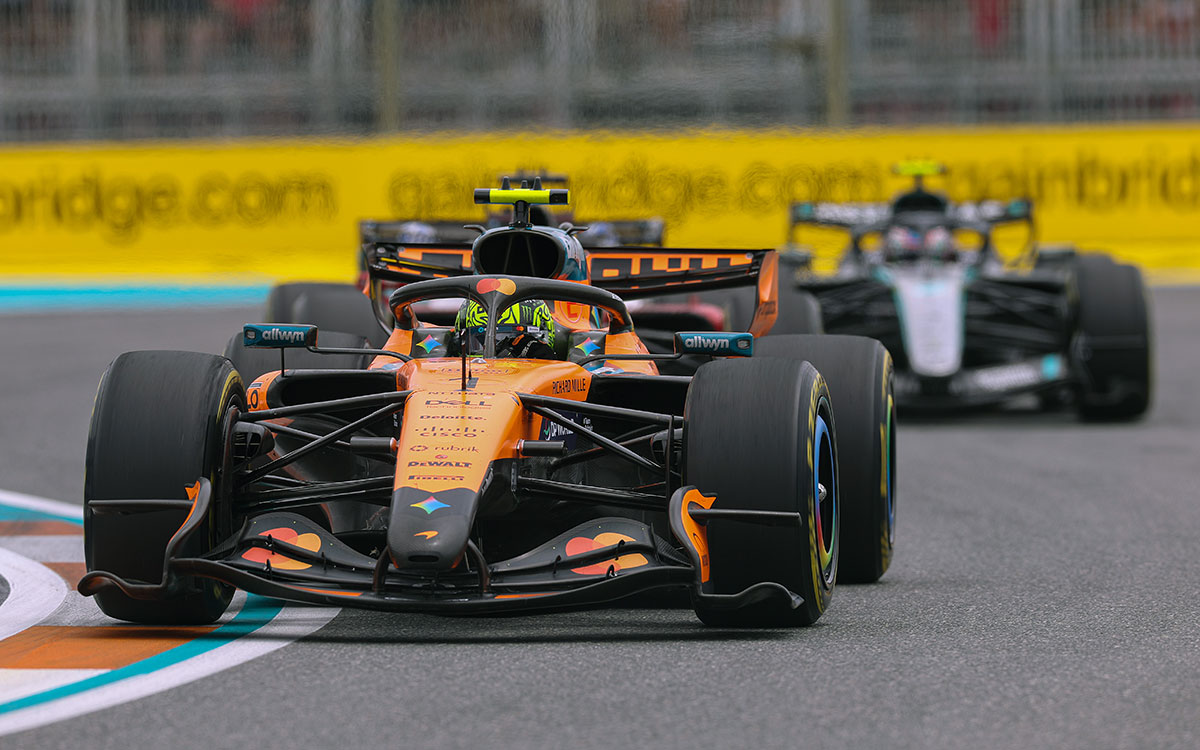
The bigger reason this feels painful is the constructors' table. After 20 of 23 rounds, Mercedes leads with 652 points and Ferrari sits second on 510. Red Bull has 415, while McLaren follows on 398. That is a seventeen-point deficit between third and fourth. With Las Vegas, Qatar and Abu Dhabi still to run, neither team can treat that gap as settled, and neither can afford to regard an avoidable low-scoring weekend as harmless.
GOATIFY
GOATIFY Formula 1
Shop GOATIFY Formula 1 shirts, hoodies and racing stickers.


Lando Norris provides one side of McLaren's argument. He won the previous race in São Paulo and stands sixth in the drivers' championship on 246 points. Piastri is seventh on 152, a 94-point difference between teammates. That is a strikingly different balance from the previous year, when Piastri was fighting deep into the championship campaign. It would be easy to use the points gap as a blunt verdict on the Australian, but points are the accumulated output of performance, car adaptation, reliability and race circumstances. The distinction matters when the latest setback is explicitly engine-related.
Piastri's best 2026 finishes include a runner-up result in Japan and third in Miami. He has not returned to the podium since those early-season performances. He has spoken about the work required to adapt to the 2026 car generation, while Norris has enjoyed a stronger recent run. A grid penalty at a venue where the team wants to reverse the constructors' deficit puts extra pressure on a driver whose year already has fewer rewards than expected. It is a competitive setback, not evidence of a lack of professionalism or commitment.
The team standings also explain why one rapid McLaren cannot do all the work. Constructors' points come from both cars. A team can beat its rival in a direct duel at the front yet lose the weekend overall if the second car becomes trapped outside the points or suffers an interruption. A strong Norris result would be valuable; a Piastri recovery could be what changes a merely respectable weekend into a meaningful gain. Conversely, Red Bull can defend its lead by collecting from both cars and avoiding preventable mistakes.
Seventeen points is neither a comfortable cushion nor an impossible mountain with three weekends remaining. F1's scoring system can produce substantial movement when a team has two good finishers, especially if the nearest rival encounters trouble. But that possibility cuts both ways. McLaren cannot book an imaginary comeback before racing has happened, just as Red Bull cannot bank the standings today and assume the final classifications will follow. The race, not a storyline, decides the swing.
There is one further irony. The world titles have already gone to Antonelli and Mercedes, but the remaining rounds still contain fierce incentives for everyone else. Verstappen is fighting to preserve second in the drivers' standings. Russell, Hamilton, Leclerc and Norris also have positions to chase. Red Bull and McLaren have prize-position stakes. A midfield starting place for Piastri can put him into direct contact with drivers who have objectives of their own, rather than creating a clear path through cars that willingly step aside.
The sensible target for Piastri and McLaren is therefore measurable, not cinematic: qualify as well as possible, minimize grid-drop damage, finish cleanly, and score enough to help the team reduce or overturn its deficit. If the revised power unit performs reliably and Piastri makes a disciplined charge, the choice may look justified even without a podium. If traffic or another issue intervenes, the race can still be disappointing despite the decision to prioritize reliability. This is a high-stakes engineering and execution story with no guaranteed Hollywood ending.
McLaren has already chosen the first compromise of its Las Vegas weekend: put a fifth combustion engine into Piastri's car and absorb ten lost grid positions. The team has not claimed the replacement is a miracle performance upgrade. It has described a reliability problem it needs to address, while also joining the Mercedes-backed rollout of a separately updated turbocharger.
What follows is the part that cannot be settled by the announcement. How far up the qualifying order can Piastri put the car? How much clean air can he find after the penalty? Will the revised power-unit package work without interruption? And can his recovery help McLaren close a seventeen-point deficit to Red Bull before the final two rounds? Those answers will emerge on track in Las Vegas, not from an early assumption that overtaking opportunities automatically cancel a ten-place loss.
GOATIFY
GOATIFY Formula 1
Shop GOATIFY Formula 1 shirts, hoodies and racing stickers.





















