

Coello and Chingotto Will Team Up in Russia. The Role Switch Is the Real Story.
GOATIFYArturo Coello and Federico Chingotto normally spend the biggest matches of their season trying to outthink one another. In December, they are set to walk onto the same side of the court. The two headline names are among 17 announced pairs for the RCC Padel League Master Final in Ekaterinburg, Russia, scheduled for December 3–5, 2026. It is a striking crossover between players best known as rivals in the Coello–Agustín Tapia versus Alejandro Galán–Chingotto battles.
This is not an announcement that either established Premier Padel partnership has permanently split. The Russian event sits outside the main Premier Padel circuit and offers a short, unusual experiment rather than proof of a 2027 transfer. Still, an atypical pairing creates a real sporting question: with Coello's left-handed attack and court coverage usually balanced by Tapia, how will Chingotto adapt to a less familiar left-court job while playing beside one of his biggest opponents?
A familiar rivalry becomes an unfamiliar left-right partnership
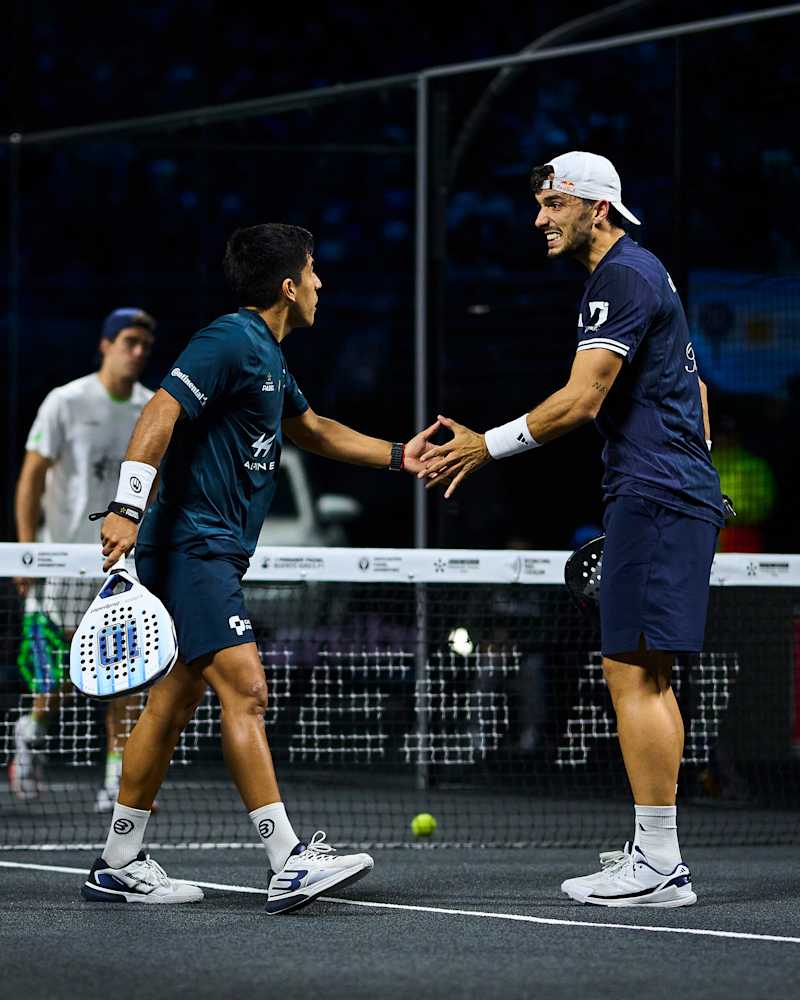
The headline looks like a fantasy partnership because the two players normally anchor different sides of one of padel's defining rivalries. Coello, the left-handed Spaniard, shares his usual court with Agustín Tapia. Chingotto, a right-hander, has built his established rhythm alongside the more attacking Alejandro Galán. Those combinations are familiar to anyone who has watched a major final, which is precisely why the December draw feels so strange.
The important complication is positional rather than personal. Coello generally occupies the right side of the court despite being left-handed, giving his partnership a left-handed attacking option from that channel and powerful coverage through the middle. Chingotto also normally plays the right side with Galán, and the Russian plan is expected to send the Argentine to the left. That is not a simple change of address: it changes the angles available from the back glass, the overheads he can choose and the positions from which he must make split-second decisions.
On the right, Chingotto's anticipation, defensive range and consistency can keep a rally alive until his partner finds the opening. Moving left would give him different responsibilities for finishing points and protecting the center. Coello's reach and ability to finish from difficult positions could help compensate, but having two accomplished players does not automatically create an accomplished pair. They must agree who takes balls arriving through the middle and how aggressively to close the net after a defensive exchange.
The contrast becomes clearer when remembering their most recent major clashes. In September's Paris Major final, Coello and Tapia beat Galán and Chingotto in three sets, 6–3, 4–6, 7–6. The score says this was a contest decided at the margins. Those same margins depend on familiarity: one partner knows when the other is likely to chase a lob, abandon a risky smash or call for a ball through the center. Coello and Chingotto do not possess that same shared match history as teammates.
Why has this pairing become possible? The report on the Russian field points to absences involving the regular partners. Tapia recently withdrew from Dubai P1 amid a physical issue, and Galán was recovering from a hand problem. That context explains the opening without suggesting that either athlete has announced a long-term separation. Their established pairs remain the relevant reference points for Premier Padel; this event is a special arrangement with its own schedule and incentives.
GOATIFY
GOATIFY Padel
Coello and Chingotto must build a new on-court partnership quickly. Explore GOATIFY padel-inspired apparel and accessories.


It is tempting to imagine a short spell of unrestrained attacking padel. Yet successful teams often win by knowing when not to attack. The two will need a clear plan for low balls, defensive lobs and the first volley after taking the net. If Chingotto can preserve his reliable decision-making from the opposite side, Coello may gain opportunities to be more aggressive. If the timing is awkward, opponents will have a simple target: ask the new partnership to make repeated decisions under pressure rather than allowing spectacular winners.
That gives the December matches their most useful test. The scoreboard will matter, but individual shots will be less revealing than the points that require communication. Watch who returns on the left, how the pair handles lobs into the center and whether Coello has to drift beyond his normal zones to cover. The event is a rare controlled experiment in the value of partnership chemistry, carried out in front of an actual competitive field rather than in a practice session.
The field is stronger than an exhibition label suggests

Even without the Coello–Chingotto surprise, the RCC field would demand attention. Organizers have announced 17 pairings for the December 3–5 final, including a recognizable mix of established Premier Padel figures, ambitious younger players and familiar names from other professional competitions. It has the ingredients for serious matches, even though it does not follow the same rankings and season-long logic as a major event on the primary international tour.
Juan Lebrón and Leo Augsburger are among the most intriguing combinations in the lineup. Lebrón's pace, appetite for aggressive exchanges and capacity to dictate at the net can make opponents uncomfortable. Augsburger brings substantial power of his own and the willingness to finish a point quickly when a ball hangs short. Their challenge is balance: two attack-minded players still need to build points patiently enough to find the right shot instead of merely taking the first available one.
The timing adds a twist. Lebrón and Augsburger have been part of the live Dubai P1 conversation this week, so their presence in the Russian announcement is not a vague invitation built around retired names. They bring current match rhythm to an event that will take place after several demanding weeks. Form from the regular tour can offer clues, but cannot be imported as a prediction because the court, schedule and opponents will differ. The specific December draw and match times should be checked when the organizers release them.
Paquito Navarro and Martín Di Nenno provide a different kind of challenge. Navarro's improvisation and ability to change the rhythm of a rally make him difficult to prepare for, while Di Nenno's defensive resistance can extend exchanges long enough for a mistake to emerge. The pair arrive in the conversation after a Dubai P1 defeat to qualifiers Aragón and Roglán. That result is useful context, not evidence that they cannot trouble elite opponents three weeks later: individual matches can be decided by a few points or an awkward stylistic clash.
GOATIFY
GOATIFY Padel
The RCC field is packed with contrasting styles and established stars. Browse GOATIFY padel designs for fans of the game.
Another name to watch is Sanyo Gutiérrez, listed with Gonzalo Alfonso. Gutiérrez's reputation rests on touch, anticipation and shot choices that are rarely as simple as they first appear. Alfonso adds a different energy, potentially making this a pairing that seeks to pull an attacking opponent into longer patterns. Their ability to disrupt Coello and Chingotto would depend less on winning a pure power contest than on taking away comfortable overheads and making the new partnership defend multiple consecutive balls.
The announced lineup also includes Fran Guerrero with Javi Leal, Lucas Campagnolo with Tolito Aguirre, Tito Allemandi with Aimar Goñi, and Denis Perino with Miguel Lamperti. There is enough variation here to prevent the event from becoming a single celebrity pairing against anonymous challengers. Some teams may be able to lean on existing habits; others will have to improvise. That variety makes it especially hard to treat rankings elsewhere as a reliable guide to every matchup.
We should also separate the list of participants from a completed bracket. Announced pairs tell us who is expected to take part; they do not establish the route to the final, seedings, match format or winner. With 17 teams, any structural assumptions about byes or qualifying games would be speculative until the competition releases its formal draw. The strongest analysis now is therefore about contrasting styles and preparation rather than pretending that the first-round opponents are already known.
For spectators, that is part of the appeal. The competition is a rare chance to watch elite padel players solve unfamiliar problems against opponents who have different ideas about pace and court positioning. Fans naturally gravitate to the two biggest names, but an adaptable defensive pair or a well-drilled combination might be the most awkward opponent for a temporary superteam. The field gives Coello and Chingotto a genuine test of how quickly talent can become coordination.
€150,000 and two sports cars raise the stakes — but not the rankings

The most obvious difference between the Russian Master Final and a conventional special exhibition is the scale of the reward. The announced prize for the winning pair is €150,000 plus two sports cars. The runners-up are due €100,000 and third place €80,000, figures large enough to change the incentives for everyone entering. Players will have reason to compete intensely even if the event does not fit into the familiar Premier Padel points race.
The three-day competition is scheduled for December 3–5 at the RCC Padel Ekaterinburg Arena, a venue reported to hold roughly 4,500 spectators. A compact schedule and a sizable indoor audience should produce an atmosphere unlike a routine tour stop. There will be little time for an improvised team to work its way slowly into form. If a pair struggles with timing on its first outing, the tournament may not give it many matches in which to correct the problem.
That raises an interesting economic question. The Russian circuit is competing for attention by offering a reward package that can attract world-class players even without being the center of the traditional ranking calendar. A large purse can bring elite talent to a new market, but the sporting meaning of a victory still depends on who participates, what format is played and how demanding the field proves to be. A champion of the RCC event would have earned a meaningful result there without necessarily changing the broader hierarchy of Premier Padel.
GOATIFY
GOATIFY Padel
The stakes in Ekaterinburg go well beyond one spectacular new pairing. Find GOATIFY padel fan gear and designs.
For Coello and Chingotto, that distinction is important. A title as a temporary combination would not automatically make the two the best long-term team in the world. Nor would an early defeat prove that their individual abilities were overrated. Teams develop systems across hundreds of practice points and matches, learning preferences that cannot be transferred wholesale from existing partners. This event compresses those lessons into a few days, which makes outcomes unusually dependent on preparation and adjustment.
Money can also affect the character of a match. When the upside is large, players may be less inclined to treat an unfamiliar partner as a novelty and more inclined to search immediately for efficient patterns. Coello and Chingotto would have to decide how much risk to take on big points: trust the spectacular strike that fans came to see or take a safer ball and build the rally around their combined defensive strengths. That choice becomes especially revealing in tie-breaks and late-set games.
There are wider commercial implications, too. A venue able to draw thousands and a roster of widely recognized players can expose padel to spectators who might not follow every round of the international tour. The ability to stage a well-attended event in December also tests whether high-profile crossovers can work as a repeatable product rather than an isolated promotion. Yet headlines about an extraordinary purse should not obscure the need for clear rules, reliable match information and an experience worth watching after the opening weekend.
The exact conditions around player availability remain worth monitoring. The original reporting connects this unusual combination partly to Tapia's physical issue and Galán's recovery. Their respective health and scheduling decisions are separate from any imagined permanent break in partnership. If organizers or players announce an adjustment before December, the lineup could change. The best current framing is a scheduled special pairing, not a guarantee that every listed athlete will make the opening match.
On court, the questions will be practical. Does Chingotto settle on the left quickly? Can Coello preserve the attacking angles that make him so dangerous from the right? Will opponents target the new coordination through the middle, or will the pair's shared experience of high-pressure finals make them unusually fast learners? The answers, not just the winner's cheque or the promised cars, will determine whether this event is remembered as an entertaining curiosity or an illuminating display of top-level padel versatility.
The RCC Master Final should be judged as its own event, not a referendum on whether the world's leading Premier Padel partnerships must break up. Its unusual appeal comes from putting familiar champions into unfamiliar combinations, then asking them to solve the geometry of a court they know so well from opposite sides of the net.
For Coello and Chingotto, the technical test is more interesting than the novelty photo: who takes the middle, how they manage transitions and whether their complementary instincts survive a change of position. The purse is large, the draw is deep and the dates are fixed for December 3–5. What remains uncertain is how quickly this partnership can function under genuine match pressure.
GOATIFY
GOATIFY Padel
Shop GOATIFY padel products from the Padel-filtered collection scope.


















