

Three Goals in 5:14. Carolina Broke the Rangers.
GOATIFYAt 1–1, New York had every reason to believe its afternoon against the defending Stanley Cup champions was under control. The Rangers had tested Brandon Bussi early, tied a short-handed opening goal with a power-play finish and had the home crowd watching a competitive Metropolitan Division contest. Then Jackson Blake completed a slick passing move, Alexander Nikishin struck from distance and Sean Walker finished a rush in his 500th NHL game. Carolina had scored three times in five minutes and 14 seconds.
That second-period burst decided Sunday's November 22 meeting at Madison Square Garden, a 5–2 Hurricanes victory with implications beyond the two standings points. Bussi finished with 25 saves, 12 different Carolina skaters earned points and the visitors improved to 18–3–3 despite playing a second afternoon game in consecutive days. For the Rangers, the alarming number was not the final margin. It was their three shots in a second period that surrendered the entire game.
The First Period Belonged to New York. Bussi Refused to Let It Matter.
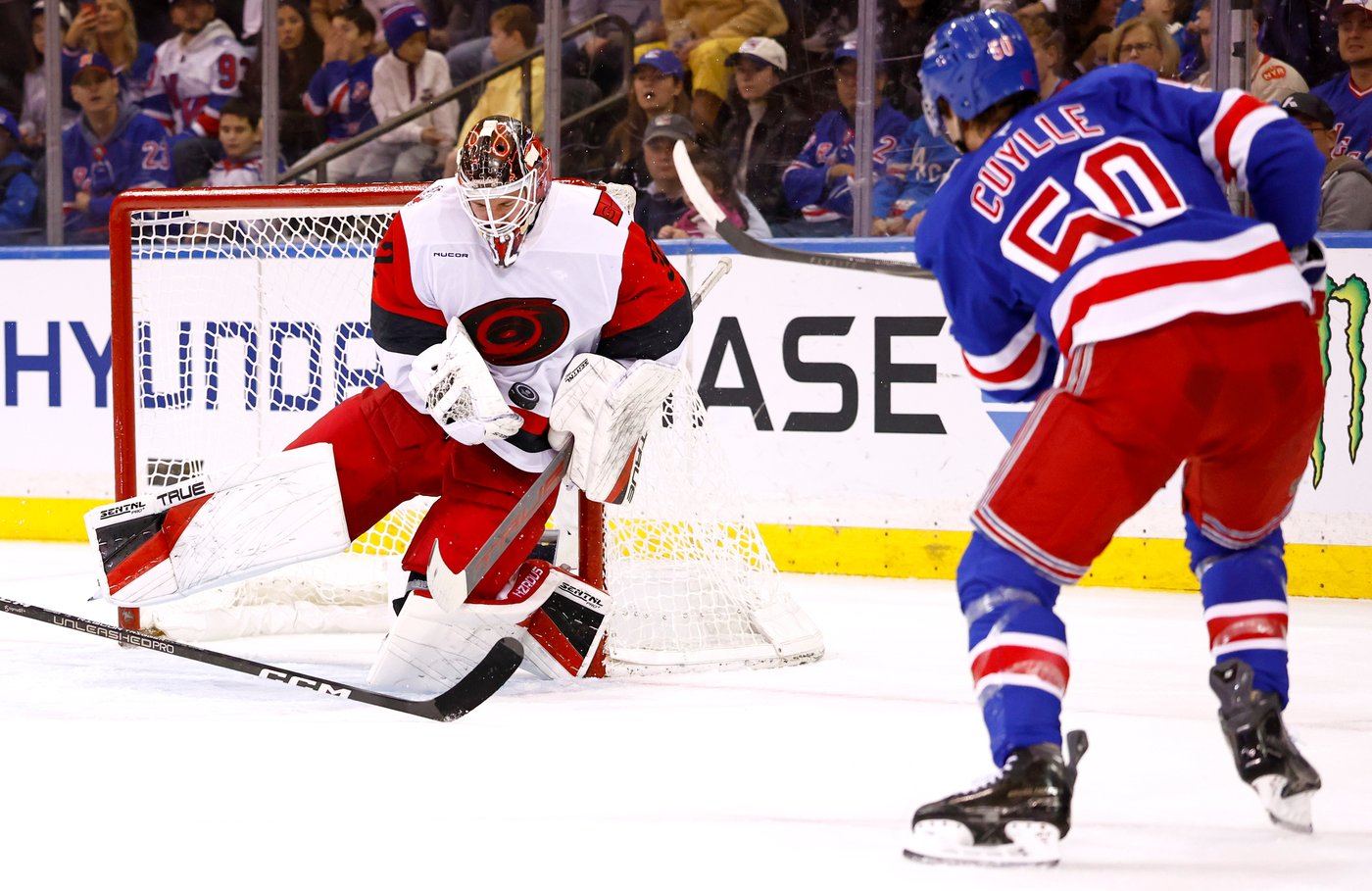
When a team wins 5–2 and finishes with 41 shots, there is a temptation to describe the entire afternoon as comfortable. That would misread the first twenty minutes. New York recorded 16 shots on Brandon Bussi in the opening period and generated enough sustained pressure to expose how tired Carolina looked after a 7–4 home victory over Edmonton the previous afternoon. This was a quick turnaround, including travel to Manhattan, against an opponent that had won three straight. Carolina's legs did not look like those of a team already in control.
Bussi's assignment was to prevent a slow start from becoming a deficit that forced his teammates to chase. He completed it without the luxury of a quiet first period. New York moved the puck decisively through the neutral zone, attacked on its power plays and tested Carolina's defensive organization while the visitors looked for the speed of their own game. A goalie stopping early chances does not erase those problems. It buys the group time to correct them. With a final total of 25 saves on 27 shots, Bussi's most influential work came before the score established any cushion.
The game's first goal was almost an illustration of the Hurricanes' preferred identity appearing in miniature. Carolina was killing a penalty at 13:00 when Jordan Staal engaged Adam Fox behind the New York net. Fox moved the puck to Scott Morrow, whose imperfect reception allowed Staal to win it back in dangerous space. Staal found Eric Robinson between the circles, and Robinson scored short-handed. It was a goal born from pressure and fast recognition, not from the kind of elaborate possession sequence that usually starts with a defensive-zone breakout.
New York responded promptly. At 14:12, just 72 seconds later, Mika Zibanejad redirected Fox's feed on the power play to make it 1–1. The equalizer prevented Carolina from using its opportunistic goal to dictate the rest of the first. It also exposed the game's contrasting special-teams moments: one penalty kill rescued by an aggressive forecheck, then a Rangers man advantage that created precisely the interior touch New York needed. Neither side had solved the other yet.
The strategic takeaway is not that Bussi stole a game in which his teammates failed to appear. The Hurricanes improved dramatically after the first and eventually outshot New York 41–27. Instead, the value was that the goalie kept the result open until Carolina's territorial pressure could take over. That distinction explains why a 25-save performance can matter more than its raw number suggests. Against a playoff-caliber divisional rival, the saves that prevent an early two-goal hole may be more valuable than routine stops with a three-goal lead. Bussi supplied those early stops; the skaters supplied the correction.
GOATIFY
GOATIFY Hockey
Bussi's opening saves kept Carolina close. Browse GOATIFY hockey styles.


Blake Turned a Broken Entry Into a Goal. The Flood Followed.
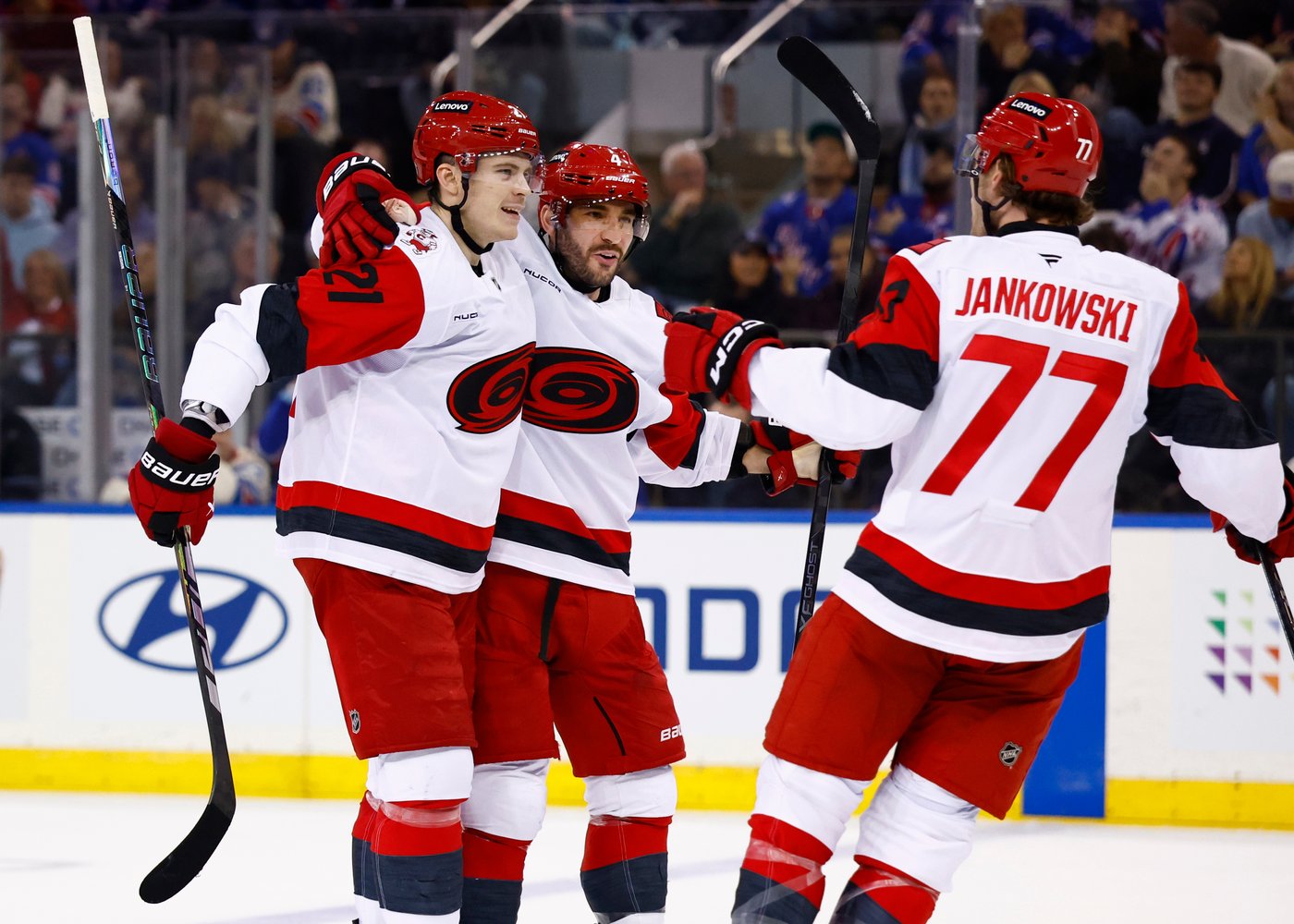
Jackson Blake's go-ahead goal arrived with 6:47 left in the second period, but the context made it bigger than a routine finish. Carolina had started to control where the puck was played. New York had managed only a handful of meaningful offensive possessions since the interval. At 13:13, the Hurricanes transformed movement through the middle of the ice into an almost effortless finishing chance, and the Rangers never recovered their defensive spacing.
The play began when Logan Stankoven carried the attack into the zone. Taylor Hall controlled an awkward touch from skate to stick and moved the puck to Blake, who drove into the available lane. Blake finished with a forehand-to-backhand move past Dylan Garand. The detail worth studying is the sequence before the shot. A defense that follows the puck carrier without accounting for the forward arriving inside can look organized at the blue line and suddenly be beaten at the crease. Blake exploited that separation, but Stankoven's entrance and Hall's quick adjustment turned the opening into a high-quality attempt.
There were two different skills on display. The passing movement created a chance that belonged to a collective play; the deception on the finish belonged to Blake. He did not have to force a low-percentage shot through traffic. Instead, he received the puck in a position where his hands could move Garand laterally. That is why the 2–1 goal changed more than the scoreboard. New York could no longer spend its shifts defending a tie and hoping for the next power play. It had to find a response from a second period in which its puck movement had already stalled.
Alexander Nikishin extended the lead at 17:46. The young defenseman fired a one-timer from distance that went off Garand and in. Sean Walker then produced the defining punctuation at 18:27, only 41 seconds later. Walker cut in from the right point, accepted Sebastian Aho's pass and finished from the lower right circle. The two defensemen did not simply repeat the same attack. One goal used a hard shot to punish a defensive unit that failed to close the shooter; the next used a defender's movement down the lane to find a better scoring angle.
Walker happened to be playing his 500th regular-season NHL game, making the goal a personal milestone as well as a decisive team contribution. Together, the Nikishin and Walker strikes were Carolina's quickest two goals by defensemen since Joe Corvo scored twice within 39 seconds in February 2009. From Blake's finish at 13:13 to Walker's at 18:27, the elapsed time was 5:14. A scoreline that had been 1–1 became 4–1 in little more than five minutes.
The lesson is the breadth of Carolina's scoring threat. A third-line combination can deliver a deft finish, an offensive defenseman can score from range, and another blueliner can attack the circle as if he were a winger. Garand finished with 36 saves, so it was not a case of an unprotected goalie failing every test. The Hurricanes kept creating different kinds of tests in rapid succession, and the Rangers could not solve any of them quickly enough.
The Rangers' Real Collapse Was Possession, Not Just Goaltending.
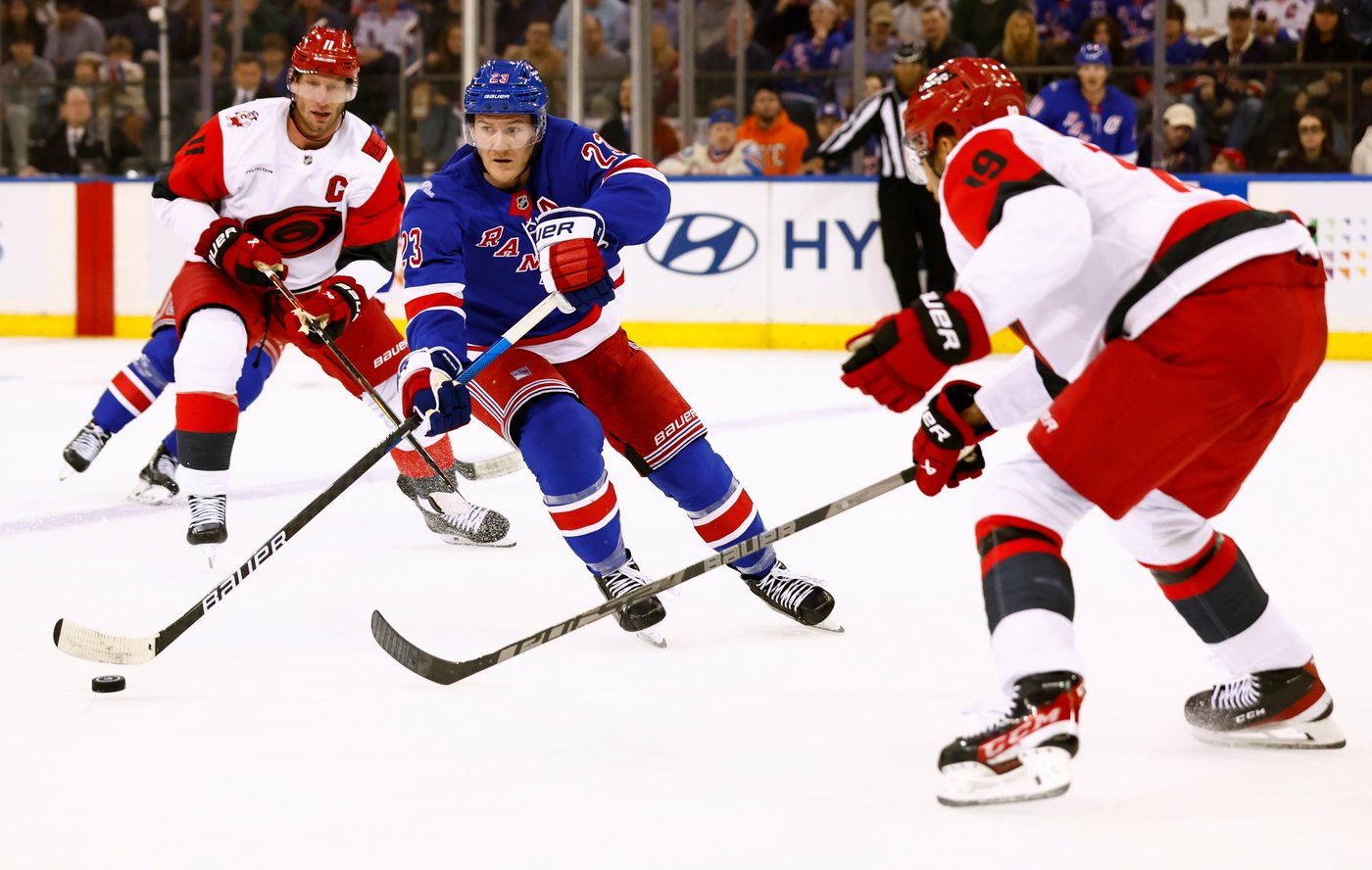
New York's goaltender made 36 saves. The Rangers still conceded five goals, including an empty-netter, and their largest problem was further up the ice. They generated 16 shots on Bussi in the first period, then managed three across the entire second. During the last 8:25 of that middle frame—the stretch in which Carolina scored all three of its goals—New York did not put a puck on goal. The visitors had taken away both possession and the practical chance for an immediate response.
GOATIFY
GOATIFY Hockey
Blake, Nikishin and Walker scored in waves. See GOATIFY hockey gear.
The important distinction is between an isolated defensive mistake and a sustained failure to exit the zone. A team can survive a bad turnover if it promptly retrieves the puck, changes, or attacks at the other end. The Rangers surrendered the first short-handed goal when a puck mishandled after a pressured exchange became Robinson's opening, then later struggled to relieve pressure when Carolina's second-period pace increased. Different plays, same vulnerability: short moments without control were being converted into chances before New York could reset.
Adam Fox's involvement in the first-period sequence illustrates how a skilled team can still lose a battle in a dangerous location. Jordan Staal pressured him on a penalty kill and pounced after the attempted release ended up loose. That one play did not doom New York: Fox helped create Zibanejad's tying goal soon afterward, and he also assisted on J.T. Miller's third-period power-play score. It does, however, show Carolina's confidence in attacking elite puck handlers rather than merely backing away when outnumbered.
The third Carolina goal and fourth Carolina goal came from defensemen, another pressure point. Against Nikishin, New York needed to contest a one-timer before the release. Against Walker, it needed to track a defenseman moving into a shooting lane and recognize Sebastian Aho's pass. Those are related but not identical tasks. The Hurricanes' willingness to involve the point and the middle of the ice forces defenders to communicate across layers. When those reads are late, a team can surrender multiple dangerous looks without any one player being spectacularly beaten.
Rangers coach Mike Sullivan's postgame analysis was revealing because it did not claim New York had been hopeless from the opening faceoff. His assessment of an encouraging first half and a costly five-to-six-minute run is consistent with the period-by-period data. The Rangers won their share of early territory, then lost control with speed. The wider 41–27 shot deficit was especially punishing because Carolina built it while scoring, not through harmless attempts after the contest had been settled.
That leaves a question for the next time the Rangers meet this opponent: can they shorten the interval between losing one possession and getting the next? Cutting out turnovers helps, but so does winning the first race after a failed breakout, making a clean line change and denying the pass into the low slot. Sunday's middle period was an example of how quickly an opponent with Carolina's depth can turn a temporary loss of shape into an insurmountable lead.
Carolina's Record Goes Beyond 5–2. New York Still Has Evidence to Use.

The scoreboard after forty minutes looked severe, but New York did not simply disappear. J.T. Miller scored on the power play at 15:13 of the third, narrowing the deficit to 4–2 with time left. The Rangers were working with an extra attacker and a man advantage for the goal, a reminder that their top skill can still punish coverage. Carolina's answer came through Jordan Martinook into an empty net at 17:38, ensuring there would be no unlikely final push.
There was individual significance in New York's scoring, too. Mika Zibanejad's first-period redirection was his 139th career power-play goal, moving him past Daniel Sedin into second place among Swedish-born NHL players in that category, behind Mats Sundin. That is more than a consolation statistic. It reflects a longstanding strength the Rangers can still lean on. Fox assisted on both Zibanejad's and Miller's power-play goals, while Garand turned aside 36 attempts in a game that ultimately generated too many difficult saves for him.
GOATIFY
GOATIFY Hockey
New York's second-period struggles frame these hockey fan picks.
What separates Carolina at this stage of the season is that these individual performances are happening inside a powerful system of repeatable team results. The Hurricanes entered the night as reigning champions, then left with an 18–3–3 record and a seven-game point streak at 6–0–1. Twelve different players recorded at least a point. On a schedule that had asked them to score seven against Edmonton on Saturday and travel for an afternoon divisional game on Sunday, that distribution mattered. The offense did not depend exclusively on one hot forward line to generate five goals.
Carolina's road record became 10–2–1, giving the franchise its quickest ten road victories in a season, accomplished in its thirteenth road contest. The team's previous quickest pace was fourteen games. Road wins are a useful measure of depth because the visitor cannot control every matchup with last change; lines and defense pairs must handle imperfect situations without being sheltered throughout an entire game. Carolina's answer on Sunday was to use Bussi's saves to absorb the opening and then bring scoring from a surprising variety of places.
The shot profile is even more striking. With a 41–27 edge at Madison Square Garden, the Hurricanes outshot their opponent for the 23rd consecutive game. According to the league's historical tracking, that passed the 1971–72 Rangers' 22-game stretch as the longest recorded run since 1959–60. It does not mean every attempt was dangerous, nor that possession alone guarantees playoff success. But controlling the attempts this consistently makes it much harder for an opponent to win repeatedly on the strength of one short offensive stretch.
Carolina's fifth goal was its 100th of the 2026–27 season, the first NHL team to that total. Sebastian Aho had reached 20 assists in just 24 games, an individual pace that helps explain why the Hurricanes can obtain offense from both wingers and defensemen. The group has questions ahead, including Nikolaj Ehlers' status after he did not travel to New York following an injury against Edmonton. It is too early to treat a November table as a guarantee of another Cup. Nevertheless, a champion that can outshoot opponents every night, score from multiple lines and survive a slow start is a formidable benchmark.
Carolina's next listed game is at Tampa Bay on Wednesday, November 25, while the Rangers are scheduled to visit Buffalo that day. New York can take something constructive from its first period and its power-play execution, but the bigger challenge is maintaining that competitiveness through the middle forty minutes of a high-pressure game. Carolina, for its part, will be trying to make another team's dangerous first period irrelevant.
The Hurricanes did not dominate every minute in Manhattan. New York had the stronger beginning, generated chances on the power play and briefly closed the margin in the third. The difference was Carolina's ability to survive its worst stretch, turn its best five minutes into three goals and keep controlling territory once ahead. Bussi made that possible; Blake, Nikishin and Walker made it decisive.
At 18–3–3, with 10 road wins already banked and 23 consecutive games of outshooting opponents, Carolina has produced a body of early-season evidence that is much sturdier than one highlight reel. The Rangers remain a credible team, but Sunday exposed the challenge of facing a deep champion when the margin for defensive mistakes disappears. Their next meetings will be about whether New York can sustain its strong opening rather than simply survive another late surge.
GOATIFY
GOATIFY Hockey
Shop GOATIFY NHL and hockey shirts, hoodies and stickers.





















