

Hadjar Lost a Podium and Got a Penalty. Perez Pays in Qatar.
GOATIFYLas Vegas handed Red Bull two very different verdicts. Max Verstappen won the Grand Prix, but team-mate Isack Hadjar left with a broken front wing, no points and a ten-second penalty for the way he managed the field behind the Safety Car. Meanwhile Sergio Perez, driving for Cadillac, ended his race in a collision with Haas rookie Rafael Camara and will carry a five-place grid penalty into Qatar. The finishing order makes these stories look like footnotes to Verstappen's triumph. The race circumstances make them much more revealing.
Hadjar had spent the opening half of the race behaving like a genuine podium contender. The Red Bull strategy then became a problem of geometry: two cars, one pit crew and a queue of rivals that could not legally overtake under Safety Car conditions. The team needed space, but the stewards concluded that the space was created by deliberately driving too slowly. In one stretch Hadjar was roughly 100 kilometres per hour slower than Verstappen ahead. A clever-looking pit-lane shortcut had crossed a sporting line.
Perez made a different kind of error. His attempt to take the inside at Turn 14 ended with contact that removed Cadillac from the race, yet the punishment could not be served there. It will follow him to the next starting grid instead. Both rulings matter beyond their immediate arithmetic: the Red Bull case is about the boundary between strategy and manipulating a neutralised field; the Cadillac case is about an overtaking driver's responsibility when a move is not sufficiently established.
Hadjar created the gap Red Bull needed. The stewards called it tactical slowing.
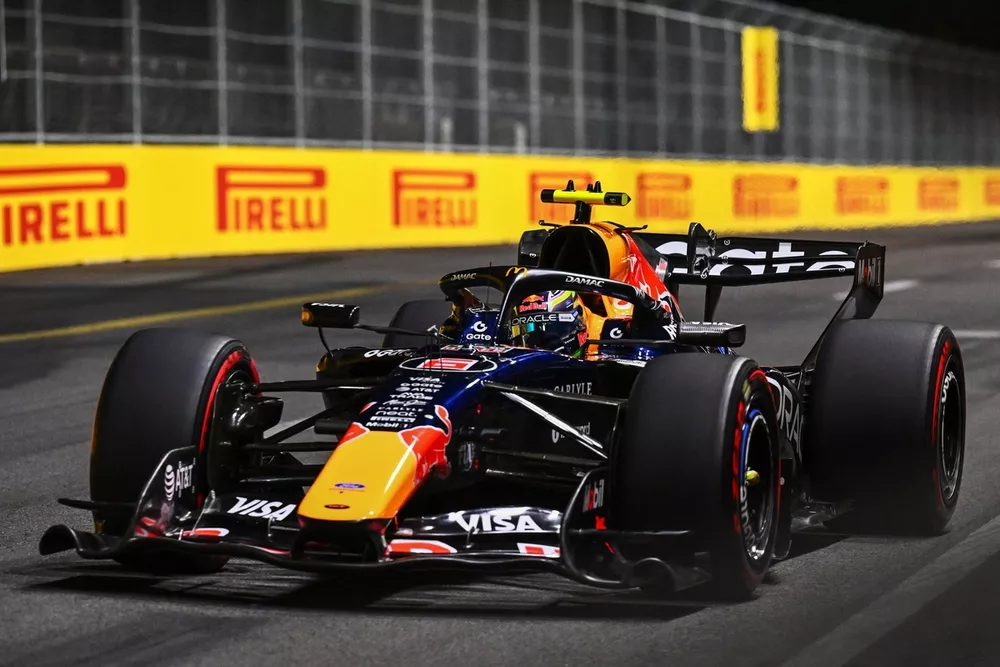
The collision between Perez and Camara brought out the Safety Car on lap 19, just as Red Bull had a precious advantage to protect. Verstappen was at the front, Hadjar was immediately in contention behind him, and Mercedes was close enough that a routine pit stop threatened to alter the order. Both Red Bulls could change tyres under the caution, but the second car would normally arrive at the same pit box before the first had cleared it. That is the uncomfortable reality of a double-stack: the lead driver has priority, while the following driver risks waiting in line.
Hadjar's answer was to manufacture a buffer on the circuit. The official investigation recorded repeated radio calls instructing him to seek five seconds. The Frenchman lifted enough that his lap under the Safety Car was 4.288 seconds slower than Verstappen's. At one point, the speed difference between the Red Bulls reached approximately 100 km/h. That scale matters more than a vague suggestion that the driver merely managed his tyres or approached pit entry with caution. The drop was deliberate, significant and timed to the team's intended two-car stop.
The problem is that the drivers behind Hadjar were trapped inside the same neutralised procession. Under the Safety Car they could not simply pull out and reclaim the road space he surrendered. George Russell and the other cars had to reduce their speed in response, which gave Red Bull strategic control over more than its own race. The stewards judged this to be unnecessary slow driving for tactical reasons, and issued Hadjar a ten-second time penalty. They also referenced the 2023 Canadian Grand Prix case involving Lando Norris as a precedent.
There is a perfectly legitimate version of managing a gap: saving tyres, conserving fuel or maintaining a prescribed distance while respecting safety and sporting regulations. But this was not simply a driver choosing how quickly to run an isolated lap. It changed the shape of a line of cars that could not overtake him. The regulations cannot allow a team to turn the Safety Car into a private traffic-management system whenever its pit box is busy. The crucial question is whether the speed choice served a racing or safety purpose, or was designed mainly to inconvenience competitors behind.
GOATIFY
GOATIFY Formula 1
Explore Formula 1 gear while tracing Red Bull's Safety Car strategy.


Ironically, the manoeuvre did not even preserve second place for Hadjar. Russell emerged ahead after the stops, and the younger Red Bull driver was third at the restart. So the distinction between successful strategy and illicit strategy is not whether the tactic delivered the exact result the team wanted. It is the action itself. That is why a penalty can be warranted even when the supposed advantage proves fleeting.
The front wing failure erased the podium before the penalty could change much
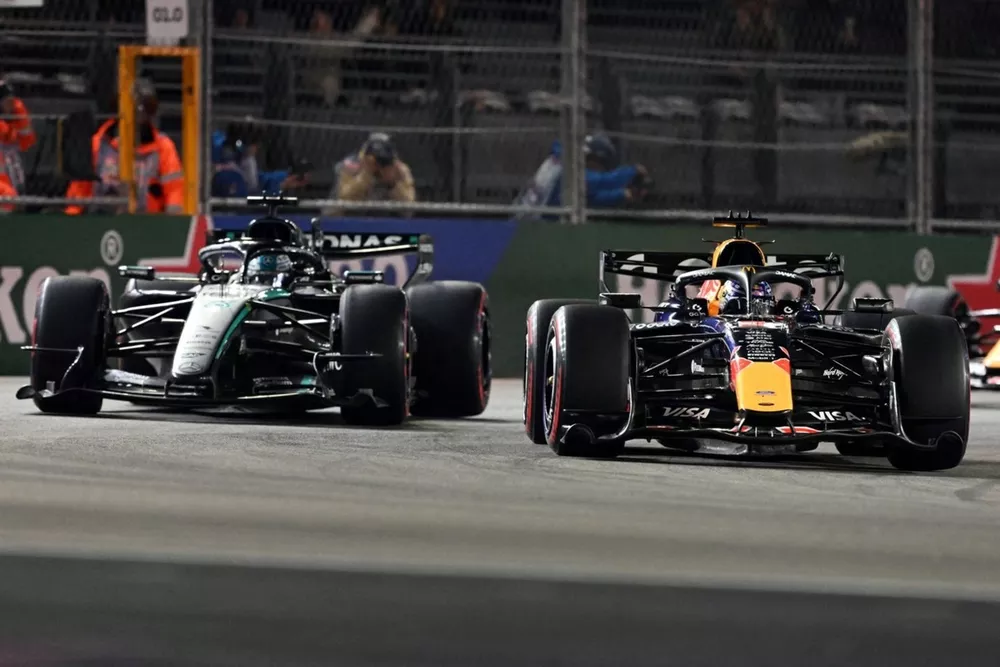
Hadjar's night had looked like proof that Red Bull possessed two genuine weapons in its closing-season fight. Starting fourth, he moved through the front group rather than merely holding position. He cleared Norris early, fought with Russell and made Verstappen defend track position. The exchanges were more significant than the final classification suggests: they showed the second Red Bull could operate near the sharp end on a circuit that rewarded straight-line speed, timing and confidence under braking.
When the field restarted on lap 26, Hadjar was third and pressing Russell. Then his front wing failed as he approached Turn 5. The break occurred without an obvious collision at that moment. Debris came off the front assembly, and the car needed a replacement nose. A driver who had been choosing where to attack the podium positions was suddenly wrestling with a mechanical problem and an unscheduled stop. He rejoined far down the order, and the remaining distance offered no realistic route back to the top ten.
It would be easy to treat the penalty as the reason Hadjar's Las Vegas result went wrong. The timeline shows the opposite. The physical wing failure had already destroyed the competitive outcome. He reached the chequered flag in fourteenth on the road, and the ten-second addition formally demoted him to fifteenth, behind Liam Lawson. Neither placing scored points. The sanction changed the record, but not Red Bull's haul. Hadjar's biggest loss was not one position; it was the chance to turn strong race pace into a substantial Sunday contribution.
The contrast with Verstappen makes the team dimension sharper. Verstappen ultimately secured victory and all 25 points available for the win. Norris and Piastri finished second and third for McLaren, collecting 33 between them. That meant the leading Red Bull result could still be outweighed by two McLaren cars coming home together. The reported lead Red Bull held over McLaren in their constructors fight narrowed to nine points. A second Red Bull score would have changed that calculation; Hadjar's speed made it plausible, which is why the lost nose mattered so much.
There is also a separate technical question that should not be prematurely answered. Hadjar was unable to identify a definite reason for the break in immediate post-race comments, and the exact failure mechanism requires the team's investigation. The 2026 cars use changing aerodynamic configurations, and the reported failure happened as the car transitioned out of Straight Mode, but temporal proximity is not proof of root cause. Until Red Bull supplies technical findings, it is stronger analysis to separate the confirmed failure from speculative explanations about the bump, loads or the aero system.
GOATIFY
GOATIFY Formula 1
Find F1 fan designs alongside the Hadjar and Verstappen race analysis.


Hadjar can take encouragement from the performance and frustration from the result at once. He demonstrated he could put pressure on Verstappen and Mercedes, then watched that work disappear. The stewards' decision will appear in the classification; the wing investigation is what could determine whether he has the hardware to convert similar pace into another podium in Qatar or Abu Dhabi.
Perez's Turn 14 gamble means a five-place grid drop at the next race

Perez's case is much less ambiguous as a race-management question. The Cadillac driver attempted to overtake Camara on the inside heading for Turn 14. The front-right tyre of the Cadillac made contact with the rear-left of the Haas, sending the cars into the barriers. Camara was able to carry on, while Perez retired. The incident not only ended an attempt to improve Cadillac's position, it became the trigger for the Safety Car period in which Hadjar later got into trouble.
The stewards' reasoning turned on a concrete measure of overlap. They found that Perez's front axle had not reached the level of Camara's mirror at any point in the move. Under the governing driving standards, Perez had therefore not established the position needed to claim the corner against the outside car. The officials assigned responsibility for the collision to Car 11, Perez's Cadillac. That finding is a better way to understand the ruling than the simplistic idea that the driver on the inside always owns the apex. Being on the inside is not an automatic right to occupy whatever space remains.
Because Perez had already retired, a conventional ten-second race penalty could not be meaningfully served in Las Vegas. The officials converted it into a five-place grid penalty for his next start, scheduled at the Qatar Grand Prix from November 27 to 29. That means qualifying pace alone will not determine his grid spot: whatever position Cadillac can earn on Saturday must then absorb the sanction. If the car is fighting near the back, five places may not produce a dramatic numerical drop, but the liability is real and forces a team to race the weekend from an even less forgiving starting position.
The bigger Cadillac story is the missed opportunity to build a clean race. The new entrant was still searching for its first Formula 1 points, and Valtteri Bottas finished eighteenth in Las Vegas. Neither car supplied the breakthrough the team wanted. Perez's experience is supposed to help Cadillac navigate situations like these, where a marginal pass can cost far more than the single position being chased. On a street circuit with walls waiting beyond the painted racing line, an ambitious but insufficiently established move is particularly expensive.
None of this means Camara necessarily drove a flawless race or that every contentious corner can be reduced to a single geometric test. It means this incident had a specific documented finding: Perez did not earn the overlap and caused the contact. The collision, retirement and next-event grid drop form one chain of consequence. The team now has to plan for Qatar with that chain fixed in the record rather than spending another week debating whose car was closer to the apex.
Qatar inherits one unresolved Red Bull question and one Cadillac certainty
The calendar does not give either team long to digest Las Vegas. Qatar follows next weekend, and the teams have to convert the lessons of a chaotic street race into practical decisions. For Red Bull, the least complicated part is the sporting ruling. The stewards have made clear that a team cannot secure a double-stack by making the following cars crawl under a Safety Car. Whether that sort of manoeuvre might save seconds in one pit phase is no longer a persuasive defence. Hadjar's ten-second penalty is a clear warning to the pit wall as well as the cockpit.
GOATIFY
GOATIFY Formula 1
Shop F1 favourites after the Perez-Camara Las Vegas collision breakdown.


The harder Red Bull question is technical. What caused the front wing on a car running in the podium positions to fail without an obvious contact at the restart? A repeat would turn promising pace into a recurring weakness. A fix that compromises aerodynamic efficiency could create a different cost. Hadjar needs the team to give him confidence that he can attack corners and close on rivals without worrying about the nose of the car. His actual race speed in Vegas provides reason for optimism, but he cannot score with potential alone.
For Cadillac, there is no equivalent unknown about the Perez penalty: the five-place Qatar grid drop is already confirmed. Preparation can therefore be specific. The team must decide how much qualifying emphasis to place on maximising the raw lap and how aggressively to approach the first stint once he starts lower than his qualifying performance warrants. A new outfit with an unproven points ceiling cannot afford to build a weekend around heroic recovery moves. It needs completed stints, clean procedures and the chance to benefit if rivals encounter trouble.
Camara's side deserves attention because the other driver in a collision is not merely a prop in a veteran's penalty story. The young Haas racer was making only his second Formula 1 race appearance after a debut in São Paulo. He recovered from the Las Vegas contact and reached the finish in sixteenth. The experience is part of a rapid education in wheel-to-wheel judgement: a rookie may have to defend confidently against a far more established name without surrendering a corner that the attacker has not earned. The officials' decision gives useful clarity about that particular moment.
These two penalties also expose a distinction that fans frequently miss. Hadjar was sanctioned for how he controlled the speed of the procession while overtaking was restricted. Perez was sanctioned for causing a collision while trying to overtake. One case concerns an artificial tactical advantage under neutralisation; the other concerns the threshold for claiming racing room. The penalties look very different on paper because one driver finished and the other did not. Their common purpose is to prevent teams and drivers from externalising the cost of their decisions onto competitors.
Vegas therefore leaves a strangely split verdict. Red Bull takes a victory, a damaged car and a regulatory lesson; Cadillac takes a retirement and a penalty that will be felt at another circuit. Neither punishment can undo what happened under the lights. Qatar will show whether the organisations understand the distinction between the speed they can generate and the decisions they can afford.
The most surprising part of Las Vegas is that Hadjar's penalty hardly changed Red Bull's points, even though the stewards were unequivocal about the infringement. Once his wing broke, the difference between fourteenth and fifteenth was purely classificatory. That does not make deliberate slowing a harmless trick. It reveals an enforcement problem for any incident where the team benefits before a damaged or delayed car absorbs the eventual punishment.
Perez's sanction works differently. Cadillac has no way to leave it in Nevada; the grid penalty travels with him. For Hadjar the immediate priority is understanding the front wing and recovering the pace that made a podium plausible. For Perez it is starting Qatar with a known disadvantage and producing a weekend clean enough to survive it. Both entered Las Vegas with something to gain. Both left with a reminder that racecraft, team tactics and technical reliability remain separate parts of the same finishing result.
GOATIFY
GOATIFY Formula 1
Shop GOATIFY Formula 1 shirts, hoodies and racing stickers.





















