

Mexican vs British vs Puerto Rican Boxing Fans: What Changes?
GOATIFYBoxing fans can make a prizefight feel like a national holiday, a football away day or a reunion across an ocean. Mexican, British and Puerto Rican supporters have all produced unforgettable fight-night atmospheres, but not through one universal script. A Las Vegas arena full of Mexican flags, a Manchester chorus following Ricky Hatton abroad and a New York crowd welcoming Miguel Cotto each tell a different story about identity and place.
These differences are best understood through specific events rather than claims that everyone from a country cheers the same way. Supporters vary by city, generation, fighter, class, and whether they watch at home or travel internationally. Some attend for a tactical contest; others make a night out of the songs, flags and shared history. The same fan can be both.
The comparison below follows the calendars that build anticipation, the places supporters gather, and the fighters who turned ordinary bouts into public occasions. It also examines what happens when two boxing communities meet across the ring without mistaking sporting rivalry for a description of entire nations.
Mexico: the calendar, the flags and the hometown hero

One way to understand the Mexican boxing audience is to begin with a date rather than a weight class. Big fight weekends around early May and mid-September became major attractions for Mexican and Mexican-American spectators, especially in Las Vegas. Those weekends connect the sporting calendar to holidays, family gatherings and travel. September's boxing celebrations align with Mexican Independence Day festivities; Cinco de Mayo, celebrated on May 5, marks the Battle of Puebla and is not Mexico's independence day. That distinction matters even when promotional language blurs it.
An icon gives the celebration a face. Julio César Chávez did that for a generation, especially through his reputation for pressure, durability and fights that became collective events. Saúl 'Canelo' Álvarez later became the prime modern draw for holiday-week boxing. His appearances against major opponents in Las Vegas have drawn supporters from Mexico and the United States, while his 2023 homecoming against John Ryder in Guadalajara demonstrated the pull of bringing a star back to his own region. Neither fighter represents every Mexican boxing fan, but both show how a champion can carry a wider public story.
Mexican flags in the stands are not simply decoration. For supporters who have travelled from home, and for families who have built lives elsewhere, a flag can make the arena briefly feel connected to another city or generation. Weigh-ins, ring walks and national anthems turn a competitive event into a visible gathering. The spectacle can be joyful without implying that viewers share the same politics or opinions about a fighter.
Yet boxing identity is also intensely local. A supporter who grew up around a modest neighborhood gym in Mexico City may prize the hard rounds and technical craft more than the star's entrance. Someone in Guadalajara might experience Canelo as a hometown figure, while another fan in Tijuana follows different fighters and stylistic traditions. Arguments over judges, matchmaking and whether a star has taken the toughest fights are as common as applause. Mexican support should not be reduced to a mythical taste for brawling: analysts and fans appreciate defensive intelligence, patience and timing as much as a body-shot knockout.
GOATIFY
GOATIFY Boxing
Explore boxing fan apparel alongside the traditions behind Mexican fight weekends.


Commercially, those May and September weekends are powerful because the event is often bigger than one ticket. Flights, watch parties, food, music and family plans can surround a main event. The weakness is that dates and celebrity can sometimes overshadow the merit of the actual matchup. The strongest fan culture does not suspend criticism; it gives supporters enough ownership to debate whether a supposed national hero really earned the night's celebration.
Britain: travelling supporters, terrace songs and stadium nights

British boxing nights often borrow the social habits of football without being football matches. Chants, regional loyalties, group travel and pub gatherings create an atmosphere before the ring announcer ever speaks. The famous example is Ricky Hatton. Thousands followed the Manchester fighter to Las Vegas during his American campaigns, making the MGM Grand and surrounding streets sound, at moments, less like neutral ground than an overseas home end.
Hatton's appeal was not only the number of titles on his résumé. He came across as approachable, rooted in Manchester and unusually close to his audience. His supporters had their own rituals: meeting friends before a show, singing familiar refrains during weigh-ins and wearing the symbols of their city. A Manchester United supporter could cheer alongside a Manchester City supporter for Hatton; the boxer became a temporary shared local identity. The much-recalled chants around the Floyd Mayweather matchup in 2007 are a case study in how a visiting fan base can affect the feel of a world-title event.
That travelling tradition is only one side of British boxing. Home stadium nights offer the opposite scale: instead of fans crossing the Atlantic to find their fighter, a major boxing event takes over a familiar football ground. Carl Froch and George Groves packed Wembley for their 2014 rematch. Anthony Joshua's dramatic 2017 win over Wladimir Klitschko became another landmark stadium spectacle. In September 2024, Daniel Dubois stopped Joshua at Wembley in front of a crowd widely reported at around 96,000. Stadium size makes the ring look tiny, but the shared noise can turn a single punch into a moment heard across the arena.
Britain's boxing public also has lively rivalries within the country. London, Manchester, Liverpool, Belfast and Glasgow are not interchangeable, and neither are fans of rival promoters, clubs or boxers. A hardcore audience at a small hall may value a competitive eight-round bout more than a heavily marketed arena show. Some followers are impatient with expensive ticket prices, long undercards and heavyweight celebrity culture; others enjoy making a full weekend of it.
Another difference lies in how supporters handle the result. Hatton's fans were passionate after defeats as well as victories, which challenges the idea that British fight culture is merely triumphal nationalism. A boxer who takes difficult fights, speaks without pretension and remains connected to home can retain loyalty through setbacks. The strongest parallel with Mexican and Puerto Rican crowds is not volume but the feeling that the person in the ring came from a world the spectator recognizes.
GOATIFY
GOATIFY Boxing
Browse boxing designs while remembering Hatton's unforgettable travelling support.
Puerto Rico: the island, New York and the parade-week fight

Puerto Rican boxing support has a particularly visible bridge between the island and the diaspora. In New York, Madison Square Garden became more than a neutral venue when a major Puerto Rican fighter arrived on a weekend associated with the National Puerto Rican Day Parade. The location allowed fans born on the island and those raised in New York to share a sporting stage. The crowd was celebrating a boxer, but also a connection to language, family and heritage across distance.
Miguel Cotto's Garden bouts made that relationship concrete. Promoters repeatedly placed his fights near the parade, and Puerto Rican supporters filled the arena with flags and noise. The tradition was not automatic: it had to be sustained by a marketable boxer winning significant fights and by fans willing to buy tickets. Cotto's draw was therefore a mixture of athletic accomplishment and community resonance. The matchup still mattered, but its place in the calendar changed how the evening felt.
Félix 'Tito' Trinidad inspired another form of collective celebration. His victories and homecomings prompted huge receptions on the island; contemporary accounts describe caravans meeting him after major bouts, especially following the 1999 Oscar De La Hoya win. Those gatherings suggest that for some Puerto Rican fans the fight does not end with the final bell. The fighter's return can become the next chapter, a public welcome that lets people who were nowhere near the arena participate in the moment.
The emotions are particularly strong when the opponent comes from a boxing culture with its own proud champions. Puerto Rico's tradition includes Wilfredo Gómez, Héctor Camacho and other figures whose fans and styles were far from identical. Within Puerto Rico, as elsewhere, people disagree about their favorite era, fighter, trainer and the meaning of a close scorecard. Some identify first with their hometown, others with family ties to New York or the island as a whole. There is no single Boricua reaction to a controversial decision.
Even so, the social rituals are recognizable. Salsa, flag displays, Spanish-language chants and large groups of relatives and friends have featured in accounts of Cotto fight weeks. These are documented scenes, not an instruction manual for every Puerto Rican fan. The deeper pattern is that a boxing event can become a cross-border reunion. When a fighter walks to the ring, people in different cities may feel they are cheering beside one another.
Where the cultures overlap — and what actually separates them
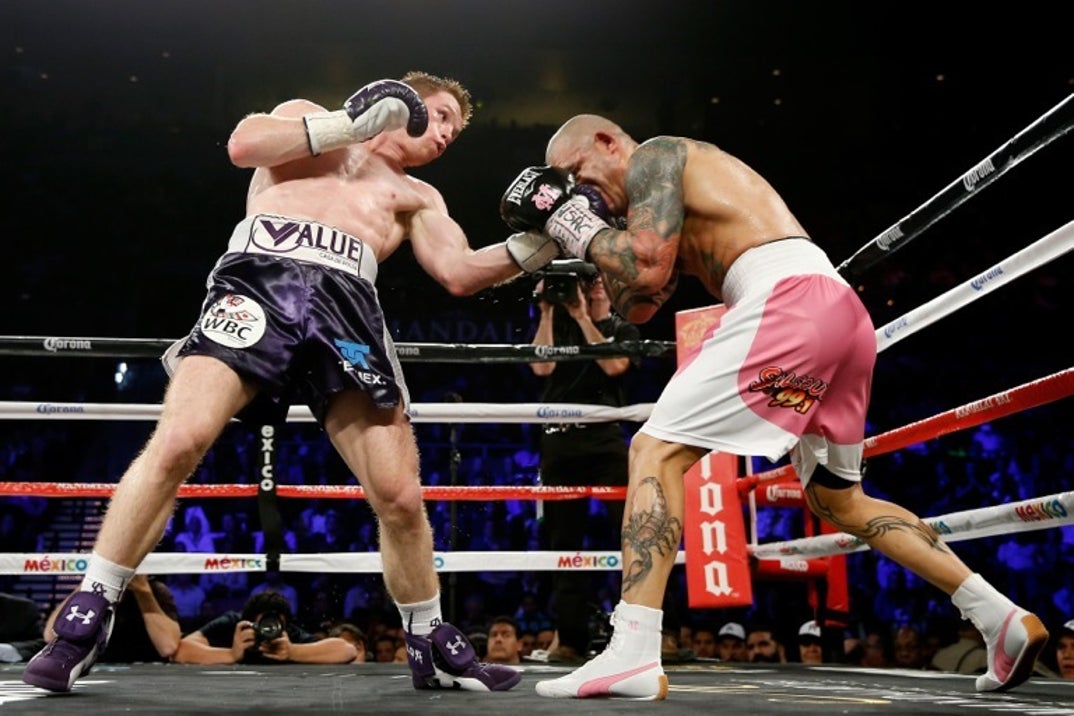
Put the three traditions side by side and it is tempting to assign each a neat label: Mexico brings national holidays, Britain brings football chants, and Puerto Rico brings the island-to-New-York connection. These examples are memorable because they are true of particular nights, not because they exhaust what millions of people do. Mexican fans travel internationally; British communities celebrate national identity; Puerto Rican supporters follow local prospects in small halls. All three care about the quality of the action.
GOATIFY
GOATIFY Boxing
Find boxing fan gear as Puerto Rican Garden fight-night traditions come to life.
The Mexico–Puerto Rico rivalry illustrates the danger of exaggeration and the attraction of real stakes. Historic pairings such as Salvador Sánchez against Wilfredo Gómez helped make the countries' ring histories intertwined. In November 2015, Mexican star Canelo Álvarez and Puerto Rico's Miguel Cotto fought in Las Vegas, with Canelo winning a decision. For spectators, it was a matchup of two outstanding boxers and two sporting lineages. Calling that passion a rivalry does not mean viewers from either place dislike one another outside boxing. Often it creates exactly the opposite: a shared language of elite fighters, difficult opponents and arguments over technique.
British fans add a different commercial shape when they travel in numbers to the United States or fill Wembley at home. Their arena experience can depend heavily on a regional hero and the importance of one giant night. Mexican fight-week travel is closely associated with established Las Vegas holiday weekends, and Puerto Rican Garden gatherings have benefited from a parade-linked calendar. Promoters understand the pattern: a cultural occasion gives casual supporters a reason to attend, while a credible opponent gives serious boxing fans a reason to stay interested.
Ask what changes for a first-time visitor and the answer is more practical than romantic. At a Mexican-linked Las Vegas weekend, prepare for a major event calendar beyond the arena. At a British stadium show, plan for long queues, a large crowd, and the difficulty of seeing the ring from the back of the ground. At a Puerto Rican-linked New York show, expect the audience's connection to the island and city to be part of the experience. In every setting, be respectful of flags and songs, avoid assuming someone's nationality, and remember that not everybody is there to perform for a camera.
The same economics create the same problems in different accents. Ticket prices can shut out the very working-class supporters who built a fighter's reputation. Pay-per-view barriers and fragmented broadcasting can keep fans from watching together. National storytelling can give a merely ordinary matchup undeserved importance, while a talented boxer without a famous flag or market can be overlooked. Fans in all three places have a stake in resisting that: demand good fights, honest scoring and events where the atmosphere enhances the competition rather than replacing it.
The real comparison is therefore about how local pride becomes a public boxing ritual. Mexico's holiday weekends, Britain's travelling support and stadium singalongs, and Puerto Rico's island-diaspora celebrations are distinct routes to the same emotional destination. The bell rings for two fighters, but a great crowd makes the contest feel as though a whole neighborhood, city or family is in their corner.
Mexican, British and Puerto Rican boxing supporters do not need to be ranked for passion. Different histories shaped how their biggest nights look: a holiday calendar and hometown ring walk, a travelling chorus or stadium spectacle, and a parade-week gathering that links an island with a diaspora.
The best way to appreciate any of them is to watch the actual fighters, learn why the occasion matters to the people attending, and leave room for disagreement. A strong fight-night culture is not a national personality trait. It is what happens when people make room in their lives for a shared event and give its memories a life far beyond the final round.
GOATIFY
GOATIFY Boxing
Shop GOATIFY boxing shirts, hoodies and stickers.





















