Brighton Had 89 Minutes. McBurnie Took Two in Stoppage Time.
GOATIFYBrighton spent almost an entire afternoon looking like the team most likely to score. Instead, they left the MKM Stadium with nothing. On November 22, 2026, Hull City beat the Premier League's second-place side 2–0 after Oli McBurnie struck twice in stoppage time. The timing made the result extraordinary, but the clock alone does not explain it.
For 89 minutes, Konstantinos Tzolakis and Hull's last line of defence kept Brighton out. Then João Costinha collected a second yellow card, the match tilted sharply, and the visitors could not survive the final minutes with ten players. McBurnie's 92nd-minute breakthrough was followed by a second in the 95th, turning what had looked like an improbable point into Hull's first league win since August.
The most interesting part is how two very different performances created one outcome: Brighton did much of the attacking, while Hull won the moments that finally decided the result.
Tzolakis Made Five First-Half Saves, Then Hull Had a Chance

Brighton's numbers and the rhythm of play described a match the visitors were controlling. Their possession moved Hull from one defensive response to another, and they repeatedly reached shooting positions inside or around the penalty area. For a promoted home team facing an opponent in second place, that could easily have become an exercise in damage limitation before the interval. The obstacle was Tzolakis, whose five first-half saves prevented Brighton from converting that control into a lead.
The early stop from Diego Gómez established the goalkeeper's afternoon. Brighton had found space to deliver low into a dangerous area, Gómez arrived in a position from which he could reasonably expect a finish, and Tzolakis got down to block. Later, Georginio Rutter's powerful effort required the Greek goalkeeper to spread himself and reach out with his hand. Those were not routine catches to pad a statistical column: they were interventions at moments when the defending structure had already been stretched.
Yasin Ayari also struck the crossbar, and Gómez was denied again when Tzolakis reacted with his leg to an attempt at close range. The goalkeeper's positioning mattered as much as his reflexes. He repeatedly made the target smaller, forced attackers to execute perfectly, and recovered quickly enough to confront the next shot. The difference between a goalkeeper's highlight reel and a result-changing contribution is whether those saves keep a game alive. Here they did.
That point deserves emphasis because Brighton's failures were not simply a series of wild shots. The visitors created enough to win on another day. Their reported expected-goals figure of 2.24 reflects genuine opportunity, although an xG total remains an estimate of chance quality rather than a promise of goals. Brighton could have been two ahead and managing the second half. Instead, every missed chance added a little pressure and kept Hull's supporters convinced there might be another ending.
GOATIFY
GOATIFY Soccer
Explore GOATIFY football favorites while revisiting Tzolakis's game-saving performance.

Kylian Mbappe – El Dictator Retro Soccer Sweatshirt
A football fan design for everyday wear.
Shop Now ↗
Lamine Yamal – Future Messi Mirror Decal Sticker
Add football personality to your favourite gear.
Shop Now ↗
Kylian Mbappe Ninja Turtles football/ soccer Mug
Add football personality to your coffee break.
Shop Now ↗
Kylian Mbappe Ninja Turtles Real Madrid Soccer Hat
A football fan design for everyday wear.
Shop Now ↗
Next Season FC Arsenal Parody Football London Tee
A football fan design for everyday wear.
Shop Now ↗
Hull also benefited from a goalkeeper who did not allow one near miss to affect his next decision. Tzolakis stayed composed while the game accelerated around him. That composure let the outfield players continue with their compact defensive work without feeling that any single breach would finish them. The attack would ultimately take the headlines, but it could only take them because the goalkeeper had kept the scoreboard level.
Brighton Had the Chances. Slater Supplied the Last Clearance
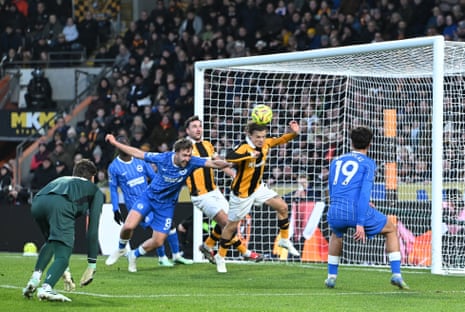
To describe this as a purely defensive masterclass would overlook how difficult Hull made life for themselves. Brighton's attack asked enough questions to expose gaps, and goalkeeper brilliance is often required precisely because a team has not kept those gaps closed. The visitors' control persisted after half-time. Pascal Groß tested Tzolakis, Gómez missed a close-range opportunity, and the match continued to move toward the home penalty area.
The sharpest warning came when Charalampos Kostoulas found himself through on goal after a short Hull pass created danger. He lifted the ball beyond his Greek compatriot in the Hull goal, but Regan Slater recovered to clear on the line. It is one of the moments that separates the scoreboard from the run of play: Tzolakis had been beaten, and a defender still found the final intervention. Without Slater's recovery, the last ten minutes likely would have been played in an entirely different tactical landscape.
Brighton's chance creation cannot be separated from their finishing choices. An accurate shot aimed a fraction differently, an extra touch avoided, or an earlier pass to a better-positioned teammate can decide such games. That does not mean every opening was easy or that a large xG total guarantees two goals. The collective performance created enough dangerous situations; execution and defensive resistance prevented those situations from becoming a lead.
Hull, meanwhile, did not need to win every midfield exchange to remain dangerous. Mohamed Belloumi had flashes of space on the break and twice carried the ball into promising areas. Those attacks initially lacked the final ball, but they showed how Brighton's high territorial position could leave something to run into after a turnover. It was a small but important tactical clue to the second goal that would arrive much later.
The responsibility for this defeat does not rest on one forward or one missed opportunity. It was a chain: possession produced pressure, pressure produced chances, chances met a goalkeeper in unusually good form, and each failed finish preserved a different possible result. The Brighton players had earned the right to feel frustrated. Hull had also earned the right to believe their defensive work could matter at the other end.
The scoreboard remained 0–0 not because both sides had offered the same threat, but because they had solved different parts of the match. Brighton were better at arriving near goal. Hull were better at ensuring nothing actually crossed the line.
GOATIFY
GOATIFY Soccer
Browse football fan designs after Brighton's missed chances and Hull's last-line defence.

Glazers Out Manchester United Fan Protest Sticker
Add football personality to your favourite gear.
Shop Now ↗


Manchester United Ratcliffe Out, Glazers Out Sweatshirt
A football fan design for everyday wear.
Shop Now ↗
Make United Great Again Manchester United Mug
Add football personality to your coffee break.
Shop Now ↗
Costinha's 89th-Minute Red Opened the Door for McBurnie
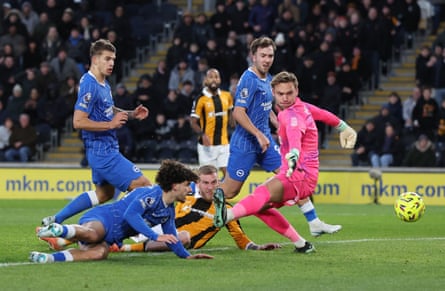
The game turned before the first goal. In the 89th minute, João Costinha fouled Sorba Thomas and received a second yellow card. The dismissal left Brighton with ten players exactly when their priority should have been to secure at least the point that their long periods of control had seemingly promised. A late red card cannot explain everything that happened earlier, but it changed the risks and available choices for the final moments.
With eleven players, Brighton could have continued searching for a winner while keeping enough defensive cover to handle turnovers. With ten, every player sent forward came at a greater cost. Protecting the draw meant conceding territory; chasing three points meant exposing space. Hull sensed that hesitation and pressed with a level of urgency that had not characterized much of the preceding hour.
The response from the MKM Stadium reflected that change. A goalless draw would already have been a respectable result given the pressure on Hull's goalkeeper. Suddenly the home side had an extra outfield player, fresh energy, and a centre-forward who could attack loose balls in a crowded area. McBurnie's opener in the second added minute came from close range following a counter-attack, an untidy finish in a situation that rewarded the striker's determination to be in the right place.
The finish was not a 30-yard masterpiece, and that is precisely why it suited the moment. Hull had spent so long preventing a goal that they did not need an aesthetically perfect move to justify the gamble. The most important action was getting enough players into advanced positions while the opponent reorganized. Once the ball stayed alive in front of goal, McBurnie reacted first and supplied the decisive touch.
Brighton have two different decisions to review. The first concerns Costinha's challenge so late in a level match, when staying on the pitch mattered enormously. The second concerns how the team collectively responded to losing him. There is no way to recover a numerical disadvantage instantly, but a more controlled first response might have bought time. Instead, the visitors allowed the first dangerous sequence to become the breakthrough.
That distinction matters for the broader debate about whether Brighton were unlucky or architects of their own defeat. Both descriptions contain some truth. Their finishing did not reflect the quality of their chances; Hull's goalkeeper was outstanding; and the late dismissal was an avoidable turning point. Hull still had to seize the advantage, and McBurnie's timing turned possibility into points.
Belloumi's Break Sealed It — and Brighton Paid in the Table

Brighton's predicament became harder after conceding. With so little time left, accepting defeat by one goal was not a realistic option for a team that had come expecting to challenge for three points. The visitors pushed forward looking for an equalizer, even though ten men made it harder to cover the field behind the attack. Hull finally found the very space Brighton had left exposed.
GOATIFY
GOATIFY Soccer
Shop GOATIFY soccer collections as McBurnie and Belloumi's late winner gets the final word.

Next Season FC Arsenal Parody Football Decal Sticker
Add football personality to your favourite gear.
Shop Now ↗
Next Season FC Arsenal Parody Football London Sweatshirt
A football fan design for everyday wear.
Shop Now ↗
Next Season FC Arsenal Parody Football London Hoodie
A football fan design for everyday wear.
Shop Now ↗
Kylian Mbappe Ninja Turtles football/ soccer Mug
Add football personality to your coffee break.
Shop Now ↗

Kylian Mbappe Ninja Turtle Football Euro 2024 Hat
A football fan design for everyday wear.
Shop Now ↗Mohamed Belloumi carried the break and squared the ball to McBurnie, who finished into an empty net in the fifth minute of stoppage time. It was the more recognizable counter-attacking goal of the two: the opponent committed bodies, a ball carrier exploited the opening, and the striker completed a simple chance. After the late first goal, the second eliminated almost any possibility of a recovery.
Belloumi's contribution also makes the result more substantial than one striker happening to be in the right place twice. His running had offered Hull intermittent relief earlier, even when the final pass did not materialize. In the closing sequence he converted that promise into the pass that finished Brighton off. The partnership between his direct running and McBurnie's penalty-area positioning was exactly what the home team needed once the match became stretched.
The win moved Hull to 11th in the table, gave them their first league victory since late August, and extended their unbeaten home record since promotion. Those are meaningful measures for a promoted side, particularly one facing an opponent with aspirations much higher up the table. Three points matter for survival calculations; the manner of their arrival can matter for confidence. A team that has resisted wave after wave of attack and still found a winner will believe its work can produce something tangible.
For Brighton, the context is considerably less comfortable. They remained second after the match, but a win would have reduced the gap to the leaders to three points. Instead, they lost to a side they had largely pushed back throughout the afternoon. That is not evidence their strong season has collapsed; one match cannot settle that argument. It is evidence that a side competing near the top has to turn control into points more often than it did in Hull.
The managerial reviews should therefore look different. Sergej Jakirovic can praise resilience, goalkeeper execution, recovery defending and the late willingness to attack. Fabian Hürzeler has to examine how his players handled their chances and the volatile moments surrounding the dismissal. Neither coach should confuse the final score with a complete tactical verdict on the other 89 minutes.
McBurnie will be credited with the two goals, but the result was assembled from earlier interventions: the first-half saves, the clearance on the line, a late red card, and an outlet who finally delivered the killer pass. The match's final three minutes were spectacular; the preceding 89 made them possible.
Brighton's performance generated more chances and more sustained pressure, yet goals determine the result. Tzolakis, Slater and Hull's defenders made the long wait possible; Costinha's second booking reshaped the ending; and McBurnie converted the final two openings with the urgency of a striker who knew they might be the only ones left.
For Hull, it was three points with real value, not merely a dramatic highlight. For Brighton, it was a reminder that a title challenge can lose ground on the days when the football looks good but the finishing and late-game decisions do not.
GOATIFY
GOATIFY Soccer
Shop GOATIFY soccer and football shirts, hoodies and stickers.

Kylian Mbappe Blue Ninja Turtle Leonardo Men's Tee
A football fan design for everyday wear.
Shop Now ↗
Bottlers Arsenal Parody Football London Fans Sweatshirt
A football fan design for everyday wear.
Shop Now ↗
Corner FC Arsenal Parody Football Decal London Sticker
Add football personality to your favourite gear.
Shop Now ↗
Kylian Mbappe Blue Ninja Turtle Leonardo with Mug
Add football personality to your coffee break.
Shop Now ↗
GLINEOS OUT Manchester United Protest Against Hoodie
A football fan design for everyday wear.
Shop Now ↗