Yoro Saw Red in Eight Minutes. Liverpool Put Four Past Pochettino.
GOATIFYEight minutes into Mauricio Pochettino's first Manchester United match, Liverpool already had the kind of advantage that changes every decision a manager makes. Leny Yoro's dismissal left United with ten players at Anfield. Two minutes later, Dominik Szoboszlai converted the resulting free-kick. By the 13th minute, Florian Wirtz had made it 2–0. The remaining 77 minutes were not a rescue mission United ever looked likely to complete.
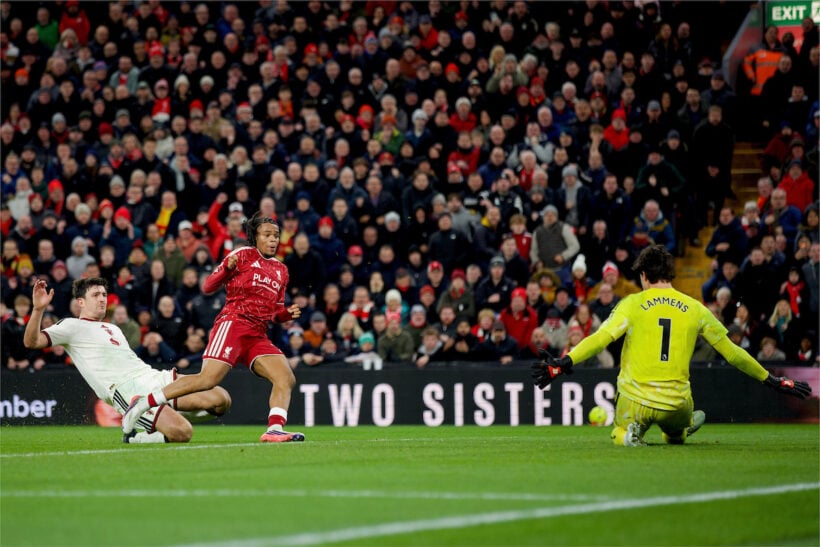
Liverpool won 4–0 on Sunday, November 22, 2026. Rio Ngumoha added the third in the 66th minute, and substitute Víctor Muñoz finished the scoring in the 82nd. It was a result that looked severe on the scoreboard and every bit as severe in the underlying chances: Liverpool had 28 shots to United's 10, with the reported expected-goals split at 4.38 to 0.63.
The red card explains why the visitors were placed under extreme pressure. It does not, on its own, explain why Liverpool found so many different ways through or why United produced so little once they had reorganized. Liverpool's wide players kept creating space, Wirtz made effective decisions between the lines, and Andoni Iraola's team maintained its threat after the initial burst. For Pochettino, the most uncomfortable questions concern what happened after the obvious emergency had been addressed.
Yoro's Eighth-Minute Red Changed the Match Before United Could Settle
There is no useful way to analyze Manchester United's afternoon without beginning with the eighth minute. Liverpool forward Alexander Isak threatened to run beyond the final defender, and Leny Yoro brought him down. Referee Sam Barrott dismissed Yoro for denying a clear scoring opportunity. From that moment, Pochettino had to reorganize a side already heading into one of the hardest away fixtures in the league.
The incident did not arrive in isolation. United's positioning before the foul left Yoro defending the most dangerous space with very little margin for error. When Isak attacked that gap, the centre-back faced an awful choice: allow the forward a route toward goal or intervene and risk the dismissal. Yoro was responsible for the challenge, but the situation also reflected how easily Liverpool had reached the space behind him. A team cannot expect its last defender to solve every problem created further up the pitch.
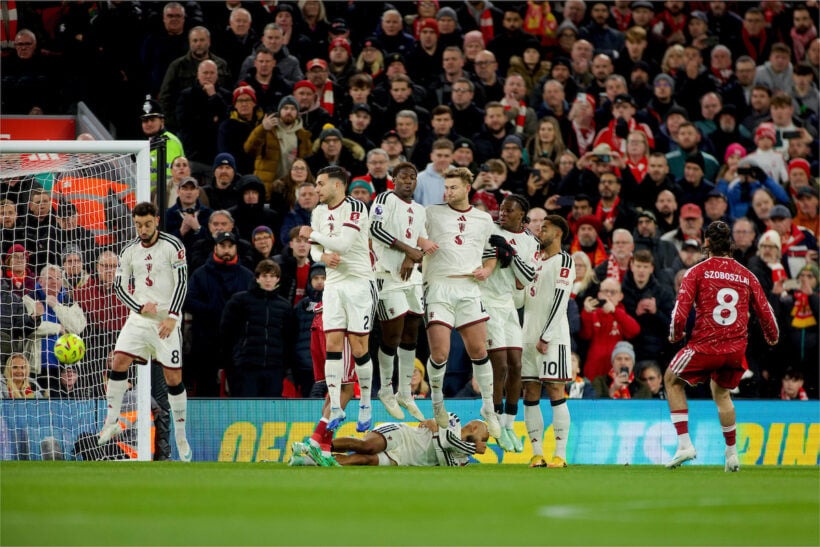
The punishment was immediate. Szoboszlai took the free-kick awarded outside the penalty area and guided a low strike past Senne Lammens in the tenth minute. It was a direct free-kick, not a penalty, and it gave Liverpool an important first reward for forcing United into retreat. Szoboszlai's selection had been discussed because of knee concerns during the international break. The midfielder answered by becoming the first player to score, which is a much more useful contribution than any pre-match debate about whether he should start.
Three minutes later, Liverpool doubled the lead. Rio Ngumoha attacked down the left and delivered a pull-back that Florian Wirtz finished with an acrobatic volley. The critical detail is the speed of the second strike. United had not yet established a workable replacement shape before the margin doubled. When a side is reduced to ten players, it normally tries to slow the game, keep the ball in safer areas and buy time for clear instructions. Liverpool denied it that breathing room.
Two early goals did more than change the score. They let Liverpool choose when to push forward and forced United to contemplate opening up when it could least afford to. It also meant every promising Manchester United possession had a very different calculation attached to it: one goal might revive the contest, but losing the ball could leave another attacker running into the gaps. The dismissal was a turning point; the ruthless finishing immediately afterward made it a near-impossible mountain.
GOATIFY
GOATIFY Soccer
Browse GOATIFY soccer designs while unpacking the early Anfield red card and Szoboszlai's opener.

Glazers Out Manchester United , Red Letters Sweatshirt
A football fan design for everyday wear.
Shop Now ↗
Kylian Mbappe Red Ninja Turtle Raphael with Mug
Add football personality to your coffee break.
Shop Now ↗
Glazers Out Manchester United , Red Letters Hoodie
A football fan design for everyday wear.
Shop Now ↗
OUTEOS INEOS OUT Manchester United Protest Sticker
Add football personality to your favourite gear.
Shop Now ↗

Trashford Marcus Rashford Manchester United Tank
A football fan design for everyday wear.
Shop Now ↗That distinction matters for judging Pochettino's debut. A manager cannot rewind an eighth-minute red card. He can organize his remaining players and try to limit the damage. But after 13 minutes, the challenge had already moved beyond simple damage control. United needed a way of denying Liverpool entries into the same channels while still retaining some means of escaping pressure. Finding either proved difficult.
Ngumoha and Wirtz Turned Liverpool's Width Into Real Chances
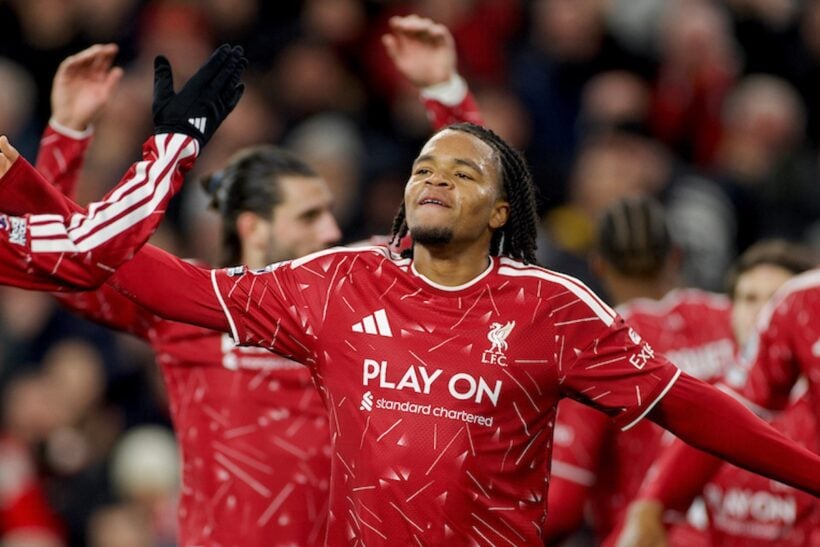
The dismissal opened up extra space, but Liverpool still had to exploit it. That is where the performances of Rio Ngumoha and Florian Wirtz separated this match from the kind of possession-heavy game that ends with a surprisingly narrow score. Liverpool did not merely pass around a depleted opponent. It used different runners and receiving positions to make United repeatedly move its defensive line.
Ngumoha was the most direct example. With Cody Gakpo unavailable because of a calf issue, Andoni Iraola used the young winger from the start. His job was not complicated: stay dangerous on the left, confront Diogo Dalot, and carry the ball into areas where a defender would have to make an uncomfortable decision. The execution was consistently effective. Ngumoha could take an opponent on himself or reach the byline and deliver for a teammate. The second goal demonstrated the value of that combination, because he created the opportunity that Wirtz finished rather than forcing a shot from a difficult angle.
Wirtz's influence was different. The German was available to receive in the spaces between United's midfield and defensive lines, then accelerate a move with either a turn or a well-timed pass. That role becomes especially destructive against ten opponents. A defender who steps toward Wirtz leaves space for a winger to attack; a defender who stays back allows Wirtz to face forward. The answer is not simply telling an individual to mark him more closely. It requires the team to protect central passing lanes while giving the wide defenders support.
Bradley Barcola offered another layer on the opposite side. His speed and movement widened United's back line even when his finishing was less decisive than his approach play. A match can feature missed openings without the attack itself becoming wasteful. What mattered was that Liverpool kept arriving in threatening positions from multiple directions. Isak provided a target centrally, Ngumoha pulled defenders toward the left, and Wirtz connected those movements without requiring the ball to travel slowly through every player.
There were moments when Liverpool appeared to take too many touches around the penalty area. That is a fair criticism when a team has the extra man and a two-goal lead. The difference is that the pattern of chance creation remained intact. Liverpool's attacks were not dependent on a single set-piece or one opponent losing his balance. The pressure came from repeatable choices: draw a defender out, find the next runner, and attack the space before the recovering player can close it.
Ngumoha's goal later in the match was the clearest reward for keeping that approach. Liverpool did not need a spectacular long-range effort to stretch the lead; it needed one accurate final decision after getting behind United again. Wirtz's contribution across the game supported the same reading. His value was not confined to the goal he scored. He repeatedly helped Liverpool take advantage of the numerical edge with purposeful movement and an ability to see where the next opening would be.
Pochettino Changed United's Shape. Liverpool Still Found the Gaps
Pochettino's first major decision as Manchester United manager was not an ambitious tactical experiment. It was an emergency response. After Yoro's dismissal, he removed Bryan Mbeumo and introduced Harry Maguire around the 22nd minute. The intention was apparent: get a dedicated defender into the back line, reduce the open spaces and give the remaining players a clearer reference point. United's 5-3-1 shape at least offered an organizing idea for surviving a miserable opening.
GOATIFY
GOATIFY Soccer
Explore football fan favorites after Ngumoha and Wirtz's attacking masterclass.

Nevereton Everton Parody Football Liverpool Sweatshirt
A football fan design for everyday wear.
Shop Now ↗
Stop INEOS, OUTEOS Manchester United Sticker
Add football personality to your favourite gear.
Shop Now ↗

Manchester United Ratcliffe Out, Glazers Out / Mug
Add football personality to your coffee break.
Shop Now ↗

There is a reasonable argument that the change worked in its narrowest immediate sense. Liverpool did not score again before halftime. United had enough bodies behind the ball to slow some moves, defend some crosses and occasionally get forward for a dead-ball opportunity. A more chaotic response could have produced a much larger score much earlier. It is important not to judge the manager solely by a scoreboard that his team had already allowed to move sharply against him.
But containment only counts as success if it creates a path back into the match. With one forward isolated and limited options for supporting runners, United struggled to turn clearances into attacks. Even when they recovered the ball, the distance to Liverpool's goal was large and the supporting players often had to cover ground before a dangerous passing angle appeared. That meant Liverpool could regain its shape and attack again without having to endure prolonged defensive pressure of its own.
United's problem was therefore bigger than which numerical formation appeared on the tactics board. The side needed coordinated decisions about when to press, when to retreat and which runner would be allowed to leave a defensive position. A back five can look solid on paper and still be vulnerable if the midfield cannot prevent an opponent from receiving between the lines. The defensive unit keeps moving, and the fullbacks become unsure whether to engage a winger or hold the inside channel. Liverpool consistently forced precisely those choices.
At halftime, Pochettino replaced Matheus Cunha with Joshua Zirkzee. That gave United a different reference point ahead of the midfield, but it did not suddenly make the visitors capable of keeping possession high up the pitch. Liverpool's pressure continued. The hosts went through a spell of untidy finishing decisions and missed chances, but that should not be confused with United having taken control. The opportunities kept coming; the third goal was a matter of the right sequence finally being completed.
The decisive second-half move began with Alexis Mac Allister making a quick pass in midfield to release Barcola. The winger advanced into space and squared the ball for Ngumoha to score in the 66th minute. From United's perspective, that is the most instructive image of the half: a central pass, a wide runner and an unmarked finisher in dangerous space. It was not the first time Liverpool had created those conditions, and it was not prevented by the formation change.
What should Pochettino take from it? Not that the 5-3-1 was inherently a mistake. Once down to ten men away at Liverpool, protecting the penalty area is an understandable priority. The lesson is that organization needs an attacking release valve and clearer support for the wide defensive positions. Without either, the opponents can keep resetting their attacks, making a defensive block work for long stretches and increasing the likelihood that one more precise pass will break it.
Muñoz's Fourth Goal Exposed the Gap Between Depth and Damage Control
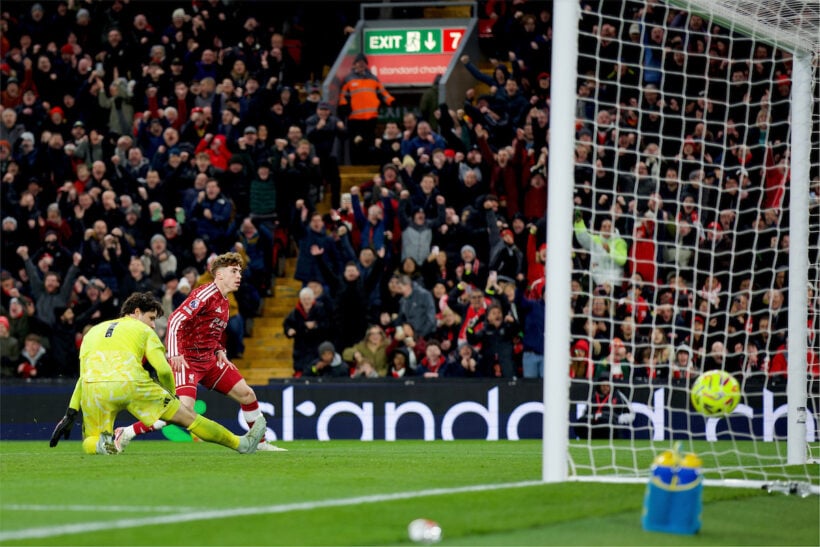
When Víctor Muñoz came off the bench in the second half, Liverpool had already established that its starting attack could create chances at will. His arrival added another runner who wanted to exploit space behind United's defensive line. In the 82nd minute, Wirtz spotted his movement, played the ball through, and Muñoz finished past Lammens to make it 4–0. The goal put the final number on a result whose direction had been clear for most of the afternoon.
The finish mattered beyond the immediate score. Against a team missing a player, a leading side can grow satisfied with a comfortable advantage, slow its movement and allow the contest to become static. Liverpool did not entirely avoid that temptation, but it continued to introduce attackers who were eager to contribute rather than simply running down the clock. Muñoz's goal showed that the hosts still possessed the speed and coordination to create a clear opening late in the match.
GOATIFY
GOATIFY Soccer
See GOATIFY soccer styles as United's defensive shape and Liverpool's wide attack go under the microscope.


Kylian Mbappe – Regal El Dictator Soccer Sweatshirt
A football fan design for everyday wear.
Shop Now ↗

GLINEOS OUT Manchester United Fans Protest Hoodie
A football fan design for everyday wear.
Shop Now ↗
AMADNESS Amad Diallo Manchester United Sticker
Add football personality to your favourite gear.
Shop Now ↗
Wirtz earned the assist after scoring in the first half, strengthening the case that he was central to Liverpool's best work. He did not need to dominate possession every moment to influence the game. His interventions were decisive because they moved the ball toward a teammate in a better scoring position. It is a useful contrast with United, whose rare attacking moves too often began with a long recovery run and ended before enough players could get close to the box.
The numbers are difficult to ignore. Liverpool's reported 28 shots and nine big chances point to a performance built on repeated arrivals in dangerous zones rather than one exceptional finishing streak. Its expected goals total of 4.38 compared with United's 0.63 also indicates that the four-goal margin was broadly consistent with the quality of chances created. Expected goals are an estimate, not an alternative scoreboard, and a long spell with ten men obviously affects them. Even with that context, the gap emphasizes just how little the visitors manufactured.
For Iraola, this was a significant home win against a rival that carries attention regardless of table position. It came after an uneven sequence at Anfield, and the victory left Liverpool one point behind second-placed Brighton, according to the match-day table. The identity of the opposition added a different sort of weight. Four goals against Manchester United will always travel further than four against an opponent that rarely appears on national television. But the more sustainable benefit was the way Liverpool's combinations produced quality chances across 90 minutes.
For Pochettino, the larger standings picture was grim. United finished the weekend just one point ahead of Sunderland at the bottom end of the table. A manager debut does not erase the previous months' problems, and there is no value in pretending he should have solved them all in his first match. Nor should he allow the early dismissal to become a shield for a broader inability to threaten opponents. He has to find a team structure that can survive difficult moments and still offer a credible path toward scoring.
The comparison between the benches is revealing. Liverpool used a substitute to add one more attacking problem; United used its bench primarily to repair the shape of a depleted team. That was rational in the circumstances, but it is also an image of the difference between a side playing from a position of freedom and one trying to hold itself together. The final goal was a reminder that Liverpool was still asking new questions in minute 82 while United was looking for ways to stop the examination.
Liverpool did the difficult thing first: it converted the numerical advantage into goals before United could settle. Then it did the equally important thing over the following hour by continuing to force uncomfortable choices. Four different scorers reflected a performance in which Wirtz's movement, Ngumoha's running, Barcola's deliveries and Muñoz's fresh legs all offered genuine ways to hurt the visitors.
United can fairly say that an eighth-minute red card changed the terms of the match. They cannot use that fact to avoid examining the spaces Liverpool repeatedly accessed, the scarcity of their own chances and the lack of a meaningful second-half adjustment. Pochettino's first fixture brought a brutal situation; the next matches will show whether he can give a struggling side a structure that survives one bad event.
The 4–0 score is a single result, not a final verdict on a new manager. For Liverpool it is evidence that an aggressive attacking plan can deliver against a major rival. For United it is a warning that the personnel change in the dugout has not, by itself, changed the underlying problems on the pitch.
GOATIFY
GOATIFY Soccer
Shop GOATIFY soccer and football shirts, hoodies and stickers.

Kylian Mbappe Ninja Turtle Football Euro 2024 Hoodie
A football fan design for everyday wear.
Shop Now ↗
Bottlers FC Tottenham Hotspur Parody , Spursy Sweatshirt
A football fan design for everyday wear.
Shop Now ↗
Kylian Mbappe Red Ninja Turtle Raphael Men's Tee
A football fan design for everyday wear.
Shop Now ↗
Amad Diallo Goal Celebration AMADNESS Sticker
Add football personality to your favourite gear.
Shop Now ↗
Kylian Mbappe Purple Ninja Turtle Donatello Mug
Add football personality to your coffee break.
Shop Now ↗