Suter Gives the Yankees Another Lefty. Hill Makes the Fit Tricky.
GOATIFYThe Yankees did not sign Brent Suter to throw 100 mph. They reportedly reached an agreement on November 23 with a 37-year-old left-hander whose value comes from making hitters uncomfortable without the kind of velocity that usually drives winter headlines. The financial commitment is modest by major-league relief standards: approximately $4 million guaranteed, consisting of a reported $3.75 million salary and a $250,000 option buyout, with a $3.5 million club option for 2028.
It would be easy to call this an uncomplicated depth move. Suter had a 3.36 ERA over 91 innings in 2026 and became particularly effective after Atlanta acquired him from the Angels. But the Yankees had already brought back Tim Hill, restored David Bednar to the ninth inning, and added Jonathan Loáisiga. Suter's arrival is intriguing not because one more veteran makes the bullpen worse, but because several useful pitchers now want overlapping kinds of work. The test is whether Aaron Boone can turn that overlap into a genuine advantage.
Suter's 91 Innings Make This More Than a Lefty Matchup
Suter's best argument is not one spectacular pitch. It is the different shape he gives an inning. During the 2026 season he appeared 54 times yet worked 91 innings, a workload that averages substantially more than three outs per appearance. He also made four starts. On a roster built around a strong rotation but still exposed to short starts, extra-inning games and stretches of consecutive appearances, that ability to absorb more than a single matchup has immediate value. The Yankees do not have to deploy him as a traditional specialist simply because he throws left-handed.
His late-season performance offers the optimistic version of the signing. After moving from the Angels to Atlanta at the trade deadline, Suter delivered a 1.63 ERA over 27 2/3 innings, with 23 strikeouts and eight walks. That is a meaningful run of success, but it is also a small enough segment that New York should avoid treating it as a new permanent baseline. His entire 2026 season, with a 3.36 ERA and a 3.53 fielding independent pitching mark, is a more sensible starting point for expectations. The Braves stretch demonstrates what can happen when the contact goes his way, rather than guaranteeing it will happen again.
Suter works by disrupting the timing and quality of contact. His fastball lives below the velocities of many bullpen arms, but his release extension effectively shortens the distance a hitter has to recognize the pitch. A sinker and changeup give batters different speed and movement profiles from a similar visual window, while his other offerings prevent the approach from becoming completely predictable. He is not a purely passive ground-ball pitcher: his 2026 strikeout rate cleared 20 percent, even if it did not approach the dominant numbers of a conventional power reliever. The useful distinction is between being unable to miss bats and not needing strikeouts as the first solution.
The strongest supporting figure is the quality of balls opponents put into play. A reported 31.0 percent hard-hit rate tells a more favorable story than a simple ground-ball percentage, because grounders can still be struck brutally hard. Suter pairs enough grounders with consistently limited damaging contact. The profile does not make him invulnerable: any pitcher who relies on the defense turning contact into outs can suffer when the infield is poorly positioned, a runner is moving, or a routine ball finds an unusual seam. But it is a credible skill, and it fits a staff that increasingly values varied release points rather than uniform velocity.
An extra practical advantage is how that pitch mix changes the sequence a hitter sees. A power right-hander firing high fastballs followed by Suter's lower-velocity sinker and changeup asks an opponent to solve a very different timing problem in consecutive plate appearances. That disruption is not magic, and neither a contrasting radar-gun reading nor the word finesse automatically produces outs. The actual gains depend on location, defense, count leverage and the opposing lineup. Still, it broadens the options available to a manager without forcing a different starting pitcher into an unfamiliar job.
GOATIFY
GOATIFY Baseball
Weak contact and multi-inning depth reshape the Yankees bullpen


White Baseball GOAT Sweatshirt
Rep baseball’s greatest with a white GOAT graphic sweatshirt.
Shop Now ↗
White Baseball GOAT Sticker
A white baseball GOAT decal for your bottle, laptop or game-day gear.
Shop Now ↗A multi-inning role also makes the financial commitment easier to understand. If Suter can cover a difficult sixth inning and remain available for the seventh, New York might avoid burning two separate relievers in an ordinary game. On other nights, he can bridge a start that ends earlier than planned, or enter with runners on base when a ground ball is more valuable than a strikeout. Those are distinct assignments, not a guarantee that one 37-year-old can handle all of them at once. The club will need to manage recovery days and matchups instead of reading his 2026 innings total as an unlimited workload permit.
His arrival also has implications for Ryan Yarbrough, a free-agent swingman who pitched to a 3.69 ERA and excelled at avoiding hard contact. Both pitchers can cover length and neutralize offenses without relying on overwhelming stuff. Suter's contract makes it reasonable to ask whether the Yankees consider that vacancy addressed, but it would be premature to declare Yarbrough's departure inevitable. The roster can support multiple long-relief options at times, particularly if the starting staff's health changes. For now, the signing increases New York's flexibility while narrowing the space available for another pitcher of the same type.
What Suter does not offer is a clean substitute for the bullpen's missing strikeout specialist. The team can value his contact suppression without pretending that a sinker-changeup veteran is the answer to every inherited-runner jam. With a runner on third and one out, a weak grounder can still produce a run; with the bases loaded, a strikeout can be the safest way out. That distinction is why the next layer of New York's bullpen construction matters just as much as the apparent bargain on the new contract.
Hill's 2024 Rescue Collided With His 2026 Decline

The more uncomfortable comparison is with Tim Hill, because both are lefties who make sinkers and deception central to their identities. Hill returned to the Yankees earlier this month on a one-year, $2.25 million agreement with a club option. Suter's larger guarantee is still affordable, but the roster question is less about the combined salary than about whether the two can serve meaningfully different jobs. If they are treated as interchangeable one-batter ground-ball specialists, the Yankees may be buying duplication rather than depth.
Hill's relationship with New York explains why the organization might believe in a rebound. When he joined in June 2024, his unusual low release helped him become an exceptionally reliable, high-volume ground-ball option. Through the first part of 2026 he was still performing at a level that made a second stint attractive. A photograph from his original Yankees revival illustrates the mechanics that created that trust: the ball comes out of a visibly different arm slot, forcing batters to adjust their swing plane. The issue is not whether the approach ever worked; it is whether the version seen late in 2026 can recover.
The season-ending numbers were much less flattering. Hill finished with an ERA around 4.60, and his 10.4 percent strikeout rate left very little room for mistake pitches. His 68.9 percent ground-ball rate still looked extraordinary, but the accompanying 43.4 percent hard-hit rate told a different story. A ground-ball specialist becomes fragile when the contact getting through is struck with authority, especially if opponents can stop chasing pitches outside the zone. Hill remained difficult to elevate in some matchups, yet the balls that were elevated punished him badly enough to undermine the safety that once defined his role.
GOATIFY
GOATIFY Baseball
Explore GOATIFY Baseball gear while comparing two unusual lefties

White Baseball GOAT Dad Hat
A white baseball GOAT design for ballpark days and everyday fan style.
Shop Now ↗

Gold Baseball GOAT Sticker
A gold baseball GOAT decal for your bottle, laptop or game-day gear.
Shop Now ↗


Suter offers a different balance. His 50.6 percent ground-ball rate was lower than Hill's, but the reported 31.0 percent hard-hit rate, 20.7 percent strikeout rate and 23.6 percent whiff rate were all more encouraging than Hill's corresponding marks. Those are not the numbers of a classic late-inning overpowering lefty; they are evidence that Suter has more ways to escape when his favorite contact pattern fails. The contrast exposes why a single metric can mislead: Hill gets more balls on the grass, while Suter has done more to limit how violently opponents hit them.
The deliveries also create distinct matchup opportunities. Hill's submarine motion can be especially awkward for a hitter who seldom sees that release angle; Suter disguises modest speed with exceptional extension and a changeup that arrives on a different timetable. Using them together could make sense if scouting identifies lineups that react very differently to those two looks. Boone might favor Hill against a ground-ball-prone portion of an order and save Suter for hitters whose damage comes from lifting hard pitches. That is an argument for tailored roles, not automatic platoon deployment.
The mistake would be turning either pitcher's handedness into the entire decision. A lineup with two left-handed batters in a row does not automatically require Hill, and a situation demanding five outs does not always call for Suter if the upcoming hitters crush soft contact. The manager needs more granular information: who chases the changeup, who handles sidearm sinkers, who is likely to put a ball in the air, and how the infield is arranged. Suter and Hill become complementary only when those decisions are rooted in hitters rather than labels on a depth chart.
There is a second reason to avoid a quick conclusion about Hill. Relievers often rebound when a club identifies a fixable change in release, movement or usage; the Yankees have built a reputation for those adjustments. A $2.25 million bet on an arm they know can be reasonable even if his most recent season disappointed. But familiarity cannot be mistaken for proof that a correction already exists. Spring training should tell New York more about the sinker's movement and command than the sentimental value of bringing back a veteran who once saved the club from a bullpen shortage.
The real benefit of carrying both would be resilience. Suter could provide length and a more varied swing-and-miss floor; Hill could be available for particularly favorable ground-ball matchups without being asked to solve every tough inning. The danger is allocating two roster spots to similar low-velocity profiles while leaving too few options capable of ending an at-bat without contact. That is the question the Yankees still need to answer as the offseason moves beyond the affordable signings.
Bednar Closes. Headrick Solves the Toughest Inning. Who Bridges?
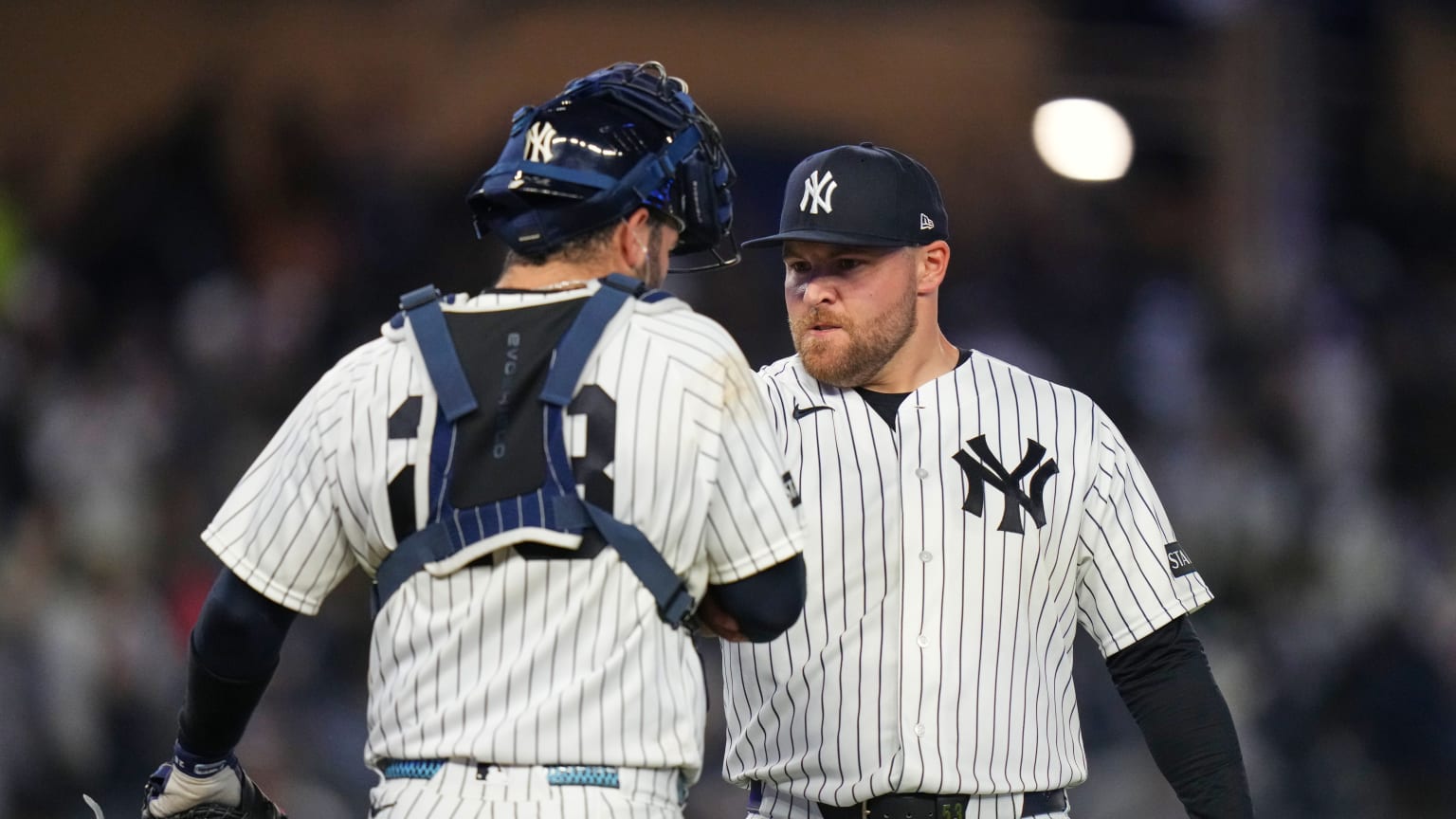
David Bednar is the most important reference point because New York already knows who it wants finishing games. The closer accepted a one-year $23.15 million qualifying offer after posting a 2.47 ERA and collecting 35 saves in 2026. That provides a proven ninth-inning identity but it is an expensive, short-term one. Bednar's return means Suter is not being asked to win the closer job. Instead, the question is which pitchers can deliver a lead to him without exhausting the rest of the bullpen on the way.
Brent Headrick offers the opposite of the two soft-contact lefties. The Yankees' breakthrough reliever appeared in a major-league-leading 81 games in 2026, logged 78 1/3 innings and recorded a 2.18 ERA with a strikeout rate of 30.1 percent. He is left-handed too, but his ability to overpower hitters and work out of inherited-runner trouble makes him a different tactical asset. Grouping Suter, Hill and Headrick together as three equivalent southpaws would obscure the most important difference in their profiles: the type of out each is best equipped to pursue.
Headrick's workload also explains why a manager might welcome Suter. If New York can use a veteran contact manager in a lower-leverage multi-inning appearance, Headrick does not have to be the emergency answer every time a starter exits early. That could preserve the harder-throwing arm for a seventh-inning crisis against the heart of a lineup. It is a reasonable deployment hypothesis, not a promise that the staff will be healthier or better next year. The club has to be willing to use Suter for actual length instead of reserving every reliever for one-inning slots.
GOATIFY
GOATIFY Baseball
Baseball gifts and fan apparel for the Yankees' 2027 bullpen debate


Gold Baseball GOAT Dad Hat
A gold baseball GOAT design for ballpark days and everyday fan style.
Shop Now ↗
White Baseball GOAT Sticker
A white baseball GOAT decal for your bottle, laptop or game-day gear.
Shop Now ↗Jonathan Loáisiga adds another variable after reportedly agreeing to return from Arizona on a two-year pact. The right-hander had worked back to a 2.42 ERA over 67 innings with the Diamondbacks in 2026. His health and changed pitch mix provide an interesting bet, and his presence introduces a different arm angle and another ground-ball option. He is not a perfect duplicate of either lefty, but every signing competes for the same fixed number of bullpen positions. New York is moving from a shortage of experienced candidates toward the harder task of choosing the correct mixture.
That mixture becomes especially important when an opponent can stack several hitters with one shared weakness. Some teams allow an aggressive bullpen to live on contact management because their defense converts almost everything on the ground. Others force pitchers into two-strike counts where the absence of a put-away pitch becomes costly. The Yankees can construct different paths through a game by assigning Suter the innings that reward weak contact, Headrick the urgent strikeout spots, Loáisiga the right-handed bridge and Bednar the finish. But if every arm is used by a rigid inning number, the theoretical variety delivers much less value.
There is also the unresolved possibility of further spending. Adrian Morejón has been linked to the Yankees, but interest is not an agreement, and a possible pursuit should not be written as a completed deal. A high-end strikeout reliever would complement Suter more directly than another specialist who requires routine contact. The costs are not only money: an additional guaranteed contract could push an existing pitcher off the active roster or narrow the club's flexibility to evaluate younger arms. That decision has to account for the lineup and rotation needs still competing for the same offseason resources.
New York should resist judging this bullpen by a roll call of recognizable names in November. A sound relief corps needs a closer, pitchers who can earn strikeouts with runners on base, pitchers who keep the ball on the ground when a double play matters, and enough length to protect the staff across a difficult schedule. The same arm may cover more than one category, but not all arms cover all categories equally well. The Suter signing succeeds if it fills a predictable category and frees his teammates to handle the assignments at which they are strongest.
That makes the 2027 audition unusually revealing. If Hill's sinker becomes more effective, he can reclaim useful specialist innings without taking length away from Suter. If Headrick repeats his breakout, he may become the manager's best escape route in the game's highest-leverage pockets. If Loáisiga remains healthy, the Yankees gain an additional bridge to Bednar. If those improvements fail to appear, merely counting left-handers and veterans will not help. New York has bought options, not yet demonstrated that every inning has a reliable owner.
The Yankees' decision to add Suter is defensible on its own merits. His 2026 innings, contact quality and late-season work in Atlanta all point to a pitcher who can help a contender without requiring a premium contract. The next move is more complicated: New York must identify the innings in which Suter is genuinely different from Hill, and the situations in which a strikeout-focused arm should take precedence over both.
Bednar's return supplies the final step, while Headrick and Loáisiga offer contrasting ways of getting there. If those roles fit together, Suter may prove to be a subtle piece of a stronger bullpen. If they do not, November's impressive list of transactions will leave a familiar problem waiting in the seventh inning.
GOATIFY
GOATIFY Baseball
Shop GOATIFY baseball shirts, hoodies and stickers.


Gold Baseball GOAT Sweatshirt
Rep baseball’s greatest with a gold GOAT graphic sweatshirt.
Shop Now ↗White Baseball GOAT Dad Hat
A white baseball GOAT design for ballpark days and everyday fan style.
Shop Now ↗White Baseball GOAT Sweatshirt
Rep baseball’s greatest with a white GOAT graphic sweatshirt.
Shop Now ↗