Rogers Has an Elite Fastball. His Changeup Could Decide the Contract.
GOATIFYTrevor Rogers is entering free agency with a résumé that looks almost impossible to price from the season-long line. The Baltimore left-hander finished 2026 with a 4.03 ERA over 30 starts, a number that suggests a useful rotation piece rather than a clear-cut front-line investment. But for the final 20 of those starts, from June 4 through September 25, his ERA was 2.90 and his fielding-independent pitching was 2.89. That is a far more compelling version of the pitcher than the one who labored through April and May.
A new analysis of his three main pitches, published November 22, shows why the dispute over his value will not be settled by the annual ERA column. Rogers has a fastball that confounds hitters without overwhelming radar-gun velocity, a changeup that lost much of its value, and a newer sweeper that gives him a different way to attack both sides of the plate. Every prospective buyer has to decide which elements are durable and which were a short-lived correction.
There is another wrinkle. Rogers declined Baltimore's one-year, $23.15 million qualifying offer on November 17, creating potential draft-pick costs for another club that signs him. That makes this a baseball evaluation and a roster-building decision at the same time. The most intriguing question is not whether Rogers can pitch well. He has demonstrated that repeatedly. It is whether the version that appears every fifth day next season will be the overpowering summer lefty or the starter who spent the spring searching for a dependable second pitch.
Three Versions of Rogers in 48 Starts Make His Market So Unusual

Baseball evaluation becomes a dangerous exercise when a 30-start season contains two completely different pitchers. Rogers made 18 starts after returning from a knee injury in 2025 and posted a 1.81 ERA with a 2.82 FIP. That was a remarkable run, but it also came from a partial season, and no front office wants to spend as if 18 brilliant starts automatically constitute a permanent baseline.
The opening ten starts of 2026 supplied the opposite warning. Rogers had a 6.84 ERA and 4.85 FIP during that period, and his strikeout-minus-walk rate sank to 9.1 percent. He also missed time because of illness. The gap between that stretch and the previous summer was not a minor difference in luck or a couple of inherited runners crossing the plate. One of the game's most effective starters had temporarily become the kind of pitcher for whom a short inning could spiral into a long one.
Then the final twenty starts changed the conversation again. His 2.90 ERA came with a 2.89 FIP and a 20.5 percent strikeout-minus-walk rate, a much stronger combination than a low ERA alone. FIP cannot capture every nuance of contact management, but it helps separate genuine pitching improvement from a stretch built entirely on spectacular defensive plays and hard-hit balls finding gloves. A near-match between Rogers's ERA and FIP over twenty starts gives clubs a better reason to believe in the improvement.
The key distinction is sample length. Twenty starts are not an entire career, but they are enough to force a serious evaluation of pitch characteristics and repeatability. Twenty starts, after ten difficult ones, also imply that there was an adjustment worth identifying rather than a blanket declaration that Rogers had rediscovered his confidence. His final stretch showed more strike throwing and better swing-and-miss results. Those are skills teams can measure, challenge and potentially reproduce.
That is why his 4.03 season ERA is an incomplete valuation tool. It records every run fairly, but it does not say whether the failures of the first two months are likely to return. Nor does the 2.90 finishing ERA prove he will be an ace. A club paying for his ceiling needs a plan for the months when he cannot place his four-seamer exactly where he wants it. A club paying only for his floor may miss one of the more interesting rotation upgrades available.
GOATIFY
GOATIFY Baseball
Explore GOATIFY baseball fan designs while comparing Rogers's three wildly different runs of form.

Gold Baseball GOAT Sweatshirt
Rep baseball’s greatest with a gold GOAT graphic sweatshirt.
Shop Now ↗


White Baseball GOAT Dad Hat
A white baseball GOAT design for ballpark days and everyday fan style.
Shop Now ↗

White Baseball GOAT Sticker
A white baseball GOAT decal for your bottle, laptop or game-day gear.
Shop Now ↗For Baltimore, which worked with Rogers through the 2024 trade disappointment and the recovery that followed, that uncertainty is personal as well as statistical. For another team, the first assignment would be to reconstruct what went wrong early in 2026 without assuming a new uniform will cure it. The strongest pitch characteristics are portable. The daily ability to execute them is the part that needs the closest inspection.
The Fastball Is Elite Even When the Radar Gun Says Otherwise
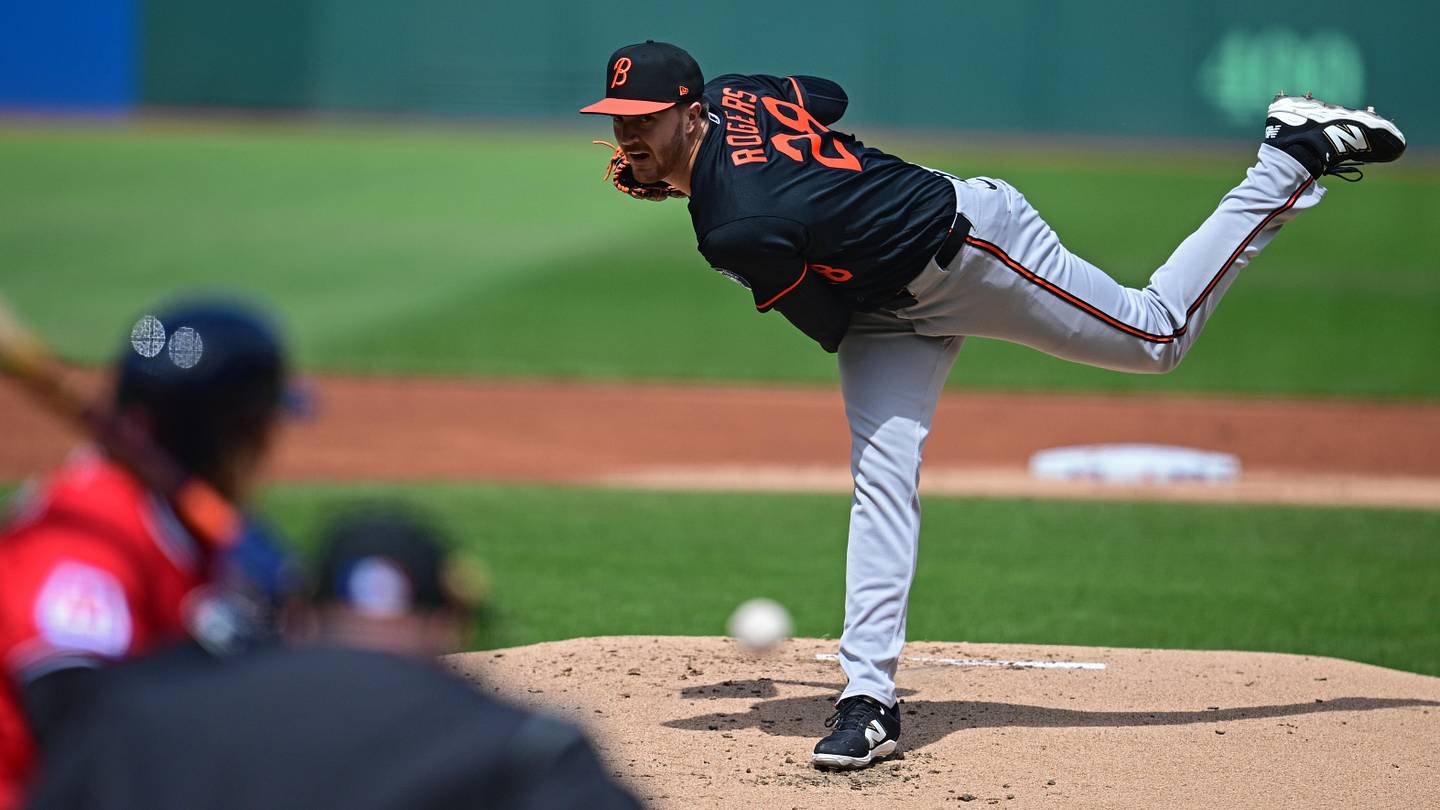
The obvious assumption about a dominant four-seam fastball is that it arrives at 98 or 100 miles per hour. Rogers is evidence that the sport is not that simple. His four-seamer averaged roughly 93.8 mph in 2026, close to the left-handed league norm rather than elite raw speed. Yet measured by Statcast run value since his 2025 return, his fastball has been worth 28 runs. Over that period only Cam Schlittler's and Jacob Misiorowski's four-seamers ranked higher in the comparison presented by MLB, with Yoshinobu Yamamoto next behind Rogers.
The pitch's unusual movement and origin explain why a fairly ordinary velocity can produce extraordinary discomfort. Rogers releases from a low arm angle of roughly 22 degrees. Many low-slot pitchers generate substantial sideways movement but comparatively little ride. His fastball combines around eleven inches of arm-side run with fifteen inches of induced vertical break. The result is movement in more than one plane, so the ball does not travel quite where a hitter's visual system expects it to finish from that release position.
That shape matters only if a hitter must respect the strike. Rogers struggled early in 2026 when he put just 51.2 percent of four-seamers in the zone during his first ten starts. In the final twenty, that rate climbed to 60.6 percent. It had been 64.7 percent during his spectacular 2025 run. Those are not cosmetic differences. A pitcher who lives outside the zone asks a hitter to chase. A pitcher with an unusually shaped fastball who frequently finds the plate can force the hitter to make a decision before being completely sure what the baseball is doing.
The comparison with Schlittler and Misiorowski is useful precisely because the deliveries are different. Their value is not an instruction for Rogers to imitate another pitcher's velocity profile. It is evidence that an offering with a distinctive path and reliable location can belong in the same discussion as pitches powered by more eye-catching speed. Rogers's task is to protect the ingredients that make his fastball different, not turn himself into a harder-throwing version of somebody else.
He rebuilt some of his lost velocity after a prior visit to Driveline, where a strength assessment pointed to lower-body issues. His 2024 average fastball had dipped to 91.9 mph, and the eventual recovery gave him enough speed for the unusual movement to play. The lesson for his next employer is that conditioning, arm-slot consistency and command need to remain a coordinated program. A slight velocity decline may not be catastrophic, but a drop in zone rate combined with diminished life could erase the advantage quickly.
For a potential buyer, the fastball should be the foundation of a contract argument. A genuine plus pitch is much harder to manufacture than a believable one-month ERA. But that foundation also sets the risk. If the delivery becomes inconsistent, a high fastball intended to beat a swing can drift into damage territory. The club that signs Rogers should want evidence of repeated, healthy execution rather than simply replaying his best June highlights.
GOATIFY
GOATIFY Baseball
Shop MLB-inspired baseball styles as we break down what makes Rogers's four-seamer so hard to hit.


Gold Baseball GOAT Dad Hat
A gold baseball GOAT design for ballpark days and everyday fan style.
Shop Now ↗
White Baseball GOAT Sweatshirt
Rep baseball’s greatest with a white GOAT graphic sweatshirt.
Shop Now ↗

Gold Baseball GOAT Sticker
A gold baseball GOAT decal for your bottle, laptop or game-day gear.
Shop Now ↗The Broken Changeup Is the Real Reason Teams Should Hesitate
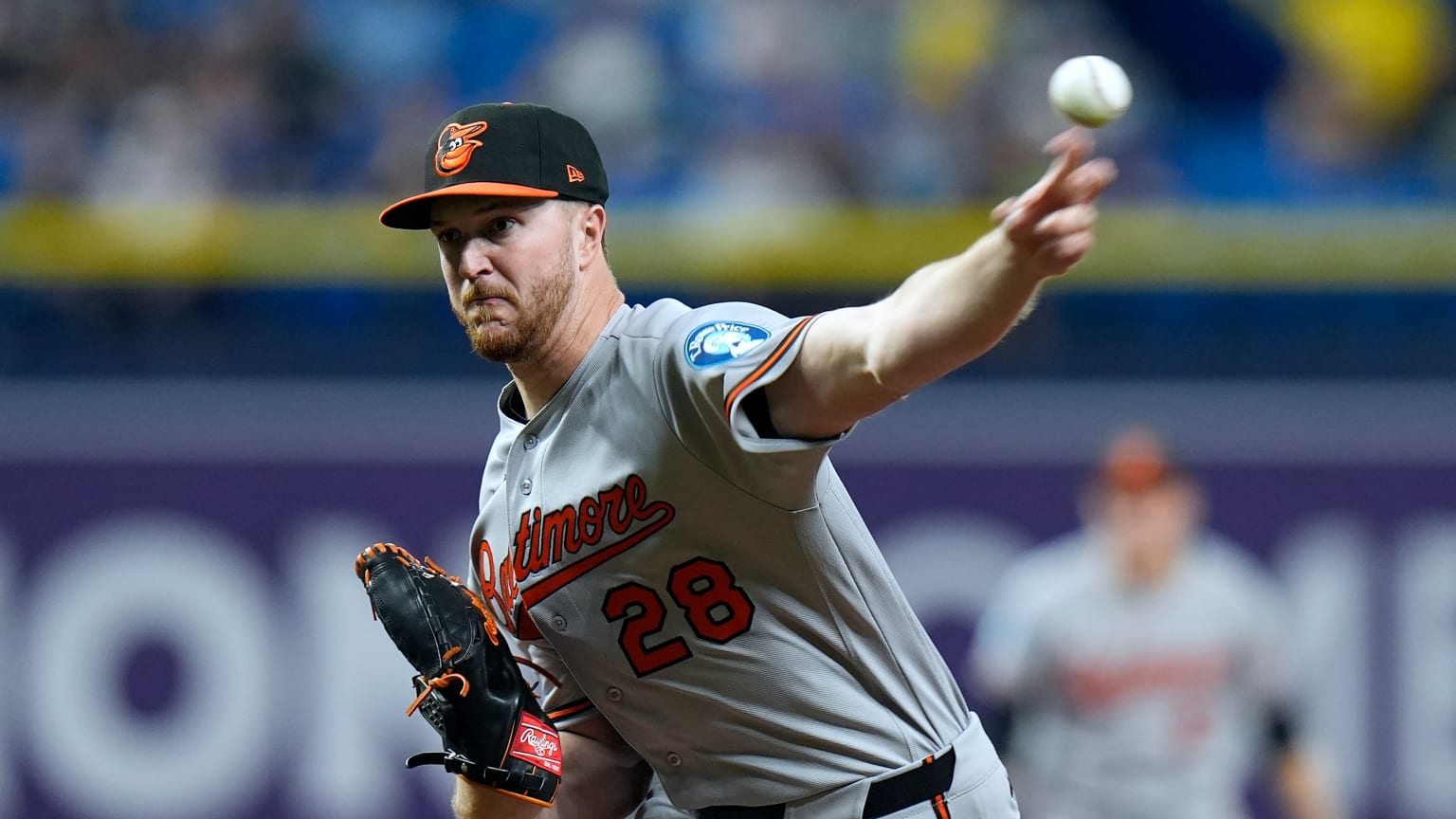
If the fastball is what attracts bidders, the changeup is what should make their pitching departments ask harder questions. In 2025, Rogers's changeup carried a positive seven-run value. In 2026, it fell to negative eleven. That is a large deterioration in a pitch that historically supplied much of his ability to neutralize right-handed bats. The damage was not confined to a couple of memorable home runs; opponents hit .336 with a .477 slugging percentage against it, both unusually poor marks for the offering.
The problem becomes clearer when looking at the situations in which a left-handed starter most needs a trustworthy off-speed weapon. Rogers used his changeup 29 percent of the time with two strikes against right-handed hitters in 2025. Opponents hit only .106 in those situations and the pitch generated a 19 percent whiff rate. The following year, two-strike usage dropped to 20 percent, the batting average allowed rose to .309, and the whiff rate slipped to 12 percent. A pitch designed to finish plate appearances instead became one he had less reason to trust.
There is a feedback loop here. When an off-speed pitch is not convincing, the pitcher can stop using it, but hitters then become less concerned about encountering it in dangerous counts. They can focus more attention on the fastball, particularly against a pitcher whose main advantage depends on where the hitter thinks the ball will finish. Rogers's September changeup usage fell to 15.7 percent, the lowest monthly share of his career. That is an adaptation, but not necessarily a complete solution.
The contrast by batter handedness adds to the unease. Right-handed hitters batted .185 against Rogers in 2025 and .269 in 2026. Those are overall splits rather than proof of a single pitch causing every extra hit, but they show the practical problem. A team considering a substantial multiyear deal cannot assume it will face left-handed batters in the most convenient sequence. The changeup is one of the tools that make a starter viable across an entire lineup and across multiple passes through the order.
It is tempting to diagnose the problem from afar as a grip issue, a change in release point, or a loss of conviction. The available pitch models point to weaker quality and command than Rogers had previously shown, but they do not establish a single mechanical cause. There may be room for a modest adjustment rather than a wholesale rebuild. There may also be a harder truth: the pitch that once looked like a second dependable weapon might no longer be special enough to justify frequent use.
That uncertainty changes the free-agent negotiation. Teams do not need to restore the 2025 changeup to exactly its old form for Rogers to succeed. They need an offering that righties cannot ignore when the fastball starts above the zone or moves off the plate. A pitch can succeed by creating a timing problem, generating weak contact, or persuading hitters to let a fastball pass. The next club has to decide how to rebuild that credible threat without compromising a fastball that is already demonstrably elite.
The Sweeper Offers a Way Forward — and a Complicated Free-Agent Price
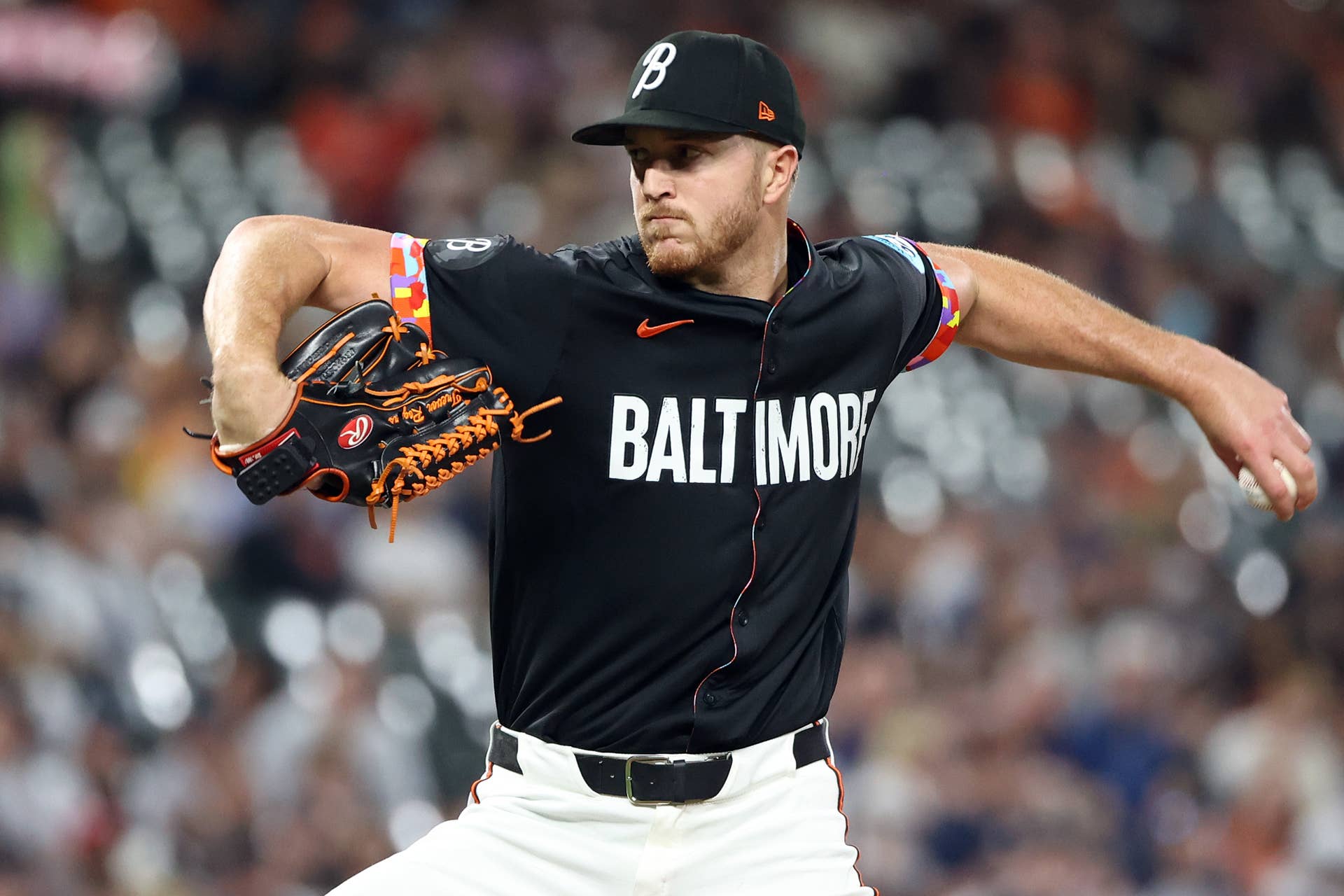
The best argument for not overreacting to the changeup comes from a third pitch that grew more important during the second half. Rogers's sweeper held opponents to a .183 batting average in 2026 with a 31.7 percent whiff rate. Compared with 2025, its horizontal break increased by about three inches. This is a movement profile with a very different direction from the fastball, sinker and changeup, and that distinction gives a hitter something else to consider.
A sweeper works particularly well when the pitcher can make two offerings look similar early and then send them toward different finishing locations. Rogers's low release adds intrigue to that concept. If the batter decides to sit on fastball ride, the breaking ball can leave the anticipated path. If the batter begins to worry about the sweeper, the four-seamer may arrive with less competition for attention. The arsenal does not require every pitch to be a star; it requires the parts to reinforce one another.
GOATIFY
GOATIFY Baseball
Find GOATIFY baseball accessories while examining Rogers's changeup and its consequences against righties.


White Baseball GOAT Dad Hat
A white baseball GOAT design for ballpark days and everyday fan style.
Shop Now ↗White Baseball GOAT Sticker
A white baseball GOAT decal for your bottle, laptop or game-day gear.
Shop Now ↗But a sweeper is not an automatic replacement for a changeup. The two pitches have different movement, timing and platoon considerations. A left-handed starter who relies too heavily on a horizontal breaking ball risks developing a visible pattern, especially when right-handed hitters can anticipate where the pitch will finish. A successful season-long mix will depend on when Rogers can use the sweeper for a strike, when to bury it, and how it interacts with the vulnerable changeup he may be trying to rehabilitate.
That is where the investment could be worthwhile. Rogers already showed the capacity to experiment with grips and training methods during his work with Driveline. The sweeper did not appear by magic; it emerged from a deliberate attempt to add a pitch shape he lacked. Teams may reasonably see a 29-year-old pitcher who can still develop, not a veteran whose entire arsenal is fixed. The distinction matters in free agency because paying for past innings is only half the job. The other half is estimating how many better innings can be created.
Money is not the only consideration. Rogers turned down Baltimore's one-year qualifying offer worth $23.15 million, so another club signing him could sacrifice draft capital under the qualifying-offer rules. The exact cost varies with the signing team's circumstances. For the Orioles, a reunion would not come with that external pick loss, although the salary and competitive opportunity cost would still be real. That difference can influence how two organizations value precisely the same projected performance.
The Orioles also have a baseball reason to remain interested. They helped Rogers move beyond an ugly initial stint after the 2024 trade, and their rotation still needs left-handed balance. A contender elsewhere might be willing to live with volatility if its pitching staff can provide targeted pitch-design work and if the club has enough depth to survive a rough April. A rebuilding club should be more cautious about paying a premium for a pitcher whose present value depends on sustaining a performance improvement without a fully dependable changeup.
No responsible projection can name an inevitable destination or promise that the final twenty starts are the new normal. What clubs can evaluate is the logic of his arsenal. The four-seamer supplies a high ceiling, the sweeper supplies a viable complementary shape, and the changeup defines the largest known weakness. The organization that best understands the relationship among those three pitches may make a wiser bid than the one that simply offers the most optimistic comparison with his 2025 ERA.
Rogers has already disproved the simplest reading of his career more than once. He was not finished when his first Baltimore appearances went badly in 2024. He was not guaranteed to repeat his 2025 dominance after returning from injury. And he was not permanently broken when the first ten starts of 2026 went sideways. His final twenty outings were a substantial response, even if they did not erase every warning signal.
The proper question for the winter market is therefore narrower and more useful than whether he is a star. Can he keep the fastball in the zone, rebuild enough changeup credibility against righties, and avoid making the sweeper predictable? If those three conditions hold, a rotation could acquire something close to a top-of-the-staff performer. If the changeup remains ineffective and strike throwing falls off, a hefty contract would be paying ace-level money for an uneven profile. Rogers's next team will not merely buy his 2026 statistics. It will be buying a plan to make the best version of his arsenal last.
GOATIFY
GOATIFY Baseball
Shop GOATIFY baseball shirts, hoodies and stickers.


White Baseball GOAT Sweatshirt
Rep baseball’s greatest with a white GOAT graphic sweatshirt.
Shop Now ↗