Vallejos Beat Sterling. Then He Challenged Silva and Murphy.
GOATIFYKevin Vallejos did two things at UFC Qatar that do not normally come together. He beat a former champion by decision without producing a spectacular finish, then made the loudest possible argument that the featherweight title conversation should revolve around him. The first achievement was technical and patient. The second was anything but. On November 21, the 24-year-old Argentine defeated Aljamain Sterling in Doha before calling for Alexander Volkanovski's championship and openly dismissing Jean Silva and Lerone Murphy as obstacles.
The public challenge was not an offhand remark delivered in the excitement of a win. Vallejos said he took that message directly to UFC executive Hunter Campbell at cageside. Whether the blunt language earns him an immediate opportunity is a different question. Silva already owns a win over him from Dana White's Contender Series in 2023. Murphy has his own substantial featherweight résumé. Volkanovski, meanwhile, controls the biggest decision of all: remain at 145 pounds or push for a different challenge.
That creates a more interesting discussion than whether Vallejos was confident enough on the microphone. His win made a title argument credible. His choice of targets made the argument personal. The UFC now has to separate a fighter's promotional momentum from the sporting evidence, and the Qatar performance offers material for both sides.
The Sterling win was a wrestling test, not a 30–27 blowout
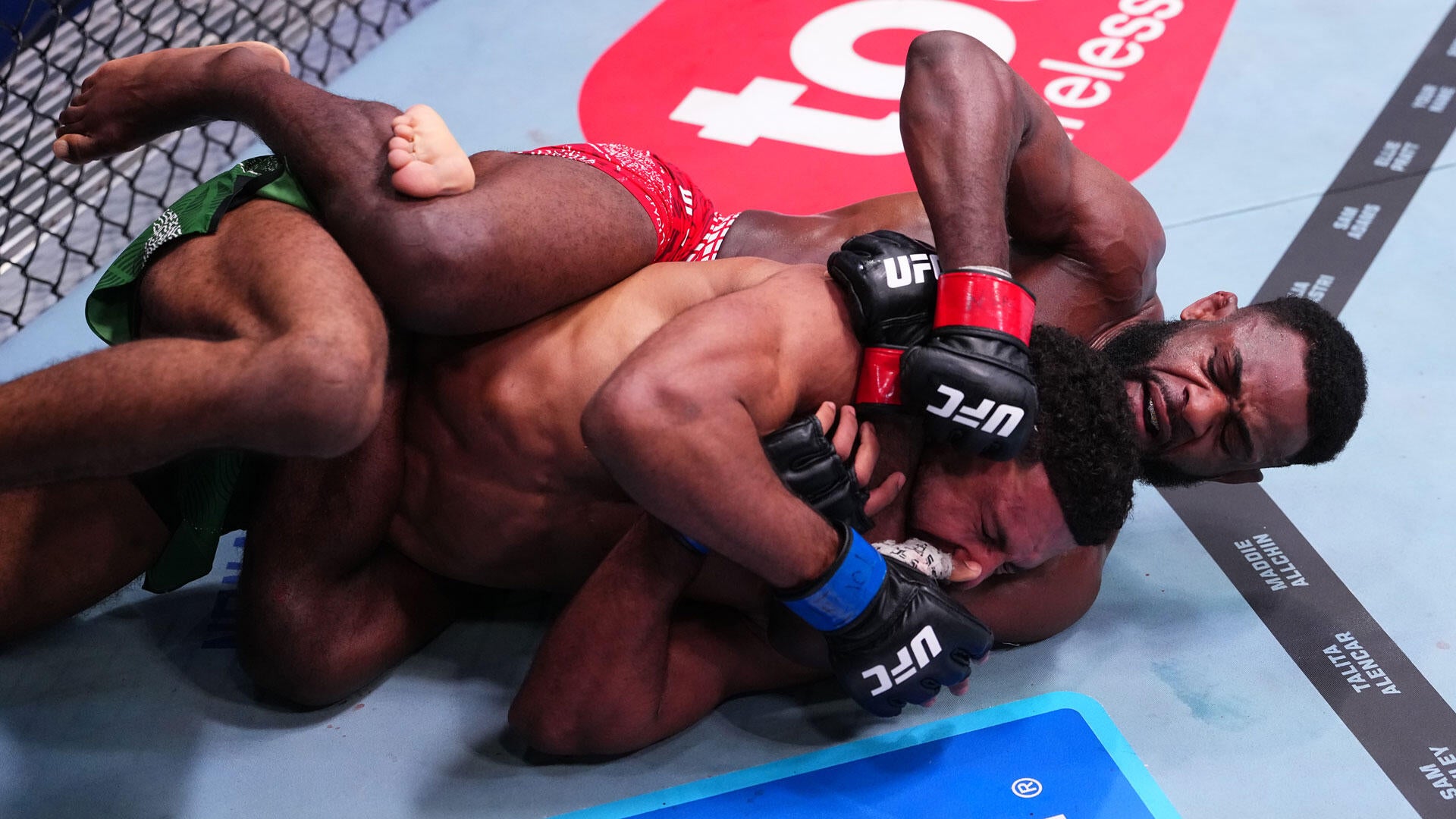
The official decision was unanimous: 30–27, 30–27 and 29–28 for Vallejos over Sterling. Those totals establish who the judges chose, but they do not describe a one-sided striking exhibition. UFC statistics credited Vallejos with 37 significant strikes to Sterling's 32, and the former bantamweight champion actually landed one more significant strike in each of the opening two rounds. Two judges awarded Vallejos all three rounds while the third gave Sterling the second. That distinction matters when the result is used as an argument for a championship opportunity.
The more meaningful statistic was wrestling defense. Sterling attempted 12 takedowns and completed one. A former champion who typically creates offense by turning opponents' hips, controlling scrambles and chaining attempts could not establish enough sustained ground control to dictate the fight. Vallejos repeatedly separated, reset his base and made Sterling work for positions that rarely lasted. It was a genuinely demanding test against a proven specialist, not a favorable striking matchup selected to produce a highlight.
Still, defensive success is not the same as complete offensive dominance. Vallejos was patient on the feet, often allowing Sterling to initiate while looking for counters. He did not consistently trap his opponent against the fence and unload the explosive combinations that had helped build his reputation. The cautious moments made sense given the wrestling threat: a reckless entry against Sterling can turn into several minutes spent defending the back. They also explain why some viewers saw a closer contest than the two 30–27 cards suggested.
Sterling publicly disagreed with the outcome, believing his volume and movement merited more credit, although he congratulated Vallejos. That reaction does not overturn the official decision. It does, however, remind us how narrow the scoring margins in individual rounds can be when neither fighter establishes prolonged domination. Vallejos should receive full credit for solving the principal tactical problem in front of him; it is unnecessary to pretend he won every second to argue that the victory was important.
GOATIFY
GOATIFY UFC & MMA
Explore GOATIFY UFC gear while revisiting the hard tactical lessons of Vallejos against Sterling.

UFC GOAT Gold Middle Finger Fight Decal Sticker
Add MMA personality to your favourite gear.
Shop Now ↗


The larger lesson is about readiness. A contender who can knock out vulnerable opponents may still struggle the first time a veteran makes him fight through frustration, positional pressure and an awkward rhythm. Vallejos did not allow that to derail him. Five UFC wins from five appearances now include a measured victory against an established former champion. That expands his case beyond excitement and potential, even if the bout itself does not prove that he has already overtaken every other featherweight contender.
Jean Silva owns the head-to-head result Vallejos cannot skip

Jean Silva is the most obvious problem with Vallejos's demand to skip the queue. The two have already fought, and Silva won their 2023 meeting on Dana White's Contender Series. That result predates Vallejos's current UFC run and cannot be treated as a permanent ranking formula. Fighters change substantially in three years. But it also cannot be erased with a post-fight declaration, particularly while Silva is considered a plausible next challenger for Volkanovski.
Silva has built a different kind of following. His fights tend to generate volatile exchanges, visible danger and the feeling that a finish could arrive unexpectedly. The Brazilian rebounded from a defeat to Diego Lopes by defeating Arnold Allen at UFC 324 in January 2026, then remained active in the division. His personality has become part of the commercial pitch, but there is actual high-level competition underneath that presentation. Dismissing him as merely theatrical would be as misleading as calling Vallejos merely a loud prospect.
For the UFC, a Vallejos–Silva rematch presents a straightforward story that a championship bout might postpone. Silva can point to the first meeting. Vallejos can point to the level he has reached since then, especially his ability to neutralize Sterling's takedown game. One fighter would try to prove the original result still reflects the matchup; the other would try to demonstrate that his development has fundamentally altered it. That is a legitimate elimination fight with stakes neither athlete needs to manufacture.
There are tactical questions worth answering, too. Silva is more willing than Sterling to build sustained offense through pressure and damaging exchanges. Vallejos would likely have more opportunities to land counters, but also fewer quiet seconds to calculate them. The Argentine's measured Qatar performance showed discipline against a difficult style; a Silva rematch could test his ability to remain composed when a dangerous striker invites a brawl. The rematch would tell matchmakers more about both contenders than another carefully chosen showcase.
Of course, requiring Vallejos to fight Silva is not the only defensible outcome. The UFC sometimes rewards a rapidly rising fighter who has defeated an established name, especially if a champion needs a challenger. A ranking is not a strict bracket, and promotional momentum carries weight. But the argument for an immediate title shot becomes weaker when another active contender both has a credible claim and can cite a head-to-head win. If Vallejos wants the belt without revisiting 2023, he must persuade decision-makers that Saturday's test superseded the unfinished business.
GOATIFY
GOATIFY UFC & MMA
Browse GOATIFY MMA designs as the Vallejos–Silva rematch question gets louder.


Rogainz Joe Rogan UFC MMA Martial Arts Sticker
Add MMA personality to your favourite gear.
Shop Now ↗
MMA GOAT Gold Middle Finger Fight Crewneck Sweatshirt
A MMA fan design for everyday wear.
Shop Now ↗

Lerone Murphy has experience, but not an unbeaten claim

Lerone Murphy is a more complicated target than the name-check might suggest. Murphy has spent years building a reputation for smart striking, defensive awareness and the ability to stay competitive with elite featherweights. He also suffered a majority-decision loss to Movsar Evloev in London in March 2026, a result that prevents any simple claim of an undefeated march to the current belt. A title argument for Murphy needs to account for that setback rather than rely on an outdated record.
The London fight illustrates the difficulty of turning a quality performance into an obvious championship case. Murphy remained competitive, reported a hip-flexor injury suffered during the bout, and later argued that the scorecards could have gone his way. Those details matter to evaluating his abilities, but they do not change the recorded defeat. He has the skill to trouble top opponents, yet in a crowded queue he may need another clear win to overtake fighters who have just beaten former champions.
That is why Vallejos including Murphy in his message is both understandable and revealing. The Argentine wants the conversation to be about the present moment rather than the accumulated respect attached to older contender campaigns. His Qatar win happened under enormous pressure, and he expects it to create immediate movement. Murphy's response, implicit or explicit, is that one headline night should not render years of high-level experience irrelevant. Neither principle is absurd; they are simply different ways of allocating scarce title opportunities.
A prospective Vallejos–Murphy fight would ask questions that the Sterling bout did not. Murphy is not primarily a takedown threat in the same mold. He is more likely to insist on clean entries, timing and range management over extended striking exchanges. Vallejos would need to generate enough initiative to avoid spending rounds merely reacting, and Murphy would have to handle a younger opponent who can change tempo suddenly. It could be less chaotic than a Silva matchup and every bit as informative.
What would be difficult to defend is treating Murphy as the same obstacle as Silva. Silva has the particular leverage of an actual win against Vallejos, while Murphy's case rests on wider divisional experience and the quality of his performances. They should not be collapsed into a single category of undeserving veterans. Vallejos can reasonably insist on a higher spot after Qatar without pretending that everyone ahead of him has arrived there for the same reasons. His toughest challenge may be turning a compelling speech into a case that withstands those distinctions.
Volkanovski decides whether this is a queue or a title opening

Alexander Volkanovski's preferences could make the whole argument change direction. The Australian defended his featherweight championship by stopping previously unbeaten Movsar Evloev at UFC 333 on October 24. It was a major result in his second reign, and it confirmed that he remains an exceptionally difficult champion to remove. But he has also expressed interest in moving up to lightweight for another opportunity to become a two-division titleholder. Whether the promotion permits that move has not been decided publicly.
GOATIFY
GOATIFY UFC & MMA
Check out UFC fan apparel while weighing the next steps for Murphy and Vallejos.

MMA GOAT Gold Middle Finger Fight Crewneck Sweatshirt
A MMA fan design for everyday wear.
Shop Now ↗If Volkanovski stays at featherweight, matchmakers must decide which contender gives him the most persuasive next challenge. Silva offers an aggressive style, popularity and an established place in the discussion. Vallejos offers youthful momentum and a fresh victory against Sterling. Murphy offers a contrasting technical matchup but also has a recent loss to explain. These are arguments, not booked fights. A social-media consensus or a forceful post-fight quote cannot make one of them official.
If Volkanovski moves to 155 pounds, the UFC faces a different problem. It could keep the featherweight title inactive while he pursues lightweight ambitions, or it could create some mechanism for resolving a championship dispute at 145. Those scenarios would reshape the incentives for everyone currently calling for him. A fighter who might not be first in line for a direct title shot could become central to a vacant or interim title conversation. None of that should be presented as settled until the organization announces its intentions.
There is also a timing question. Vallejos is 24 and does not need to force an immediate shot to have a long championship career. That observation can sound dismissive when a fighter has just won a major co-main event, but it is strategically important. A decisive win over Silva or Murphy could remove a competing claim and give him another high-quality test. The risk is equally real: every additional appearance offers a chance to lose, get injured or be overtaken by a new contender. Taking the title opportunity now would maximize speed; taking another elite fight could strengthen preparation.
Volkanovski would test more than Vallejos's ability to defend repeated wrestling entries. The champion changes rhythms, attacks small openings, mixes precision with veteran control and has just finished an undefeated grappler. Any challenger must answer tactical questions across five rounds, not merely justify a place on a fight poster. Vallejos's confidence is valuable, and the Sterling win provides evidence of composure under pressure. Neither replaces the need to adapt to a champion who has made an entire career out of punishing predictable approaches.
Vallejos left Doha with exactly what an ambitious contender should want: a significant victory, momentum and a fight that people are now discussing. The most impressive part of his weekend was not the profanity aimed at Jean Silva and Lerone Murphy. It was the disciplined response when Sterling tried, repeatedly, to impose a fight on his terms. That performance makes the title demand worth examining rather than dismissing.
The next decision belongs to the UFC and Volkanovski. Silva's earlier win over Vallejos, Murphy's competitive history and the champion's possible lightweight ambitions all complicate the path. Vallejos might receive the immediate opportunity he wants, or he might have to settle one of those arguments inside the cage. Either route can produce a serious contender. The important distinction is that he has earned a seat in the conversation; he has not yet proved that the conversation has only one correct answer.
GOATIFY
GOATIFY UFC & MMA
Shop GOATIFY UFC and MMA shirts, hoodies and fight fan gear.
Rogainz Joe Rogan UFC MMA Martial Arts Sticker
Add MMA personality to your favourite gear.
Shop Now ↗UFC GOAT Gold Middle Finger Fight Decal Sticker
Add MMA personality to your favourite gear.
Shop Now ↗