Holland Wants Perry in Orlando. The UFC Has a Real Matchmaking Choice.
GOATIFYKevin Holland has turned Mike Perry's return to the UFC into an audition for a fight neither man has been officially booked to contest. On November 23, Holland used a video inspired by Grand Theft Auto to propose a meeting with Perry, including a scene outside Orlando's Kia Center. The setting was a conspicuous choice: UFC 337 is scheduled for that arena on February 20, 2027.
Perry has signed a new eight-fight agreement with the promotion and has identified Holland as a possible opponent. That mutual interest makes the matchup considerably more plausible than a random online challenge. It also raises a question that the video cannot answer: what sort of opponent should the UFC give a returning fighter whose reputation has grown outside the Octagon?
There is a sporting argument for Holland, not just a marketing one. Both fighters have something to establish in 2027, and the unresolved result of Holland's most recent bout makes his next assignment particularly interesting.
Holland has a reason to move on from UFC 334

Holland enters the conversation after a frustrating November 14 appearance at UFC 334 in New York. His fight with Uros Medic ended in a majority draw after Medic was penalized a point for repeated fouls. UFC CEO Dana White publicly disagreed with the outcome. Whatever the competing interpretations of the rounds, the official record still contains a draw rather than a victory for Holland.
That distinction matters. Holland's next performance can move the conversation away from judging and toward his ability to deliver a convincing result against an experienced opponent. A bout with Perry would attract attention without demanding that the promotion pretend it is a title eliminator. There is no need to attach championship significance to a fight simply because the participants have recognizable names.
Holland has already occupied several different roles during his UFC career, from busy prospect to established veteran. He has experience at both welterweight and middleweight, and his win over Randy Brown in April and draw with Medic are the two official results of his 2026 campaign. His willingness to accept difficult assignments has been part of his public appeal, but choosing the right assignment at this stage has value too.
GOATIFY
GOATIFY UFC & MMA
Explore fight-night gear for UFC fans.


The appeal of Perry as an opponent is that his competitive strengths and public profile make him a credible attraction without a long promotional buildup. Holland's height, reach and experience in a wider range of MMA situations would be relevant attributes if the fight happens. Perry, meanwhile, has spent much of his recent career competing under a ruleset that rewards a narrower range of skills. Comparing those backgrounds is more interesting than treating the bout as a straightforward meeting between two brawlers.
There is also an alternative path. Holland and Medic could settle their inconclusive result in a rematch, particularly if the promotion believes their first encounter left important questions unanswered. A new opponent instead lets Holland build a separate story. Neither option is inherently more legitimate, and a callout is not evidence that the UFC has rejected the rematch.
Holland's video also poked fun at the prospect of facing Jacobe Smith, another fighter who has previously sought a meeting with him. That contrast shows how differently a matchup can appeal to a veteran and to a rising contender. Smith would represent one kind of competitive assignment; Perry represents a different kind of event. Holland is making his preference clear, but the matchmakers still have to balance those interests against their own plans for the division.
Perry's bare-knuckle success is not an MMA shortcut
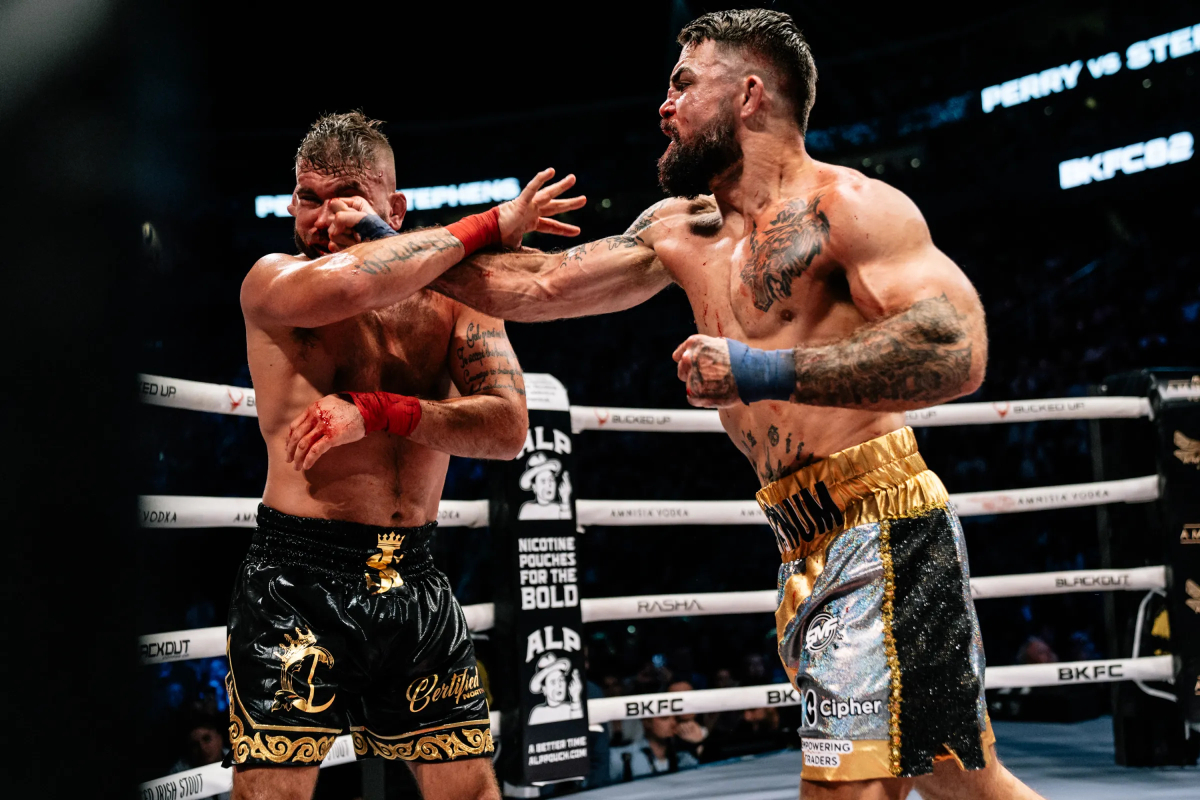
Perry's situation is unusual because the audience that followed his bare-knuckle career is not necessarily the same audience that watched his original UFC run. His last Octagon appearance was a decision defeat to Daniel Rodriguez in April 2021. Since then, his undefeated BKFC campaign and King of Violence title have made his return a more substantial commercial proposition than his old UFC record alone would suggest.
His October 2025 victory over Jeremy Stephens at BKFC 82 is a useful reminder of that intervening chapter. Perry became associated with a format in which recognizable former MMA fighters could establish new rivalries and reputations. The success was real, but the conditions that produced it are not identical to the conditions he will face in the UFC.
Returning to MMA means reacquiring the rhythm of a sport with takedowns, submissions, different gloves and a cage rather than a boxing ring. Perry has said he is committing himself to MMA training again, and that preparation is important given the length of his absence. He also reported a shoulder injury in his recent defeat to Brandon Jenkins outside the UFC. The relevant issue for his comeback is his readiness to compete, rather than speculation about the precise medical details.
GOATIFY
GOATIFY UFC & MMA
Find MMA apparel for the next big matchup.


UFC GOAT Gold Middle Finger Fight Decal Sticker
Add MMA personality to your favourite gear.
Shop Now ↗

MMA GOAT Gold Middle Finger Fight Crewneck Sweatshirt
A MMA fan design for everyday wear.
Shop Now ↗
Rogainz Joe Rogan UFC MMA Martial Arts Sticker
Add MMA personality to your favourite gear.
Shop Now ↗An eight-fight agreement provides room for the UFC to build a return over time. It does not guarantee eight particular opponents, a particular division ranking or an immediate championship campaign. That distinction is useful because Perry's popularity could otherwise encourage unrealistic expectations about what his first appearance needs to accomplish.
Holland is not the only possible choice. Perry has also mentioned Jorge Masvidal and Conor McGregor as opponents of interest. Masvidal offers a Florida connection and a recognizable personality; McGregor would bring enormous attention but has his own uncertain competitive timeline. Holland offers the simpler attraction of a veteran already competing in the UFC who has publicly expressed interest in the same fight. That is a practical advantage, even if it does not make the matchup inevitable.
Orlando would add a local dimension for Perry. A February date also provides more preparation time than an immediate booking in December. Still, there is no announced opponent, and neither the venue shown in Holland's video nor Perry's stated enthusiasm should be mistaken for a signed bout agreement. The promotion may decide to take his return in a different direction altogether.
For the UFC, the strongest selling point is the contrast in career paths. One fighter has remained active in the organization, while the other returns with a much larger audience earned elsewhere. The fight could test whether that outside success carries over to a full MMA contest, while giving Holland a chance to settle his own momentum with a result that does not depend on another disputed scorecard.
Holland has offered the promotion an entertaining pitch, and Perry has supplied the other half of it by expressing interest. A match at UFC 337 is an attractive possibility, not a confirmed booking. What makes the proposal worth following is that it offers both fighters a clear next question: can Holland convert his recent competitive form into a decisive win, and can Perry make the transition back to the sport that first introduced him to UFC fans?
GOATIFY
GOATIFY UFC & MMA
Shop GOATIFY UFC and MMA shirts, hoodies and fight fan gear.

UFC GOAT Gold Middle Finger Fight Decal Sticker
Add MMA personality to your favourite gear.
Shop Now ↗MMA GOAT Gold Middle Finger Fight Crewneck Sweatshirt
A MMA fan design for everyday wear.
Shop Now ↗