

Kantserov's Hat Trick Exposed Vancouver's First-Period Collapse
GOATIFYAt 35 seconds of the first period in Vancouver on November 22, 2026, Frank Nazar had already made Chicago's first point: this would not be another night spent waiting for Connor Bedard to manufacture the offense. By 12:44, the Blackhawks had scored four times and the Canucks had changed goaltenders. By the final horn, Roman Kantserov had his first NHL hat trick, an assist, and the kind of statement that can alter the way a rebuilding team distributes its scoring responsibility.
Chicago's 6-3 win was spectacular and uneven at once. The visitors converted three of four power plays and killed all five Vancouver advantages. Yet the Canucks cut a four-goal deficit to two, struck the posts repeatedly in the second period, and kept the result competitive longer than an early 4-0 score should have allowed. The score tells a story about a rookie finisher; the game flow tells an equally useful one about special teams, execution around the crease, and why hockey teams cannot survive the opening twelve minutes on reputation alone.
Kantserov's goals came from several different movements but one underlying habit: he put himself where a pass, rebound, or defensive lapse could turn into an immediate finish. That matters more than an eye-catching three-goal line. It suggests a skill Chicago can repeat on nights when the opposition takes away the obvious shooting lane, and it explains why this particular performance felt bigger than a one-off scoring binge.
Nazar needed 35 seconds to change the game's terms

The Blackhawks needed almost no settling-in time at Rogers Arena. Nazar intercepted the intentions of Vancouver's breakout at the Chicago blue line, blocking a Filip Chytil attempt and converting the resulting solo rush past Nikita Tolopilo. It was a defensive play transformed into a goal before either team had established a rhythm. For a young Chicago lineup, the effect was immediate: the visitors could press rather than chase, while the Canucks began making decisions under scoreboard pressure.
A first-minute goal is not automatically evidence of total tactical superiority. It can be a fortunate bounce or a goaltender beaten by an outstanding shot. Here it was followed by repeated Chicago arrivals in dangerous positions. Tyler Bertuzzi's attempted cross-crease pass deflected off Jamie Oleksiak and went in at 2:48, giving Chicago a 2-0 lead. Kantserov added the third at 11:30 on the power play, and the recalled Dominic Toninato finished a one-handed redirection from Jordan Greenway at 12:44. Four goals had arrived before Vancouver's offense had properly participated in the game.
The sequence exposed more than one kind of vulnerability. Nazar's opener punished a risky puck movement at the line; the second came from congestion around the slot; the third required defending an east-west feed on the penalty kill; the fourth rewarded a forward reaching the net at exactly the right moment. These are different breakdowns, but all ask the same uncomfortable question of Vancouver: who takes ownership of the dangerous space once a play begins to turn? A goaltender cannot manage that problem alone.
Tolopilo was replaced after allowing four goals on 11 shots. It is tempting to reduce that decision to a save-percentage judgment, but the film's logical lesson is broader. Vancouver did not register its first shot until after the switch, and a team that spends the opening stretch defending can make almost any starting goalie look abandoned. Kevin Lankinen came in and steadied the picture enough for a comeback attempt, yet the deficit was already too large to be erased with merely competent second-period hockey.
GOATIFY
GOATIFY Hockey
Explore GOATIFY hockey styles as Nazar and Chicago's quick-start offense change the pace of games.


Nazar's broader development also belongs in the story. His goal and assist extended a career-best six-game scoring streak, and his energy was not limited to a clean offensive-zone setup. For Chicago, that is a useful profile beside the more obvious creators: a player who can create offense by winning a defensive moment, then finish at speed. One rush should not be extrapolated into a full season of two-way dominance, but it was a particularly sharp demonstration of the type of play the Blackhawks want to reproduce.
Kantserov's hat trick was built in the slot, not on the perimeter
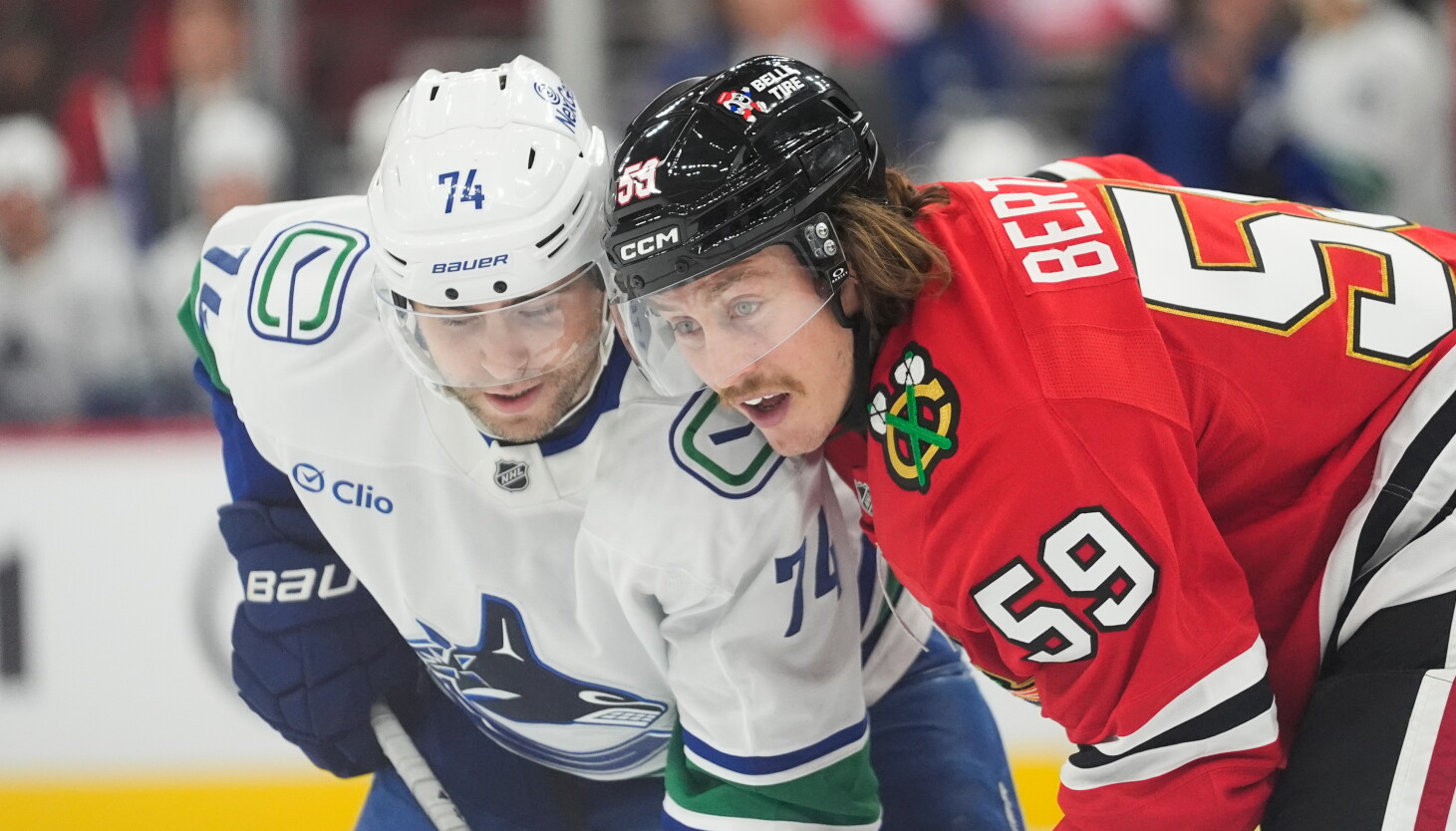
The signature image of Kantserov's night was not a breakaway or a sweeping solo move. It was his ability to arrive close enough to goal that opponents had little reaction time. For his first, Bertuzzi found him with a backhand pass across the slot, and he fired immediately over Tolopilo's glove. For his second, Alex Vlasic's delivery from the left side met him arriving at the back door, where a short finish restored Chicago's three-goal lead. The third came when Patrick Kane's one-timer was stopped, the rebound sat loose, and Kantserov had already won the race to it.
The finishers of a power-play system are often praised for the moment the puck crosses the line. The more interesting part is everything that happens just before that moment. A defender must decide whether to track the puck, seal the cross-crease seam, or turn toward a forward drifting into a pocket behind coverage. When Chicago moved it laterally, Vancouver's structure had to pivot. Kantserov exploited those small delays, staying close enough to the crease to turn difficult rebounds into manageable attempts rather than low-percentage second shots.
Three goals and an assist were a career milestone, but this did not emerge from nowhere. Chicago selected Kantserov 44th overall in the 2023 draft, and he arrived after seasons of professional hockey in Russia's KHL. That experience does not make the NHL adjustment trivial: traffic closes more quickly, penalty kills disguise pressure, and available shooting windows can disappear during the time it takes to load up a shot. His recent scoring suggests a willingness to adapt how he creates chances rather than merely importing his old shot locations.
The Blackhawks' special-teams trend makes this win particularly revealing. Their power play went 3-for-4 and had scored in six straight games, converting 10 of 18 opportunities in that span after managing goals in only five of their first 18 games. Those are encouraging recent results, not a promise that the conversion rate will continue unchanged. Small special-teams samples are especially volatile: one hot finishing run can conceal zone-entry problems, and one cold stretch can hide sound puck movement. The actionable gain is that Chicago repeatedly put its attackers in the middle instead of settling for decorative possession outside.
Bertuzzi's one goal and two assists underline how much creation sat around the rookie. Kane supplied two assists, using the threat of his shot and passing vision to hold the defense's attention. Vlasic contributed the wide-angle feed that made the second Kantserov goal look easy at the back door. A three-goal scorer may dominate the headline, but a repeatable power play requires the surrounding players to give him different ways to win: a quick slot pass, a weak-side tap-in, and a rebound that has to be recovered immediately.
Chicago cannot rely on three power-play goals every night, particularly when opponents have more time to scout this configuration. The better target is a consistent volume of threatening looks from the dangerous areas. If Kantserov continues to be available inside and the passers continue delivering quickly, the Blackhawks will have a credible scoring option even on evenings when a goalie wins the first exchange. That is why the locations of the goals say more about his long-term value than the ceremonial hats on the ice.
GOATIFY
GOATIFY Hockey
Browse Blackhawks-friendly hockey apparel while Kantserov, Kane and Bertuzzi make net-front power plays matter.
Commesso and five penalty kills kept a dangerous comeback from taking over
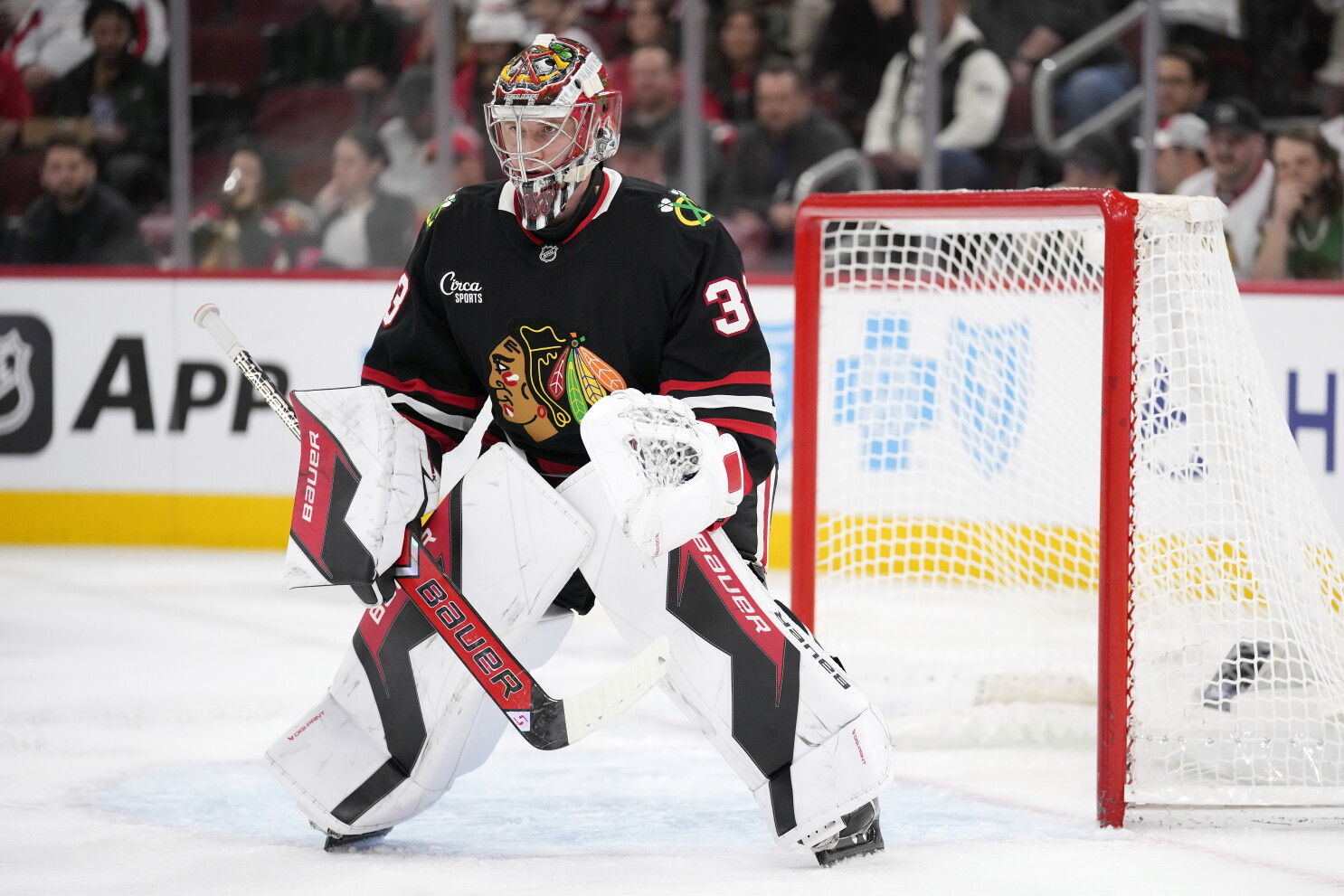
The most misleading way to read a 6-3 game is to assume the winning goaltender had an uncomplicated evening. Drew Commesso made 22 saves in his season debut after returning from Rockford. He also needed help from the iron around his net. Vancouver struck the posts three times during its second-period power-play opportunities, and Chicago survived a four-minute man disadvantage after Andrew Mangiapane's high-sticking penalty. The clean 5-for-5 penalty-kill line records success, but it should not be mistaken for total defensive control.
By the time Vancouver had reduced the score to 4-2, momentum was no longer one-directional. Zeev Buium's point attempt had deflected in off Kevin Korchinski after the goaltending change, and Chytil's pass on a two-on-one later caromed off Jordan Greenway into Chicago's net. Those were imperfect defensive outcomes, yet they gave the Canucks a path back. The next sequence mattered because Chicago could either let those irregular bounces dictate the rest of the game or reassert its offensive threat.
Commesso's part in the response was about managing a shifting environment. In a game that becomes chaotic, a goalie has to know when to freeze the puck, when to stay compact and let traffic pass, and when to avoid turning a manageable rebound into a second opportunity. His 22 saves are the measurable outcome. The penalty-kill group's ability to survive sustained pressure without conceding is the team outcome. It would be excessive to credit all five kills to any one player, especially given the Canucks' missed opportunities, but the combination kept Chicago from surrendering its lead.
Kantserov's second goal, at 12:56 of the middle period, arrived when the Blackhawks badly needed a positive offensive event. It was not merely another stat on his hat-trick route; it interrupted a comeback and restored separation. Vancouver still scored through Jake DeBrusk late in the period and had further chances, including an apparent opening that ended on the post. Chicago's next task was not to impress with another highlight. It was to maintain enough structure for the remaining clock to become an ally.
The absence of Bedard complicates this evaluation without explaining everything. The Blackhawks are trying to operate without their captain after a shoulder injury, while Commesso was stepping into a difficult road assignment and younger skaters were taking bigger parts of the game. Those are real pressures, but neither should become an excuse for defensive lapses. A rebuilding team makes progress when it can recognize such weaknesses while winning. The penalty kill earned its result in Vancouver; its next challenge is reducing the number of dangerous chances it must survive.
A more useful lesson than the final save total is that Chicago did not allow Vancouver's improved second period to become a full reversal. The goalie was adequate when the game tightened, the penalty killers had enough timely execution, and the offense still found a goal to change the emotional direction. This was not a defensively flawless performance. It was a demonstration that multiple imperfect pieces can keep working together long enough to protect a lead.
Vancouver showed a response, but its opening period remains the warning

Vancouver's final two periods were far more competitive than the opening minutes, and that distinction matters. Buium's deflected point shot, Chytil's fortunate carom, and DeBrusk's finish brought the Canucks within two at different points of the night. The team also had meaningful power-play pressure that did not show up in the goals column. A fan looking only at the four-goal opening might conclude that Vancouver never participated. A coach looking at the full game would instead see a poor start that forced every later positive play to carry an unreasonable burden.
GOATIFY
GOATIFY Hockey
See GOATIFY NHL designs as Commesso and Chicago's penalty killers handle the pressure.
The timing was particularly damaging. Chicago scored early enough to dictate which team could accept a lower-risk approach. Vancouver had to open up, take chances and hope the next bounce was favorable. That creates a trap: aggressive attacking can produce goals, but it can also leave vulnerable space for an opponent with skilled passers already playing confidently. Kantserov's backdoor second goal captured that balance. It arrived after Vancouver had begun the comeback, and it reminded the home side that being dangerous was not the same as being safe.
The Canucks had their own personnel context. Elias Pettersson was out, and the club was on the second leg of consecutive game nights. Neither fact explains why Chicago scored 35 seconds in or why Vancouver's first shot came only after the fourth goal. They do, however, matter when judging how a fragile lineup might respond to a bad start. A team missing an important center has fewer normal ways to reset possession and less margin for turnovers that become rush opportunities the other way.
Buium's involvement is encouraging on an individual level. The young defenseman reached the scoresheet again by getting a puck through a shooting lane from the point, while Chytil and DeBrusk ensured Vancouver did not finish with an empty offensive statement. But a box score can flatter a defenseman when the team collectively struggles to defend its crease. One attacking contribution does not automatically erase the underlying defensive possessions, and an improvement in the latter has to begin before a four-goal deficit forces desperation.
For Chicago, this game pushes the rebuild discussion beyond the question of when Bedard returns. Nazar can create pressure from speed and anticipation; Bertuzzi can make the power play uncomfortable for opponents; Kane can still organize a dangerous possession; and Kantserov appears to have a scoring instinct near the net that translates to NHL traffic. None of that means the Blackhawks suddenly become a finished playoff-caliber team. Their record after the victory was still 8-14-2, and the recent run only partly repaired an earlier ten-game struggle. What the win supplies is credible evidence that useful contributions can come from more than one headline player.
For Vancouver, the record of 6-19-1 makes the lesson less forgiving. A better second period offers reasons to keep working, but the obligation is to begin games with the same attention and urgency. For Chicago, the next test is consistency: repeat dangerous slot access without needing extraordinary power-play conversion, and repeat the penalty-kill result with fewer posts and loose chances required. Kantserov's hat trick is memorable, but the teams will learn more from the ordinary possessions surrounding it than from the final ceremonial celebration.
The Blackhawks did not win in Vancouver because a rookie happened to get three fortunate finishes. They won because Chicago's passing and puck recoveries created recurring chances in close, Nazar's immediate breakaway forced Vancouver to chase, and the special teams converted an advantage into three goals while protecting five disadvantages. Kantserov gave those systems a finisher who was ready for the next pass and alert to the next rebound.
There are limits to the optimism. Chicago's defensive work was far from clean, and a power play converting at this recent rate should be treated as a promising stretch rather than a permanent new baseline. But in a season defined by questions about injuries, scoring depth and the rebuilding timetable, seeing several players supply meaningful offense without Bedard is a tangible step. For Vancouver, the comeback remains secondary to the start that made it necessary. For Kantserov, the real standard now is not another hat trick; it is whether those same net-front habits keep producing danger when the next opponent knows exactly where to find him.
GOATIFY
GOATIFY Hockey
Shop GOATIFY NHL and hockey shirts, hoodies and stickers.





















