McLaren Had the Wrong Eighth Gear. Stella's Vegas Fix Was Human.
GOATIFYAndrea Stella did not celebrate McLaren's Las Vegas double podium by declaring the MCL40 suddenly cured. He identified two stubborn weaknesses, an aerodynamically draggy car and an eighth gear that was too short for the spectacular slipstream battles, then explained how Lando Norris, Oscar Piastri and their engineers worked around them. Norris finished second after falling outside the top ten. Piastri rose from seventeenth to third after an engine-related grid penalty. Max Verstappen won the November 21, 2026 race, but McLaren took a crucial combined points result.
That combination makes the November 23 technical debrief more important than another retelling of the overtakes. The distinction is between fixing a car and learning how to race it. McLaren found a way to limit the damage on a circuit that punished its straight-line package, while also reducing Red Bull's advantage in the constructors' fight to nine points. Stella's account shows how difficult energy management has become, why familiar passing logic can fail, and what the team still has to address as it looks toward 2027.
Stella identified two mechanical limits that better driving could not erase
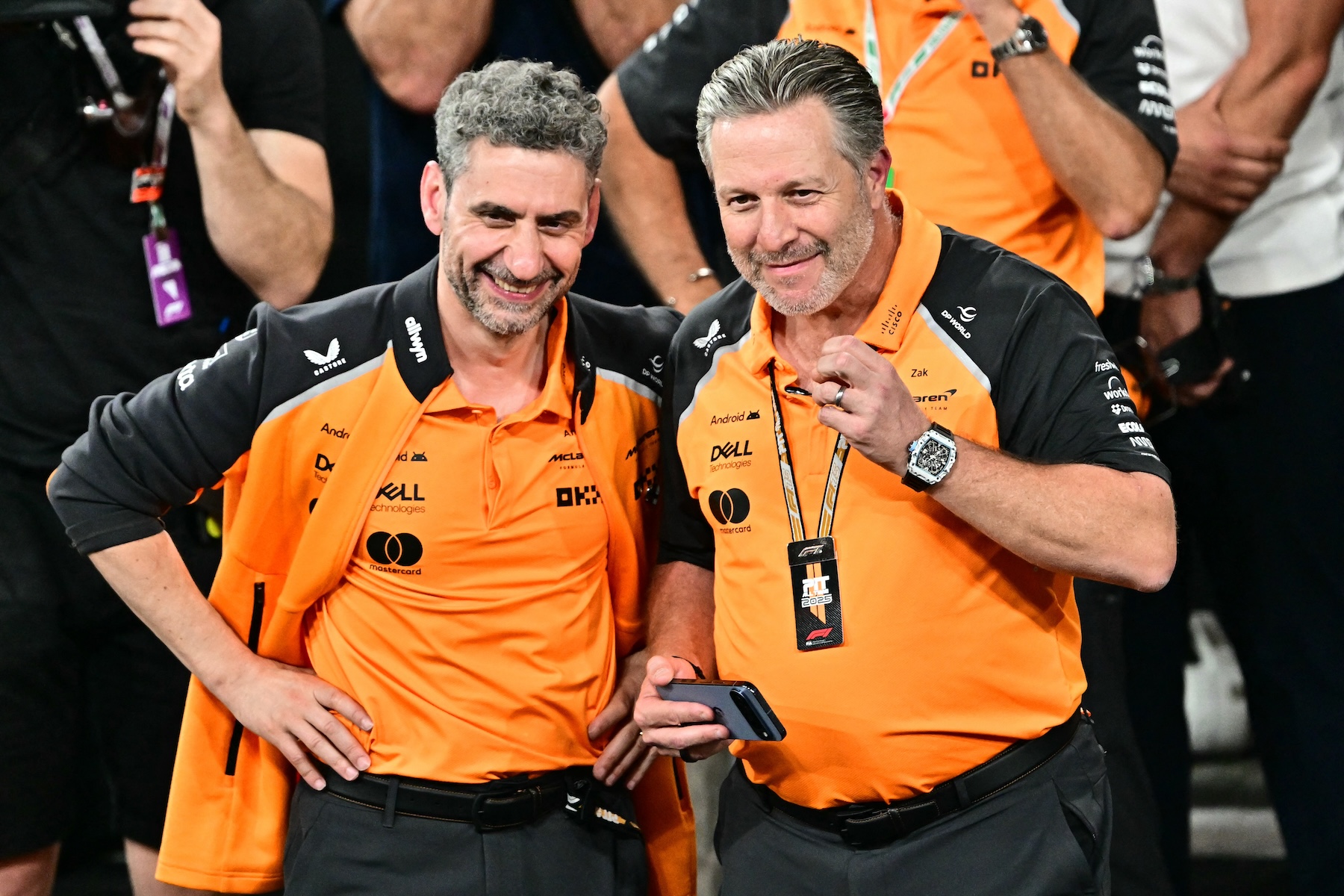
McLaren's double podium in Las Vegas makes more sense when it is treated as a result achieved around two problems, not one achieved because the team suddenly developed the fastest car. Team principal Andrea Stella separated the constraints unusually clearly after the race. The MCL40 carried too much aerodynamic drag for the long straights. Its eighth gear was also too short for the speeds and slipstream conditions encountered in a crowded field. Neither limitation disappeared as the race went on. The drivers and engineers worked around them, which is why the explanation matters more than the photographs from the podium.
Drag and gearing are different constraints, even though they can feel similar from the cockpit. A car with excessive drag must devote more power to overcoming resistance at high speed. A car that reaches the upper end of its gearing too early can run out of useful acceleration in the very part of the straight where a tow should offer its biggest benefit. Stella specifically rejected the easy conclusion that McLaren's problem was simply an inferior power unit. The Mercedes-powered rivals used the same basic power-unit family; how the entire car converted that output into forward speed was the distinction. That is a meaningful technical diagnosis rather than a complaint about an engine supplier.
The short eighth gear was particularly awkward in traffic. With a useful slipstream ahead, the car can approach a higher speed than it would manage in clean air. If the revs climb beyond the most productive region, the driver may lose the acceleration required to turn that tow into an overtake. The apparent contradiction is that getting closer to another car can make the limitation more visible. Instead of passing at the end of a straight, a McLaren driver could be left exposed to a car behind that had a better combination of acceleration and energy available. It explains why some positions appeared easier to lose than to recover during the early exchanges.
There was no evidence in Stella's account that a new component had fixed the fundamental drag penalty on race day. The track's unique mixture of long full-throttle sections, cold conditions and close pack racing made the weaknesses especially expensive. The result therefore cannot be read as proof that McLaren solved its 2026 straight-line deficit. It proves the team learned to manage it for one exceptionally turbulent Grand Prix. That difference will matter when assessing how much of the Vegas performance can travel to the next circuit.
GOATIFY
GOATIFY Formula 1
Shop F1 gear inspired by the technology behind race pace.


Stella also made the unusually strong argument that the result-to-car-potential ratio was among the drivers' best of the season. That framing is important: a fourth- or fifth-fastest package can sometimes collect second and third through execution, opportunity and timing. It does not become the second-fastest package because its drivers receive second- and third-place trophies. McLaren has reason to celebrate a valuable result without mistaking the result for a clean technical bill of health.
Norris escaped an energy-deployment trap that initially pushed him backwards
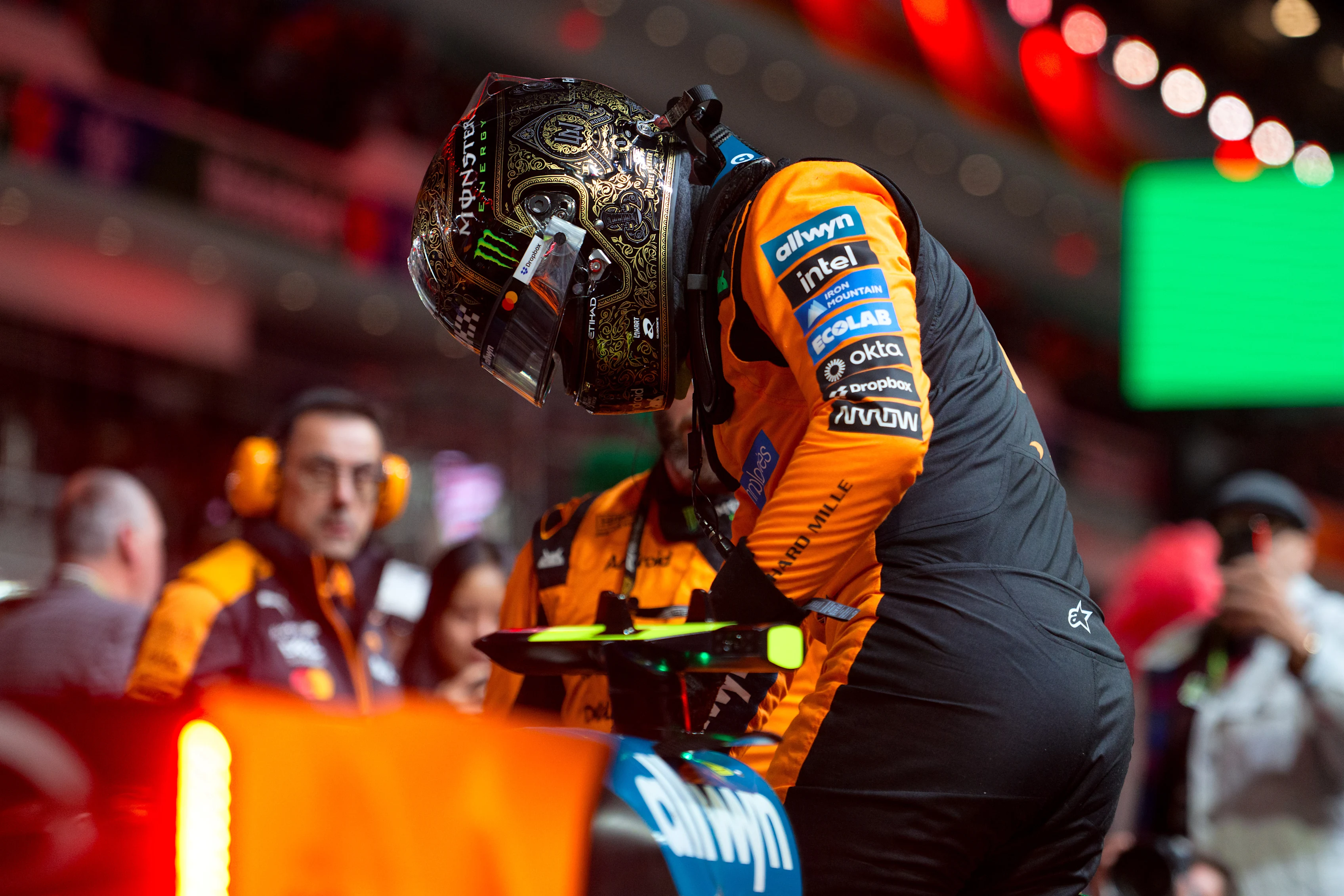
Lando Norris started third and ultimately finished second, just 0.639 seconds behind Max Verstappen. The route between those positions was anything but linear. Norris fell outside the top ten early, and the explanation was not a sudden loss of driving ability. His car was repeatedly vulnerable to rivals arriving with more usable energy and better speed at the end of the straights. He could be reasonably competitive in one part of the lap and still be overtaken before he reached the next braking zone. That made the conventional advice to simply attack the driver ahead much less useful than it sounds.
The energy system turns every long straight into an allocation problem. An electric boost available now may not be available at the next passing point. The driver and engineers must decide where to spend the available deployment, where to accept a temporary loss and how to avoid becoming defenseless in successive battles. In Vegas the tow made the decisions especially counterintuitive. A rival could surge past on one straight, then face a similar deficit on the next. The trick was not merely to harvest and deploy energy aggressively, but to do so at the part of the circuit where that energy produced the largest positional benefit.
Stella said the engineering group compared what was failing for Norris with what was working for Piastri. The team then worked with the drivers to change power-unit usage and the strategies available through the cockpit controls. That is not the same as replacing a hardware part. It is a live operational response: engineers identify a pattern from telemetry, communicate a different approach and ask drivers to execute it under racing pressure. Norris's later improvement suggests the revised approach was more effective, but it does not support assigning every recovered position to one setting. Race circumstances, other drivers' mistakes and the Safety Car also changed the competitive picture.
Norris's own account of the race makes the mental workload easy to underestimate. He was watching energy levels, evaluating cars ahead and behind, and judging whether a move would leave him immediately exposed. In another era, a driver following closely might reasonably prepare to pull out and pass as soon as the tow became strong enough. Here, remaining within the tow for longer could be the less damaging choice. If leaving the slipstream removed a speed advantage before an overtake was complete, patience became an offensive tool rather than a passive one. That kind of judgment explains Stella's praise more convincingly than the finishing position alone.
The late stages rewarded that adaptation. Norris avoided the mistakes that derailed other contenders, including George Russell's costly lock-up, while exploiting changes in the order that followed. His briefly leading was a real part of a remarkably volatile race, not evidence that McLaren could sustainably control the pace from the front. The takeaway is narrower and more useful: Norris and his engineers recognized that the normal overtaking playbook did not fit their equipment, then adjusted quickly enough to salvage an exceptional result.
GOATIFY
GOATIFY Formula 1
Browse racing gifts for fans of battery management and tactical duels.


Piastri's climb from 17th showed a different way to solve the same McLaren problem

Oscar Piastri's result looked almost implausible before the lights went out. A ten-place grid penalty for an additional internal combustion engine dropped him from seventh to seventeenth. He ended the race third, having climbed fourteen positions from the actual start slot and reached his first podium since Miami in May. The statistical comeback is striking, but the more interesting story concerns what Piastri did differently within a car that had the same drag and gearing limitations as Norris's machine. One McLaren was initially losing places while the other was finding room to gain them. The team noticed that contrast and made it part of the solution.
Piastri's penalty was a consequence of exceeding his allowance of internal combustion engines, not a penalty for his own on-track error. The replacement also coincided with Mercedes supplying a turbocharger upgrade, although that change itself did not require another grid sanction. That is why it would be misleading to explain the comeback by assuming the new engine simply had a decisive horsepower advantage. Stella's comments point instead to the driver's management of traffic, appropriate deployment and a better feeling for a low-grip car. The technical and strategic differences can coexist without being confused with one another.
The Las Vegas surface offered limited grip and an unusually congested race. Those conditions punish drivers who cannot confidently judge braking, acceleration and racing room when the available traction changes from corner to corner. Stella linked Piastri's improvement to work already visible in Brazil, where he felt the Australian had more pace than the result showed. In Vegas that progress was easier to see because Piastri repeatedly made decisions that translated speed into positions. This is encouraging evidence for the driver after a difficult stretch, though a single comeback cannot by itself settle the question of whether the underlying weakness has been eliminated.
The important quality is not reckless aggression. Piastri had to balance overtaking opportunities against the risk that leaving a slipstream too early would strand the car in the wrong place. He was also close to Norris late in the race when both drivers had a large shared incentive to secure the team's double podium. McLaren radio traffic underscored that tension. There was competitive urgency, but both drivers ultimately brought the cars home in second and third. A result that benefits the team does not require pretending the intra-team contest never existed; the point is that each driver recognized the boundary between ambitious racing and needless contact.
Piastri's performance gives McLaren a second practical reference point for its engineering work. If two drivers can respond to different initial symptoms and converge on a competitive finish, the team can compare the interventions rather than rely on one driver's preferences. His renewed confidence is also valuable beyond Las Vegas: a driver who has spent months fighting the car needs proof that an aggressive but controlled approach can still work. A Vegas podium provides evidence of progress, not a guarantee that the next circuit will bring the same opportunity.
Nine points behind Red Bull, McLaren now faces a 2027 engineering decision
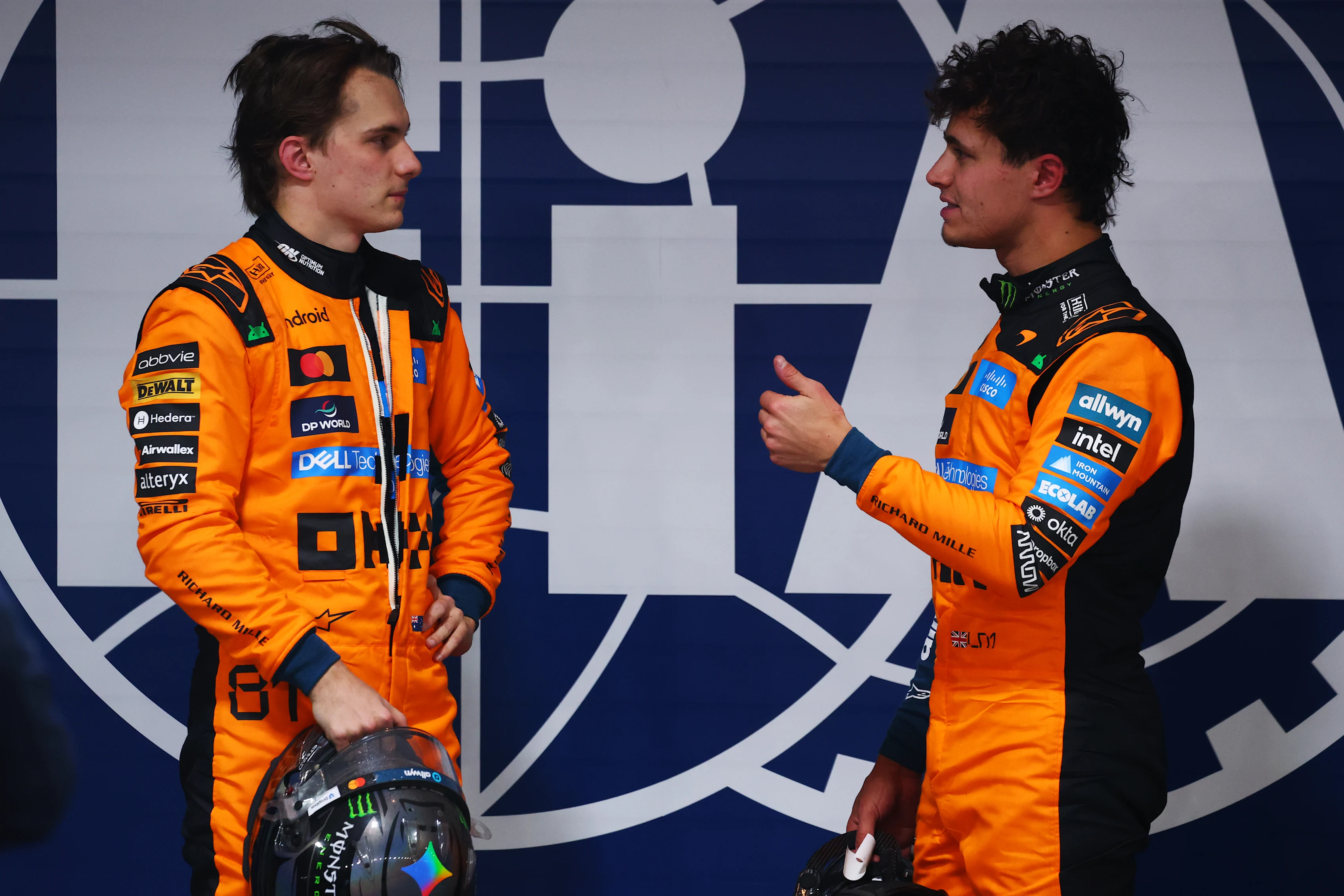
The arithmetic makes the result consequential. McLaren left Las Vegas only nine points behind Red Bull in the fight for third in the Constructors' Championship, with two Grands Prix remaining. Norris and Piastri delivered thirty-three points between them, while the Red Bull haul was twenty-five. That swing matters particularly because Red Bull's Max Verstappen won the race. McLaren did not beat the winner on the road; it achieved the better two-car outcome. In a constructors' contest, that is precisely the kind of performance that can overturn a narrow gap before the season ends.
GOATIFY
GOATIFY Formula 1
Explore GOATIFY F1 apparel as Piastri finds form.


Yet there are two different questions to ask about this comeback. The immediate one is whether McLaren can keep extracting strong results in the remaining rounds. The longer-term one is what the team should learn about the 2027 car. Drag, gearing and deployment are related on a race lap, but they require different engineering decisions. Software and operational calibration can improve how the power unit is used, while aerodynamic efficiency and the choice of ratios may demand design work that cannot be completed by clicking a switch on the pit wall. Las Vegas exposed the costs of getting the balance wrong; it did not automatically identify a single inexpensive cure.
Before the Grand Prix, McLaren had described upgrades intended both to help current performance and to inform its next design. That is a sensible dual purpose for a team facing two remaining races while already planning a new challenger. The danger is reading a well-managed podium as evidence that existing design compromises no longer need attention. Stella's public explanation does the opposite. By naming the losses and crediting the response, he preserves a clear separation between underlying performance and execution. Engineers can celebrate the latter without allowing it to disguise the former in their development review.
The comparison with Red Bull makes this distinction concrete. Verstappen won despite the frantic lead changes, while the McLarens finished close behind after recovering from difficult points in their own races. The final gaps were small enough to make the contest dramatic, but a small finishing margin does not measure the full performance advantage across fifty laps and changing race circumstances. Safety Car timing, energy availability, traffic and opponents' incidents all affected the order. Any team claiming it has found a universal fix on the basis of one unusual event would be confusing an outcome with a controlled experiment.
McLaren's clearest positive is that it discovered useful operating knowledge under pressure. It can take that knowledge to the remaining races, where the characteristics and passing opportunities will differ, and use its drivers' feedback to refine deployment maps and racing tactics. The clear negative is that the car still revealed a genuine efficiency compromise in Vegas. A nine-point chase can reward a clever short-term response; designing a more competitive 2027 machine requires fixing the reasons such a response was necessary. Those are related goals, but they are not the same one.
McLaren's Las Vegas story is not that an underperforming car mysteriously turned into a winning one. It is that two drivers and an engineering team responded intelligently to a compromised package. Norris overcame an early deployment spiral, Piastri transformed a seventeenth-place start into a podium, and the team's late-race choices produced a thirty-three-point haul that put Red Bull within reach in the standings.
Stella's most useful contribution was naming what the result did not solve. Too much drag and an ill-suited eighth gear remain design issues, even when sharp deployment decisions make them less visible. The immediate prize is a realistic shot at third in the Constructors' Championship. The larger opportunity is to carry those operational lessons forward without letting one spectacular night obscure the MCL40's limitations.
What matters next is whether the team can separate repeatable race execution from circuit-specific improvisation. A favorable slipstream or a precisely timed battery release can rescue one pass, but it cannot compensate for excess drag on every straight over a season. Engineers will need to translate the Las Vegas lessons into a car that gives both drivers more usable speed without asking them to make the same emergency adjustment each weekend. That is the difference between a memorable recovery and a durable competitive advantage.
GOATIFY
GOATIFY Formula 1
Shop GOATIFY Formula 1 shirts, hoodies and racing stickers.